







Growing up with the arts in postwar Manila
Before the CCP transformed the country's cultural landscape, postwar Manila offered unexpected opportunities to discover theater, music, literature, and the visual arts
Published Aug 9, 2026 09:25 am


At A Glance
- Live performances were rare in postwar Manila. There simply were not enough venues.
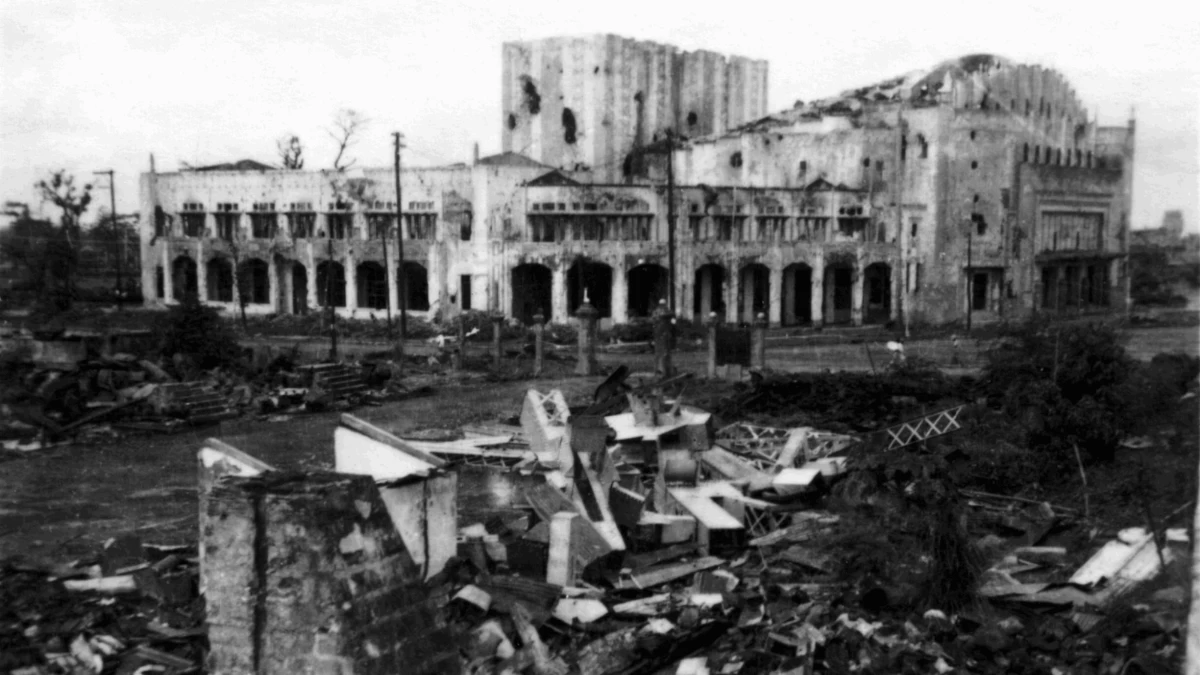
THE AFTERMATH The Metropolitan Theater Manila after World War II (Photo: John Tewell)
The latest issue of “Backstage Pass,” the Cultural Center of the Philippines’ excellent newsletter, lists events for August: the 22nd season of Cinemalaya Independent Film Festival, three plays from VLF ZZI at Teatro Ignacio Gimenez, the best of ASEAN Performing Arts 2026, Music at Sunset in Intramuros, Kabataang Gitarista 14th Anniversary Recital, and more coming up.
Manila’s and the country’s cultural calendar has not been as rich, and I sometimes wonder how I became chairman of the CCP when, like many Filipinos of my generation, I simply absorbed what happened to come my way.
I grew up in the 1940s and 1950s, attended Manila public schools, and took up accounting at the University of the Philippines. Looking back, it is clear that my education in the arts was entirely incidental and accidental, formed by chance encounters, curiosity, and unexpected opportunities.
My parents were schoolteachers, and we had shelves upon shelves of reading material. With no TV, electronics, or children my age nearby, I spent my time browsing books on history and literature, back issues of the Reader's Digest, an encyclopedia, assorted travel guidebooks, and, of all things, a book on the plots of famous operas.
I also devoted much of my allowance to comic books, especially “Classics Illustrated,” which introduced me to works such as “A Connecticut Yankee in King Arthur's Court,” “Around the World in Eighty Days,” and “The Adventures of Huckleberry Finn.” Even a Sunday magazine became an unlikely classroom, with its playing-card-sized illustrations of famous buildings, historical figures, plants, and curious objects, each accompanied by detailed captions.
School added its own unexpected lessons. In Grade Four, our teacher introduced us to gladiators and showed us a reproduction of Juan Luna's “Spoliarium.” She told us the painting was worth what to me was the astronomical (and, of course, hilariously wrong) ₱30,000.
We learned the intricacies of flats and sharps in music class; English classes opened doors to literature through poems like Walt Whitman's “O Captain! My Captain!” and Edgar Allan Poe's “Annabel Lee,” the epic “Beowulf,” and Abraham Lincoln's “Gettysburg Address.” One year, our entire third-year class trooped to the Philippine Normal School to watch a production of “The Merchant of Venice,” performed by future teachers as part of their training.
School life itself often became a stage. We spent weeks rehearsing “La Jota Moncadeña” before performing it at Rizal Memorial Stadium during what must have been a citywide folk dance festival. My PE teacher picked skinny me to be one of the “maglalatik” dancers, doing our piece outdoors one chilly evening, shirtless but for half a dozen coconut shells. The auditorium, created by folding back movable classroom partitions, regularly hosted programs featuring the whole range of student talent. I once represented my class in a declamation contest on the Bill of Rights. On another occasion, I was complimented for singing the loudest in a choral performance.
Cultural opportunities expanded when I went to UP. The Dramatic Guild staged plays by Wilfrido Ma. Guerrero as well as foreign classics, including “A Streetcar Named Desire.” Violetta’s aria “Libiamo” in Verdi's “La Traviata” got me hooked on grand opera. It was my first, performed at 10 a.m. in the university's vast, non-air-conditioned Quonset-hut auditorium.
Visual arts, however, remained scarce. The only painting I remember seeing on campus was Vicente Manansala's mural in the first-floor lobby of the LA Building. Sculpture consisted of Guillermo Tolentino's “Oblation” in front of the Administration Building and plaster casts of classical Greek and Roman statues displayed, in figleafed glory, in the Main Library’s third-floor lobby. Once, I went to the National Museum, then housed in the old Bureau of Science Building on Herran Street, and left disappointed that it had neither paintings nor dinosaurs.
The newspapers of the day devoted space to music and art criticism. I vaguely remember a reviewer named Morli Dharam describing a concert piece as being in the "French idiom," which prompted music lover Cecilia Locsin to dispatch a Letter to the Editor declaring that Dharam was writing nonsense.
Movies cost ₱1.20, and I went to a lot. Films such as “The Great Caruso,” “The Student Prince,” “Brigadoon,” and “Singin’ in the Rain” were additional exposures to grand and light opera. Television had not yet arrived, but I listened faithfully to an hour of classical music aired by DZRH every afternoon at 4 p.m. I once went to a vaudeville show at the Clover Theater near the Santa Cruz Bridge. Once was enough.
Live performances were rare in postwar Manila. There simply were not enough venues. The Metropolitan Theater had been badly damaged during the Battle of Manila and was apparently in shape only for burlesque shows and boxing matches.
Fortunately, Far Eastern University maintained an active cultural program. I had no problem going out alone, and there I saw, among others, Bizet's “Carmen” performed in Tagalog, with Salvacion Oppus Yniguez terrific as Micaela; “Pagliacci” starring Italian tenor Arrigo Pola (one of Luciano Pavarotti’s teachers); a performance of “The Nutcracker Suite”; and the French film “Jeux Interdits,” whose theme still lingers in my mind. I am no singer, but I was in a UP chorus performance of Handel's “Hallelujah” chorus with First Lady Luz Magsaysay in the audience.
Performances were held at unexpected places. I watched Severino Montano's “The Love of Leonor Rivera,” my first experience of theater-in-the-round, at the reception room of Normal Hall, a ladies’ dorm that was otherwise occupied by shy Normal School students and their dashing admirers. Then there was Nick Joaquin's “A Portrait of the Artist as Filipino” performed at Aurora Gardens, an Intramuros ravelin that was part of a prewar tennis complex and that today houses Escuela Taller de Filipinas. University of Sto. Tomas and Sta. Scholastica undoubtedly staged worthwhile productions, but if they did, I never heard about them. Eventually, the Philam Life Auditorium on Isaac Peral Street emerged as Manila's premier concert and theater venue.
Then, in 1959, everything changed. I left for the US for graduate studies, first in industrial management and later in finance. New York was an entirely new cultural world. I could afford a few shows at the Metropolitan Opera and Carnegie Hall, admire masterpieces at the Metropolitan Museum of Art and medieval treasures at The Cloisters. Broadway remained beyond my budget, but the Rockettes at Rockefeller Center made up for it.
Clearly, my education in the arts was never systematic. What seemed ordinary then became, in hindsight, a pretty good cultural education—one shaped not by abundance but by making the most of whatever opportunities postwar Manila happened to offer.
Times are now different. The opening of the CCP in 1969 inaugurated a new phase in Philippine cultural life.
It has had its ups and downs over the succeeding decades, and 50 years later, Filipinos and expats alike can have their pick of events such as those announced in “Backstage Pass.” The CCP's main building itself, half a century old, no longer complies with the Building Code, no longer the world-class venue it once was. Renovation began in 2020, and by next year, it will once again be the showcase of the best in Filipino artist creativity and talent.
Note: In the field of culture and the arts, your columnist is Chairman of the Cultural Center of the Philippines and serves on the Boards of other museums and cultural organizations.
Comments are cordially invited, addressed to [email protected]