






Manila Bulletin
 Philippines
National
Talk on technicalities dominate 1st House hearing on system loss abolition
Philippines
National
Talk on technicalities dominate 1st House hearing on system loss abolition
Philippines
National
Talk on technicalities dominate 1st House hearing on system loss abolition
Talk on technicalities dominate 1st House hearing on system loss abolition
Published Aug 6, 2026 12:07 pm


At A Glance
- House Energy Committee opens hearings on scrapping system loss charges, with Rep. Mark Cojuangco stressing that technical losses are inherent and not inefficiency.
- Rep. Sergio Dagooc warned abolition could hurt electric cooperatives financially, while ERC Chair Nino Juan agreed they may face cash flow issues without rate changes.
- Rep. Jose Alvarez said non-technical losses can be removed immediately, but technical losses should only be minimized, as other lawmakers urged fairness and further study.
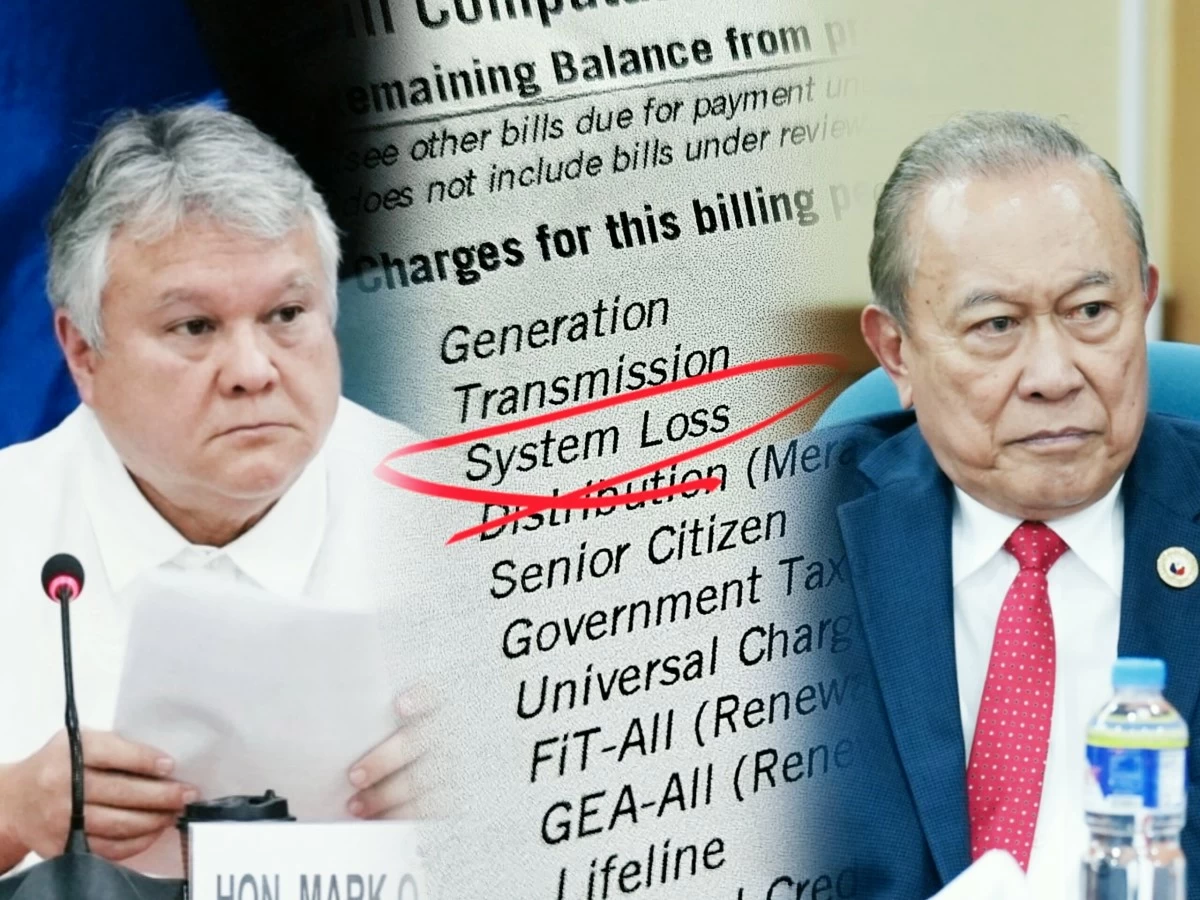
From left: Pangasinan 2nd district Rep. Mark Cojuangco, an electricity bill, Palawan 2nd district Rep. Jose Alvarez (PPAB, MANILA BULLETIN)
House members sought clarification on the highly technical nature of system loss on Wednesday, Aug. 6 as the Committee on Energy held its first hearing to discuss issues and concerns surrounding the proposed abolition of system loss charges from electricity bills.
Pangasinan 2nd district Rep. Mark Cojuangco was among the solons in the hearing who espoused an objective take on the issue to avoid further misconceptions on how technical losses occur in power distribution systems.
The hearing was held in response to President Marcos' call to scrap systems loss charges, which he articulated in his July 27 State of the Nation Address (SONA) to a standing ovation.
Cojuangco, chairman of the Committee on Nuclear Energy, acknowledged that energy losses were inherent in any system and cautioned against portraying all system loss as inefficiency.
He likened the issue to the thermal efficiency of an internal combustion engine. According to him, only around 30 percent of the energy in fuel is converted into useful work, while the rest is dissipated as heat.
“Ibig sabihin, 70 percent ng energy ng gasolina ay natatapon bilang init ng makina, exhaust, etc. Ibig sabihin ba nitong system loss na reklamo natin ay bawal maningil ang taxi driver ng kabuuan ng kanyang gasolina niya dahil 70 percent ay natapon sa system loss? It doesn't make sense," he said.
(It means 70 percent of the energy from gasoline is wasted as engine heat, exhaust, etc. Does this mean that the system loss we complain about would prevent a taxi driver from charging for all his gasoline since 70 percent is wasted in system loss? It doesn’t make sense.)
"I hope we can soul-search and look at this dispassionately because we might be misleading our people,” said the veteran lawmaker.
The discussion came as lawmakers examined the factors contributing to technical system losses.
Cojuangco further said the public should look at the theoretical maximum efficiency of a distribution utility (DU) versus the actual efficiency level of private DUs and electric cooperatives to show if “the DU is truly doing its best to reduce technical system losses."
What about electric cooperatives?
Meanwhile, Deputy Minority Leader and APEC Partylist Rep. Sergio Dagooc echoed that discussions on system loss should also take into account the distinct regulatory framework governing electric cooperatives.
He said that electric cooperatives are non-stock, non-profit entities owned by their member-consumers, unlike private DUs that are investor-owned.
Dagooc--a member of the so-called House Power Bloc--warned that removing the system loss charge could have a disproportionate impact on electric cooperatives, which may not have the financial capacity to absorb the cost.
He noted that under the Energy Regulatory Commission's (ERC) cash flow methodology, the objective was neither for electric cooperatives to earn profits nor incur losses but to cover the cost of serving the people. These include personnel expenses and network maintenance.
"If system loss is removed without corresponding adjustments, the funds intended for salaries and maintenance will instead be used to absorb those costs," Dagooc said.
ERC Chaiperson Nino Juan agreed that electric cooperatives could face cash flow constraints because their current rates do not include any allowance for absorbing system loss costs. He added that that unless rates are reset to provide additional operating funds, cooperatives may struggle to sustain operations while working to reduce non-technical losses.
Dagooc further clarified that “[DUs] do not earn from systems loss,” which Juan confirmed.
Illustrating the point, the lawmaker explained that if a generator delivers 100 kilowatt-hours but only 90 kilowatt-hours (kWh) are registered at consumers' meters, the remaining 10 kWh constitute system loss.
Since generators bill DUs for the full 100 kWh delivered, existing laws – particularly Republic Act (RA) No. 7832 and the Electric Power Industry Reform Act of 2001 (EPIRA), allow utilities to recover allowable system loss costs from consumers.
“Kaya pinapayagan ng batas, RA No. 7832, at sinalo sa Section 43f ng EPIRA, na ipasa kasi hindi pumapayag yang generator na 90 lang ang babayaran ko. Ang sinisingil ay 100. Kaya ultimately, yung siningil ko na sa systems loss na sampung kilowatt hour may bayad din,” Dagooc said.
TL vs. NTL
Committee on Energy Chairman and Palawan 2nd district Rep. Jose Alvarez distinguished between technical system (TL) loss and non-technical systems loss (NTL) during the hearing. For him, charges arising from the latter can be easily removed.
“Yung NTL po ay pwede tanggalin kaagad, ngunit yung TL ay gawan ng paraan kung papaano ma-minimize pa talaga, hindi man outright [removal],” Alvarez said.
(The NTL can be removed immediately, but the TL should be addressed in a way that it can really be minimized, even if not outright removed.)
NTL is electricity theft and pilferage that leads to operational and administrative loss while TL is the electricity transmission lost through the network.
Cagayan de Oro City Rep. Rufus Rodriguez on the other hand said Congress cannot outrightly abolish system loss, technical or otherwise, and suggested further studies into the matter.
"You cannot remove everything…but indeed, we can lower [the TL],” Rodriguez said.
Bagong Henerasyon (BH) Party-list Rep. Robert Nazal maintained that honest consumers should not be treated as shock absorbers of NTLs, inefficiencies, defective systems, and failure of electricity utilities to improve.
“Hanggang kailan pagbabayarin ang taong bayan para sa losses na dapat responsibilidad ng utilities na bawasan?” Nazal asked.
(Until when will the people be made to pay for losses that should be the responsibility of utilities to reduce?)