






 Philippines
National
Philippines deposits Bajo de Masinloc chart with UN amid China objections
Philippines
National
Philippines deposits Bajo de Masinloc chart with UN amid China objections
Philippines deposits Bajo de Masinloc chart with UN amid China objections


At A Glance
- The Philippines formally deposited with the United Nations its official nautical chart showing the baselines and maritime zones of Bajo de Masinloc, placing the information on the public international record.
- The DFA said the chart shows the shoal's normal baselines, 12-nautical-mile territorial sea, and contiguous zone extending up to 24 nautical miles in accordance with UNCLOS, Philippine law, and the 2016 Arbitral Award.
- The move comes amid China's rejection of the Philippine baselines around Bajo de Masinloc and its warning that Beijing would "respond resolutely" to what it considers Philippine acts of infringement or provocation.
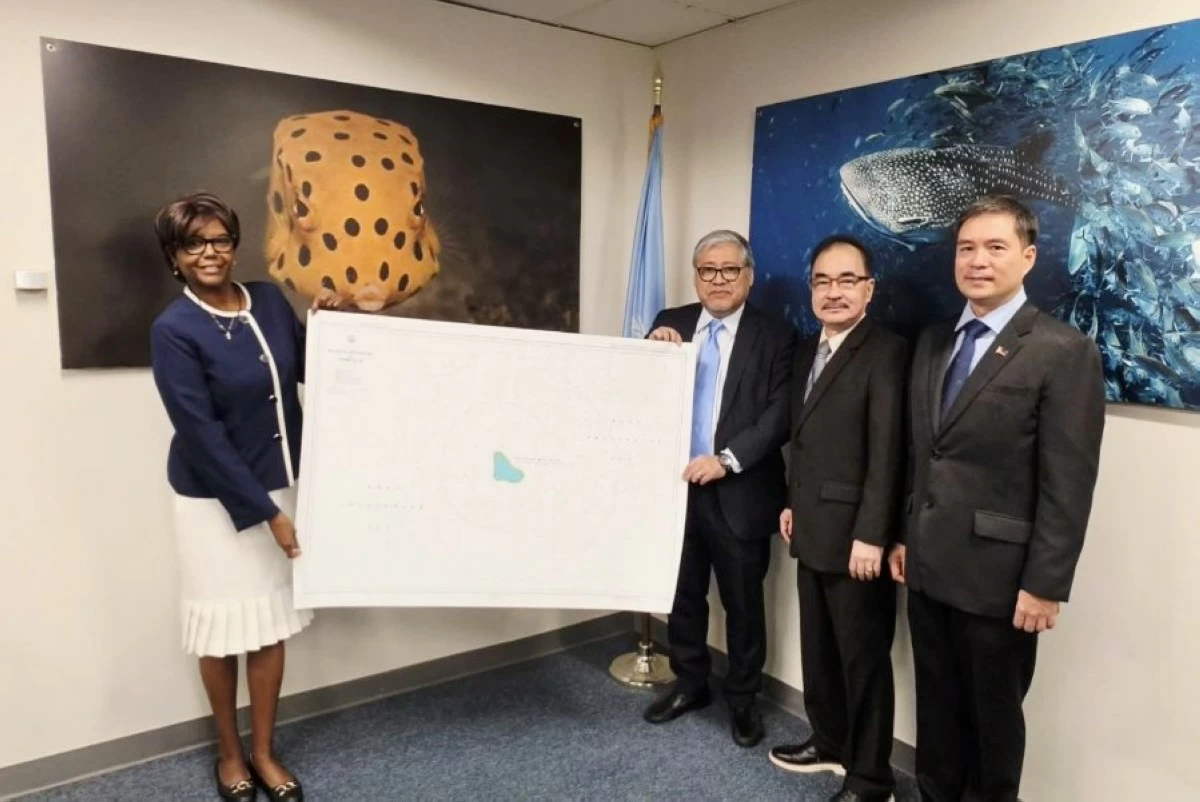
The Philippines has formally deposited with the United Nations its official nautical chart of Bajo de Masinloc and its surrounding maritime zones, placing the country's baselines and the geographic extent of its claimed authority and jurisdiction around the shoal on the public international record amid China's continued objections.
The Department of Foreign Affairs (DFA) said the Philippines deposited the chart with the UN Secretariat on July 29 pursuant to Article 16 of the 1982 United Nations Convention on the Law of the Sea (UNCLOS), which requires coastal states to give due publicity to official charts or geographical coordinates showing the baselines from which their territorial sea is measured.
Philippine Ambassador and Permanent Representative to the United Nations Enrique Manalo formally presented National Mapping and Resource Information Authority (NAMRIA) Chart No. 1567, entitled "Bajo de Masinloc and Approach," to United Nations Division for Ocean Affairs and the Law of the Sea Deputy Director Alice Hicuburundi in New York.
According to the DFA, the chart prepared by NAMRIA using internationally recognized hydrographic and geodetic standards depicts the normal baselines of Bajo de Masinloc, together with the outer limits of its territorial sea and contiguous zone, in accordance with UNCLOS and Philippine law.
Under the Philippine Maritime Zones Act and relevant provisions of UNCLOS, as well as the 2016 South China Sea Arbitral Award, Manila maintains that Bajo de Masinloc generates a territorial sea extending up to 12 nautical miles from its normal baselines and a contiguous zone extending from 12 to 24 nautical miles.
The DFA said placing the chart on deposit with the UN Secretary-General formally notifies the international community of the Philippines' normal baselines and the geographic extent of its applicable authority and jurisdiction around Bajo de Masinloc while making its official hydrographic information publicly available.
China rejects PH baselines
China has rejected the Philippines' delimitation of territorial sea baselines around the shoal and warned that it would respond to what it considers further Philippine infringement or provocation in the area.
China's Ministry of Foreign Affairs described the Philippine baselines as a "grave infringement" of Chinese territorial sovereignty and a violation of international law, including the UN Charter and UNCLOS, declaring them "illegal, null and void."
"China urges the Philippines to earnestly respect China's territorial sovereignty and maritime rights and interests, and refrain from any act of infringement or provocation in Huangyan Dao. Otherwise, China will respond resolutely," the Chinese Foreign Ministry said, using Beijing's name for Bajo de Masinloc, also known internationally as Scarborough Shoal.
Beijing maintains that the shoal is China's "inherent territory" and has also rejected the Philippine Maritime Zones Act, accusing Manila of using domestic legislation to reinforce the 2016 South China Sea Arbitral Award and its maritime claims.
Maritime Zones Act
The Philippines has maintained that Bajo de Masinloc forms an integral part of Philippine territory and that its maritime zones are established in accordance with UNCLOS, the Maritime Zones Act, and the 2016 Arbitral Award.
The Maritime Zones Act codified the country's maritime zones under UNCLOS and Philippine law, including its internal waters, archipelagic waters, territorial sea, contiguous zone, exclusive economic zone, and continental shelf.
The law also incorporated the country's maritime entitlements following the 2016 ruling, which determined, among others, that Bajo de Masinloc is a high-tide feature capable of generating a territorial sea but not an exclusive economic zone or continental shelf of its own.
The arbitral tribunal likewise found that Filipino and Chinese fishermen had traditional fishing rights at Bajo de Masinloc and that China had unlawfully prevented Filipino fishermen from engaging in traditional fishing there beginning in May 2012.
PH turns to UN mechanisms
The chart deposit is the latest step by the Philippines to place its maritime entitlements on an international legal and institutional footing through mechanisms provided under UNCLOS.
The Philippines also recently formally presented before the UN Commission on the Limits of the Continental Shelf (CLCS) its partial submission concerning the country's entitlement to an extended continental shelf in the West Philippine Sea covering the West Palawan Region.
During that presentation, Manila asked the Commission to consider relevant rulings by tribunals constituted under UNCLOS, including the 2016 South China Sea Arbitral Award, which determined the maritime entitlements of littoral states in the South China Sea.
The extended continental shelf submission was prepared over 15 years by a technical working group led by NAMRIA and marked the Philippines' second such submission after its successful claim over the Philippine Rise, which the CLCS validated in 2012.
Marcos vows to defend arbitral ruling
The latest legal moves also follow President Marcos' declaration in his fifth State of the Nation Address (SONA) that the Philippines would continue defending the 2016 Arbitral Award through peaceful and legal means against efforts to undermine it.
"This is not a claim that we advance alone, nor one that we will abandon," Marcos said as he described the ruling as a definitive benchmark in the interpretation and application of UNCLOS.
"Your government will do all that is necessary to continue upholding this Award, utilizing every peaceful and legal means available to the Republic against any attempt, foreign or domestic, to undermine this achievement," he added.