






Manila Bulletin
 Philippines
National
OPAPRU keeps door open for CPP-NPA peace talks, cites gains from localized peace engagement
Philippines
National
OPAPRU keeps door open for CPP-NPA peace talks, cites gains from localized peace engagement
Philippines
National
OPAPRU keeps door open for CPP-NPA peace talks, cites gains from localized peace engagement
OPAPRU keeps door open for CPP-NPA peace talks, cites gains from localized peace engagement
Published Aug 1, 2026 03:28 pm


At A Glance
- OPAPRU Secretary Mel Senen S. Sarmiento said the Marcos administration remains open to resuming peace talks with the CPP-NPA-NDF, provided both sides are sincere about achieving lasting peace and have no "hidden agenda."
- Sarmiento said the government has seen positive results from localized peace engagement, where governors and mayors lead efforts to convince rebels to surrender while the government delivers development projects and basic services to former conflict areas.
- OPAPRU said localized peace engagement now covers 59 provinces, involving 26,692 former rebels and 3,678 former rebel people's organizations, with some former rebels now taking part in local development councils to help shape community programs and budgets.
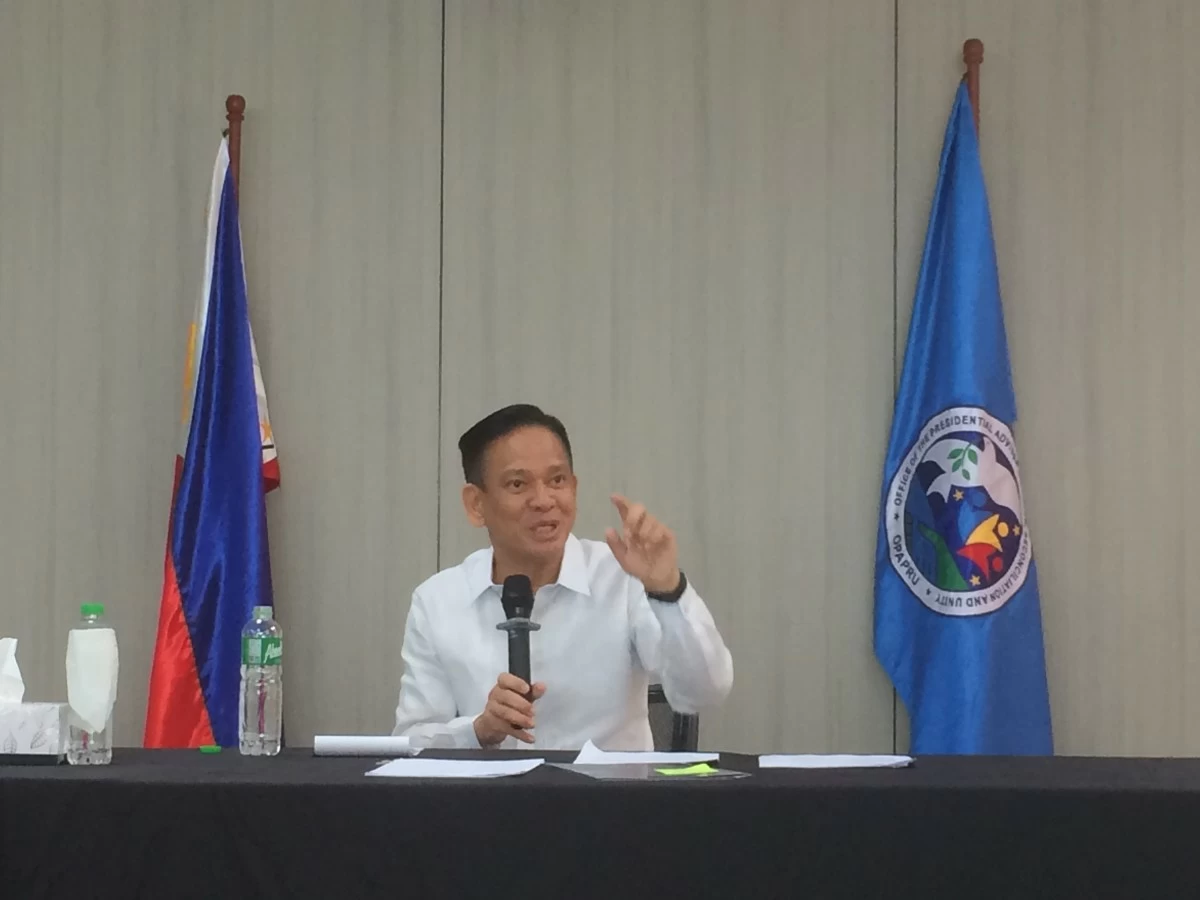
Presidential Peace Adviser Mel Senen S. Sarmiento (Photo: Martin A. Sadongdong / MANILA BULLETIN)
The national government remains open to resuming peace talks with the Communist Party of the Philippines – New People's Army – National Democratic Front (CPP-NPA-NDF) provided both sides share the same goal of achieving lasting peace without a “hidden agenda.”
Office of the Presidential Adviser on Peace, Reconciliation and Unity (OPAPRU) Secretary Mel Senen S. Sarmiento said the Marcos administration continues to pursue peace despite focusing on ending insurgency on the ground.
“Government has always been open to dialogue with anyone. The intention of government has never been in question because it is sincere,” he told reporters on Friday, July 31.
“If the objective is to achieve peace, then those talking to government should be just as sincere. There should be no hidden agenda. Both sides should have the same agenda, which is to achieve genuine peace and focus on fighting only one enemy, poverty,” he added.
In 2024, the OPAPRU had said that President Marcos Jr. remained optimistic a peace agreement with the CPP-NPA could still be pursued before the end of his term.
Asked if he remains optimistic with less than two years left in the administration, Sarmiento pointed instead to conditions in former conflict areas.
“When I go around the country, I do not rely only on data. I used to be DILG secretary and a local chief executive. I like talking to people. When I was mayor, I would sleep anywhere, walk eight to 10 hours through the mountains and stay in small bamboo houses,” he said.
"What matters to me is whether people actually feel the change. They tell me places that used to be troubled are now peaceful. What they ask for now are roads and bridges. They feel that local governments are now working for them,” he continued.
“With the help of the Armed Forces and the Philippine National Police, local officials can now reach communities they could not enter before because the fear brought by security threats is gone,” he added.
He said reports from local officials continue to show former rebels surrendering, even as insurgency has yet to be completely eliminated.
“There are still remnants but if you look at the numbers, they are already very small across the country. Just yesterday, local officials reported that more rebels had surrendered,” he said.
Localized peace engagement
Sarmiento said OPAPRU's experience shows that localized peace engagement has become one of the government's most effective approaches in encouraging rebels to return to the fold, which refers to a community-based approach to resolving local insurgency by letting local government units (LGUs) take the lead in engaging members and supporters of communist rebel groups in their respective areas.
He said the strategy is rooted in existing laws and was reinforced by Executive Order No. 70, which institutionalized the whole-of-nation approach to ending local communist armed conflict.
According to Sarmiento, the framework traces its foundation to the 1987 Constitution and the Local Government Code of 1991, which devolved powers to local governments.
Under the law, governors and mayors are responsible for maintaining peace and order in their communities as chairpersons of local peace and order councils. They also supervise local police through authority delegated by the National Police Commission (Napolcom) and may call on the Armed Forces of the Philippines and other security agencies to respond to threats such as rebellion.
“In reality, when the Local Government Code took effect in 1992, this became the responsibility of governors and mayors. It is no longer something that should be left to the President alone,” he said.
He added that local executives also lead economic development in their areas, making it possible to pursue peace and development at the same time.
“Some say peace must come before development. Others say development should come first. That cannot be the case. They should happen together,” he said.
Sarmiento said local officials are more effective in persuading members of armed groups because they know the communities and families involved.
“If they want to surrender, they are sometimes afraid to approach uniformed personnel because of things they have heard. But when they talk to their local leaders, governors or mayors, they become convinced. It has been very effective,” he said.
He said the government sustains peace by bringing infrastructure and basic services into cleared communities through a whole-of-government approach, while civil society helps convince remaining rebels to abandon the armed struggle.
Revitalized LPE
Sarmiento also said OPAPRU has been reminding local governments to fully implement provisions of the Local Government Code requiring at least 25 percent representation from civil society organizations in local development councils.
He said some former rebels are now in the process of selecting representatives to sit in municipal development councils.
“Instead of taking up arms, they now advance their concerns through advocacy. They participate in the budgeting process and in preparing the annual investment plan of local governments,” he said.
"We firmly believe government becomes more effective not by working for the people, but by working with the people. If government works with former rebels and other stakeholders, governance becomes more responsive and inclusive,” he added.
Sarmiento said localized peace engagement is now being implemented in 59 provinces involving 26,692 former rebels. He added that 3,678 former rebel people's organizations have already been organized.
“The people ask for only one thing, peace. We cannot allow conflict to continue in this country. Every gunshot is equivalent to half a kilo of rice. Money that should go to education, agriculture, and helping poor patients instead goes to buying bullets. That is why the government is very serious about achieving peace,” he said.