






 Philippines
National
PBBM defends government's response to Middle East crisis, says PH acted swiftly to cushion impact
Philippines
National
PBBM defends government's response to Middle East crisis, says PH acted swiftly to cushion impact
PBBM defends government's response to Middle East crisis, says PH acted swiftly to cushion impact


At A Glance
- President Marcos said the government did everything necessary to cushion the impact of the Middle East crisis, saying the Philippines earned praise for the speed of its response.
- The President outlined government interventions ranging from the repatriation of overseas Filipino workers (OFWs), ensuring fuel and food supply, protecting jobs, and assisting the transport sector.
- Marcos said the administration will continue its support measures through the end of the year, with more than P60 billion allocated to help about 7.5 million vulnerable families.
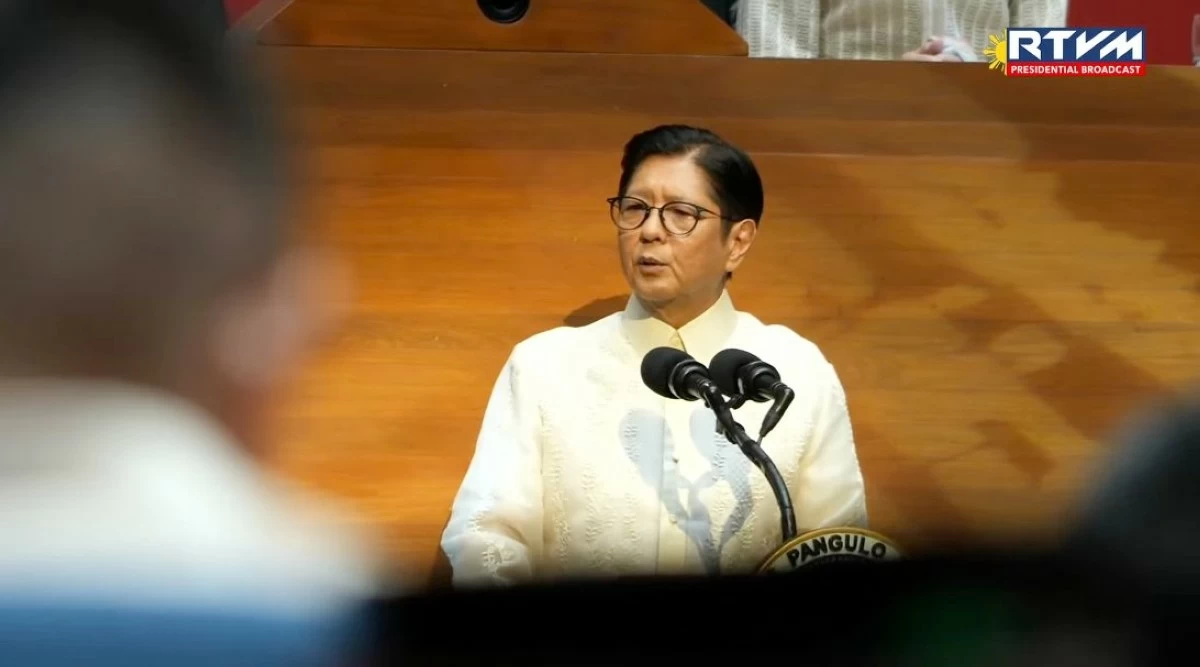
President Marcos has defended his administration's handling of the economic fallout from the conflict in the Middle East, saying the government responded quickly to protect Filipinos and mitigate the crisis' effects.
In his fifth State of the Nation Address (SONA) on Monday, July 27, the President said he could confidently face the people and tell them that the government acted accordingly and promptly to the still ongoing crisis.
"Mga kababayan, sa ating pagbalik-tanaw, kaya ko kayong harapin at sabihin na ginawa natin ang lahat ng nararapat upang malunasan ang mga epekto ng krisis (My fellow Filipinos, as we look back, I can face you and say that we did everything necessary to address the effects of the crisis),” he said.
“Agarang kumilos ang buong pamahalaan upang tumulong sa mamamayan. Sa katunayan, tayo pa ay hinangaan dahil sa bilis, liksi, at pagiging aktibo ng ating pagtugon (The entire government acted immediately to help our people. In fact, we were even admired for the speed, agility, and decisiveness of our response),” he added.
Marcos said the government immediately declared a State of National Energy Emergency after the country felt the effects of the war in the Middle East and launched the Unified Package for Livelihoods, Industry, Food, and Transport (UPLIFT) to protect vulnerable Filipinos.
"Iisa ang ating misyon: UPLIFT — ang iahon ang ating nahihirapang mamamayan (We have one mission: UPLIFT—to lift up our struggling countrymen),” he said.
The President said all government agencies were ordered to tighten spending and prioritize programs that directly addressed the crisis, while additional funding was channeled to frontline services and local governments to accelerate assistance.
He added that nearly P58 billion in additional funds was released to local government units to expand assistance, adding that public funds recovered from corrupt officials were redirected to programs benefiting the people instead of being lost to corruption.
OFWs
Marcos said the administration first focused on assisting overseas Filipino workers (OFWs) caught in the conflict, noting that more than 2.5 million Filipinos work across the Middle East.
He said more than 12,000 Filipinos had been safely repatriated since the war began, while more than 140,000 OFWs received food, financial assistance, medical aid, temporary shelter, and other forms of government support.
According to the President, returning OFWs were assisted through the AKSYON Fund, the OWWA-Kabuhayan Program, Public Employment Service Office (PESO) referrals, and Bayanihan para sa Balikbayang Manggagawa job fairs, while others were helped secure overseas employment again.
He also announced that returning OFW teachers would be deployed to public schools, saying, "Dahil dito sa Pilipinas, sila ang mga Ma'am at Sir (Here in the Philippines, they are our Ma'am and Sir).”
Marcos added that the government continues to coordinate with foreign governments to ensure the safety of OFWs, especially after some Filipinos were reported dead or missing because of the conflict.
Energy
The Chief Executive said the administration leveraged its diplomatic relations to secure enough fuel supplies despite disruptions caused by the temporary closure of the Strait of Hormuz.
He said the Philippines was able to source oil from Japan, South Korea, Oman, India, Russia, and China, ensuring enough fuel supply to last for nearly two months.
He added that the government also coordinated with Iran to ensure the safety of thousands of Filipino seafarers passing through the Strait of Hormuz.
Marcos said oil companies cooperated with the government by implementing staggered fuel price increases instead of sudden adjustments to ease the burden on consumers.
He added that the government also required oil companies to implement successive price rollbacks whenever global conditions allowed.
Food security
President Marcos said the administration also acted to stabilize food prices by limiting increases in imported rice prices and cracking down on those who took advantage of the state of energy emergency.
"Lahat ng posibleng gawin para mapababa ang presyo at mapabagal ang pagtaas nito, ginawa natin (We did everything possible to bring prices down and slow their increase),” he said.
The President said job fairs were conducted nationwide as workers lost jobs during the crisis, including nearly 100 Labor Day job fairs offering almost 300,000 vacancies, where more than 6,000 applicants were hired on the spot.
He added that wages for more than 100,000 beneficiaries under the Department of Labor and Employment's (DOLE) Integrated Livelihood and Emergency Employment Program (DOLE) and Tulong Panghanapbuhay sa Ating Disadvantaged/Displaced Workers (TUPAD) programs were also distributed during the nationwide job fair.
Marcos said banks and electronic wallet providers were encouraged to reduce or waive online transaction fees, while financial institutions, including GSIS, SSS, NHMFC, and Pag-IBIG Fund, granted payment moratoriums to ease the burden on borrowers.
He added that more than 26,000 metric tons of rice had already been distributed to more than 2.5 million families, with the program set to expand to eight million households.
The President also cited the continued implementation of the Benteng Bigas Meron Na program, which he said has benefited more than 12 million Filipinos, alongside more than 800 KADIWA outlets that continue to connect consumers directly with farmers and fisherfolk.
He added that nearly 2 million farmers and fisherfolk received assistance under the Presidential Assistance to Farmers, Fisherfolk, and Families (PAFFF) during the period of elevated fuel prices.
Utilities and business relief
The President said improved internet connectivity enabled more Filipinos to shift to online work and classes as fuel prices remained elevated.
He acknowledged that electricity prices also increased because of higher oil prices and a stronger US dollar but said the government ordered refunds for consumers who were overcharged by electric utilities.
Marcos said selected consumers were also allowed to pay electricity bills in installments from May to July, while utility companies were temporarily prohibited from disconnecting power service as long as payments were being made.
He added that the Bureau of Internal Revenue (BIR) is implementing a one-time tax abatement program this year to help microentrepreneurs whose businesses suffered because of the crisis.
Transport
Calling transportation the sector hardest hit by the crisis, President Marcos said drivers, operators, commuters, workers, and businesses all suffered from soaring fuel prices but stressed that the government could not allow public transportation to grind to a halt because it serves as "the piston of our economy."
He said jeepney and UV Express drivers received cash assistance under the Assistance to Individuals in Crisis Situation (AICS) program, along with a P10-per-liter diesel subsidy, while more than 1.8 million transport workers also received financial assistance.
For commuters, Marcos said the government expanded the Libreng Sakay program with the participation of several government agencies, while the Department of Agriculture (DA) also helped transport agricultural products to major trading centers.
The President said the government also revived the Service Contracting Program for buses and jeepneys, allowing qualified operators and drivers to earn additional income based on the number of kilometers they traveled while providing passengers with a 20-percent fare discount, on top of existing discounts for students, senior citizens, and persons with disabilities.
He added that TUPAD Tuloy-Pasada also provided additional income to public utility drivers, while commuters in Metro Manila continued to receive a 50-percent fare discount on LRT-2 and MRT-3 services.
Marcos said the government likewise temporarily reduced or suspended various fees in airports, seaports, the Parañaque Integrated Terminal Exchange (PITX), and expressways, including terminal fees, harbor charges, toll fees, and Ro-Ro terminal charges for agricultural cargo to lower transport costs and help keep food prices stable.
Continuing support
President Marcos acknowledged that the effects of the conflict remain despite the government's interventions, saying five months after the war began, Filipinos continue to feel its economic impact.
"Hangga’t kailangan, asahan ninyo na hindi titigil ang pagsuporta ng pamahalaan (For as long as necessary, you can expect that the government will not stop supporting you),” he said.
The President said the administration has allocated more than P60 billion for continuing interventions until the end of the year, adding that funds recovered from corrupt officials would instead be used to help the people.
Marcos said the government will focus assistance on 3.5 million beneficiaries of the Pantawid Pamilyang Pilipino Program (4Ps) and Walang Gutom Program, 1.5 million minimum-wage earners who are Social Security System (SSS) members, 2.5 million poor Filipinos who have yet to receive government aid, as well as the transport, agriculture, and OFW sectors affected by the conflict.
"Kung susumahin, mahigit pito't kalahating milyong pamilya na lubos na nangangailangan ang matutulungan natin sa mabigat na kabanatang ito (All told, more than 7.5 million families most in need will receive assistance during this difficult chapter),” he said.