ADVERTISEMENT

Investing in women farmers can strengthen Philippine climate resilience—ADB Institute

Published Jul 23, 2026 10:51 am
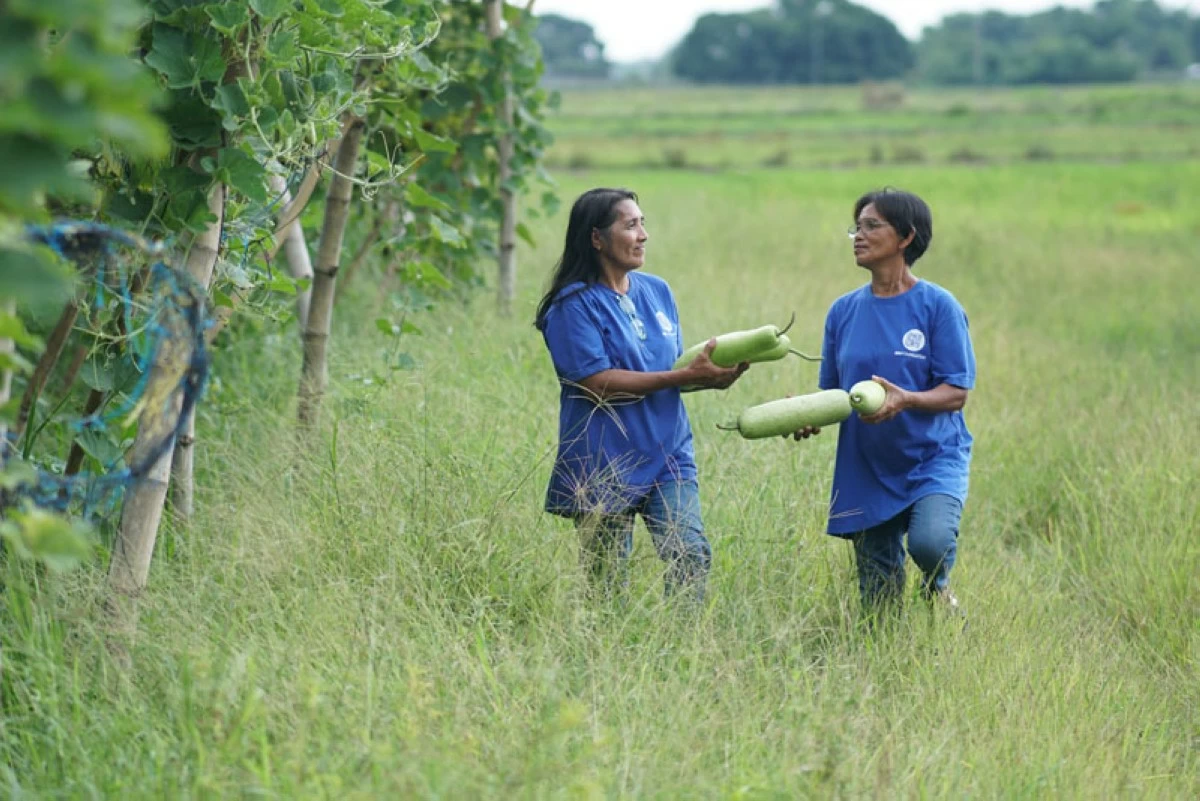
Connie Flores (left) and Imelda Lagmay (right) from Pangasinan have created an additional revenue stream for their families after graduating from SM Foundation's KSK Farming Program in 2023. Apart from their backyard garden, they have also turned portions of their rice fields into profitable vegetable gardens.

The Philippines, one of the world’s most climate-vulnerable countries, can strengthen its climate resilience by investing more in female farmers, according to Tokyo-based think tank Asian Development Bank Institute (ADBI).

In a policy brief titled “Agricultural Innovation and Women’s Empowerment Can Improve Climate Resilience in Southeast Asia,” ADBI said climate vulnerability and structural gender inequality reinforce each other in Southeast Asian agriculture, resulting in measurable productivity and economic losses.

Based on Germanwatch data cited in the report, the Philippines ranked seventh in the 2024 Climate Risk Index, making it one of three Southeast Asian countries in the global top 10, together with Myanmar and Vietnam.

“Gender inequality in Southeast Asian agriculture is not only an equity concern: it is a source of aggregate inefficiency,” the report noted.

ADBI said conventional household-level interventions often fail because they overlook documented resource misallocation within families, where male- and female-managed plots receive unequal inputs despite facing the same climate conditions.

“Within the same household, plots managed by women yield approximately 30 percent less than plots managed by men, not because women are less productive farmers, but because households allocate too much labor and too little fertilizer to male-managed plots relative to female-managed ones,” the report said.

The think tank added that such misallocation results in an estimated efficiency loss equivalent to about six percent of total household agricultural output.

According to the report, closing the agricultural productivity gender gap could increase agricultural value added by 0.47 gross domestic product (GDP) points in lower-middle-income countries (LMICs). Although the Philippines attained upper-middle-income-country (UMIC) status this year, ADBI said persistent gender gaps in access to credit, agricultural extension services, market information, and secure land rights continue to constrain female farmers’ productivity.

The report also found that research and development (R&D) spending tends to favor commercially dominant crops, while those disproportionately grown by female smallholders—such as cassava, sweet potato, leafy vegetables, and legumes—receive relatively less investment in climate-resilient technologies.

ADBI said public agricultural R&D institutions should increase investment in horticulture, root crops, legumes, and other crops commonly grown by women, while involving female farmers directly in selecting suitable crop varieties.

In the Philippine agricultural sector, access to mobile phones has been shown to increase the farmgate prices received by producers, with the economic gains accruing to the individual who controls the device.

ADBI said price-information technologies should therefore be provided directly to female farmers rather than generally to farming households, where devices often remain under the control of male household heads.

The think tank recommended increasing public agricultural R&D investment in women’s crops, expanding market price-information technologies to female smallholders, and depositing agricultural subsidies and loans directly into women’s mobile bank accounts.

It noted that mobile wallet usage has already reached 87 percent in the Philippines, providing an existing platform that could be used to deliver farm subsidies and insurance payments without requiring significant new technological investments.

Over the medium term, ADBI also called for formalizing women’s land tenure rights and incorporating gender markers into regional climate finance to monitor whether women are direct beneficiaries and decision-makers.

The report identified biological, digital, and financial innovations as complementary approaches to addressing the intertwined challenges of climate vulnerability and gender inequality in agriculture.

“What is required is the political will to redesign how resources are directed, delivered, and tracked, so that they reach the female farmers whose productivity gains would generate the largest returns for the region’s food security and economic resilience,” the report said. - Danielle T. Bayani

Related Tags

Asian Development Bank Institute (ADBI) women farmers climate resilience
ADVERTISEMENT
.most-popular .layout-ratio{ padding-bottom: 79.13%; } @media (min-width: 768px) and (max-width: 1024px) { .widget-title { font-size: 15px !important; } }

{{ articles_filter_1561_widget.title }}

.most-popular .layout-ratio{ padding-bottom: 79.13%; } @media (min-width: 768px) and (max-width: 1024px) { .widget-title { font-size: 15px !important; } }

{{ static_articles_1562_widget.title }}

.most-popular .layout-ratio{ padding-bottom: 79.13%; } @media (min-width: 768px) and (max-width: 1024px) { .widget-title { font-size: 15px !important; } }

{{ articles_filter_1563_widget.title }}

{{ articles_filter_1564_widget.title }}

.mb-article-details { position: relative; } .mb-article-details .article-body-preview, .mb-article-details .article-body-summary{ font-size: 17px; line-height: 30px; font-family: "Libre Caslon Text", serif; color: #000; } .mb-article-details .article-body-preview iframe , .mb-article-details .article-body-summary iframe{ width: 100%; margin: auto; } .read-more-background { background: linear-gradient(180deg, color(display-p3 1.000 1.000 1.000 / 0) 13.75%, color(display-p3 1.000 1.000 1.000 / 0.8) 30.79%, color(display-p3 1.000 1.000 1.000) 72.5%); position: absolute; height: 200px; width: 100%; bottom: 0; display: flex; justify-content: center; align-items: center; padding: 0; } .read-more-background a{ color: #000; } .read-more-btn { padding: 17px 45px; font-family: Inter; font-weight: 700; font-size: 18px; line-height: 16px; text-align: center; vertical-align: middle; border: 1px solid black; background-color: white; } .hidden { display: none; }
function initializeAllSwipers() { // Get all hidden inputs with cms_article_id document.querySelectorAll('[id^="cms_article_id_"]').forEach(function (input) { const cmsArticleId = input.value; const articleSelector = '#article-' + cmsArticleId + ' .body_images'; const swiperElement = document.querySelector(articleSelector); if (swiperElement && !swiperElement.classList.contains('swiper-initialized')) { new Swiper(articleSelector, { loop: true, pagination: false, navigation: { nextEl: '#article-' + cmsArticleId + ' .swiper-button-next', prevEl: '#article-' + cmsArticleId + ' .swiper-button-prev', }, }); } }); } setTimeout(initializeAllSwipers, 3000); const intersectionObserver = new IntersectionObserver( (entries) => { entries.forEach((entry) => { if (entry.isIntersecting) { const newUrl = entry.target.getAttribute("data-url"); if (newUrl) { history.pushState(null, null, newUrl); let article = entry.target; // Extract metadata const author = article.querySelector('.author-section').textContent.replace('By', '').trim(); const section = article.querySelector('.section-info ').textContent.replace(' ', ' '); const title = article.querySelector('.article-title h1').textContent; // Parse URL for Chartbeat path format const parsedUrl = new URL(newUrl, window.location.origin); const cleanUrl = parsedUrl.host + parsedUrl.pathname; // Update Chartbeat configuration if (typeof window._sf_async_config !== 'undefined') { window._sf_async_config.path = cleanUrl; window._sf_async_config.sections = section; window._sf_async_config.authors = author; } // Track virtual page view with Chartbeat if (typeof pSUPERFLY !== 'undefined' && typeof pSUPERFLY.virtualPage === 'function') { try { pSUPERFLY.virtualPage({ path: cleanUrl, title: title, sections: section, authors: author }); } catch (error) { console.error('ping error', error); } } // Optional: Update document title if (title && title !== document.title) { document.title = title; } } } }); }, { threshold: 0.1 } ); function showArticleBody(button) { const article = button.closest("article"); const summary = article.querySelector(".article-body-summary"); const body = article.querySelector(".article-body-preview"); const readMoreSection = article.querySelector(".read-more-background"); // Hide summary and read-more section summary.style.display = "none"; readMoreSection.style.display = "none"; // Show the full article body body.classList.remove("hidden"); } document.addEventListener("DOMContentLoaded", () => { let loadCount = 0; // Track how many times articles are loaded const offset = [1, 2, 3, 4, 5, 6, 7, 8, 9, 10]; // Offset values const currentUrl = window.location.pathname.substring(1); let isLoading = false; // Prevent multiple calls if (!currentUrl) { console.log("Current URL is invalid."); return; } const sentinel = document.getElementById("load-more-sentinel"); if (!sentinel) { console.log("Sentinel element not found."); return; } function isSentinelVisible() { const rect = sentinel.getBoundingClientRect(); return ( rect.top < window.innerHeight && rect.bottom >= 0 ); } function onScroll() { if (isLoading) return; if (isSentinelVisible()) { if (loadCount >= offset.length) { console.log("Maximum load attempts reached."); window.removeEventListener("scroll", onScroll); return; } isLoading = true; const currentOffset = offset[loadCount]; window.loadMoreItems().then(() => { let article = document.querySelector('#widget_1690 > div:nth-last-of-type(2) article'); intersectionObserver.observe(article) loadCount++; }).catch(error => { console.error("Error loading more items:", error); }).finally(() => { isLoading = false; }); } } window.addEventListener("scroll", onScroll); });

Sign up by email to receive news.