ADVERTISEMENT

Multilateral lenders raise record $163 billion for climate action in 2025

Published Jul 14, 2026 09:27 am
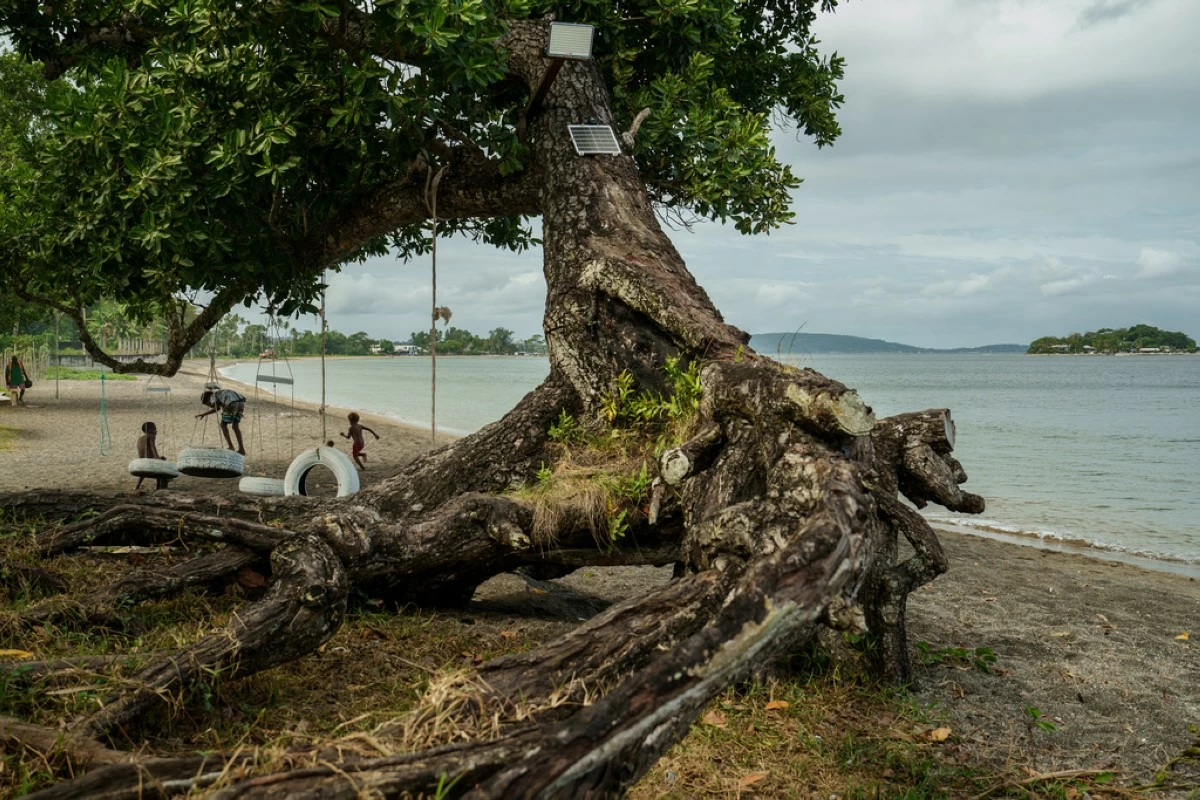
FILE - Children play on an uprooted tree along a beach in Mele, Vanuatu, July 19, 2025, that was once lined with vegetation, now largely lost to storms, erosion and other environmental pressures. (AP Photo/Annika Hammerschlag, File)

Multilateral development banks (MDBs), including the Manila-based Asian Development Bank (ADB) and the Washington-based World Bank Group (WBG), increased climate financing to a record $163 billion in 2025, reinforcing their role in supporting resilient and sustainable economies amid mounting climate risks.

In a joint report released last Monday, July 13, the MDBs said climate finance for low- and middle-income countries climbed by 21 percent to an all-time high of $103 billion last year, while total climate finance across all economies where they operate rose by 19 percent to a record $163 billion.

The report said the latest figures indicate that MDBs remain on track to achieve the climate finance commitments they announced during the 2024 United Nations (UN) climate conference (COP29) in Baku, Azerbaijan.

By 2030, the lenders aim to provide $120 billion in annual climate finance for low- and middle-income countries, including $42 billion for climate adaptation, while mobilizing an additional $65 billion a year from the private sector. For high-income economies, the target is $50 billion in annual climate finance, including $7 billion for adaptation, alongside another $65 billion in mobilized private finance.

The joint report showed that mitigation projects continued to account for the largest share of climate financing in low- and middle-income economies at $68 billion, while adaptation finance expanded by a faster 31 percent to $35 billion.

Private-sector mobilization in these economies also reached $35 billion in 2025, underscoring the growing role of private capital in supporting climate-related investments.

Across all countries of operation, MDBs mobilized a combined $179 billion in climate co-financing, including $77.64 billion for low- and middle-income economies and $101.21 billion for high-income economies. Of the total, private-sector co-financing amounted to $35.17 billion and $80.38 billion, respectively.

The report noted that climate finance in low- and middle-income economies has doubled over the past five years, reflecting sustained efforts by MDBs to help countries pursue low-carbon and climate-resilient development.

Energy projects accounted for the largest share of mitigation finance at $45.36 billion, followed by transport at $23.57 billion, cross-sectoral activities at $19.5 billion, and buildings and energy efficiency at $18.17 billion. On the adaptation side, the largest allocations went to energy, transport, and other infrastructure projects at $13.33 billion, followed by cross-sectoral activities at $11.27 billion and water and wastewater systems at $7.34 billion.

Among the participating institutions, the WBG remained the largest provider of climate finance for low- and middle-income economies at $49.89 billion, followed by the ADB at $14.75 billion, the European Bank for Reconstruction and Development (EBRD) at $8.35 billion, the Inter-American Development Bank Group (IDB) at $8.46 billion, and the Beijing-based Asian Infrastructure Investment Bank (AIIB) at $7.47 billion.

The report also highlighted MDBs’ efforts to improve the transparency and accessibility of climate finance data through the pilot MDB Climate Finance Dashboard, launched in April this year. The platform provides detailed breakdowns of climate finance commitments and harmonized methodologies through interactive tables and visualizations, complementing the annual joint report.

Related Tags

multilateral development banks (MDBs) climate finance Asian Development Bank (ADB) World Bank Group (WBG)
ADVERTISEMENT
.most-popular .layout-ratio{ padding-bottom: 79.13%; } @media (min-width: 768px) and (max-width: 1024px) { .widget-title { font-size: 15px !important; } }

{{ articles_filter_1561_widget.title }}

.most-popular .layout-ratio{ padding-bottom: 79.13%; } @media (min-width: 768px) and (max-width: 1024px) { .widget-title { font-size: 15px !important; } }

{{ static_articles_1562_widget.title }}

.most-popular .layout-ratio{ padding-bottom: 79.13%; } @media (min-width: 768px) and (max-width: 1024px) { .widget-title { font-size: 15px !important; } }

{{ articles_filter_1563_widget.title }}

{{ articles_filter_1564_widget.title }}

.mb-article-details { position: relative; } .mb-article-details .article-body-preview, .mb-article-details .article-body-summary{ font-size: 17px; line-height: 30px; font-family: "Libre Caslon Text", serif; color: #000; } .mb-article-details .article-body-preview iframe , .mb-article-details .article-body-summary iframe{ width: 100%; margin: auto; } .read-more-background { background: linear-gradient(180deg, color(display-p3 1.000 1.000 1.000 / 0) 13.75%, color(display-p3 1.000 1.000 1.000 / 0.8) 30.79%, color(display-p3 1.000 1.000 1.000) 72.5%); position: absolute; height: 200px; width: 100%; bottom: 0; display: flex; justify-content: center; align-items: center; padding: 0; } .read-more-background a{ color: #000; } .read-more-btn { padding: 17px 45px; font-family: Inter; font-weight: 700; font-size: 18px; line-height: 16px; text-align: center; vertical-align: middle; border: 1px solid black; background-color: white; } .hidden { display: none; }
function initializeAllSwipers() { // Get all hidden inputs with cms_article_id document.querySelectorAll('[id^="cms_article_id_"]').forEach(function (input) { const cmsArticleId = input.value; const articleSelector = '#article-' + cmsArticleId + ' .body_images'; const swiperElement = document.querySelector(articleSelector); if (swiperElement && !swiperElement.classList.contains('swiper-initialized')) { new Swiper(articleSelector, { loop: true, pagination: false, navigation: { nextEl: '#article-' + cmsArticleId + ' .swiper-button-next', prevEl: '#article-' + cmsArticleId + ' .swiper-button-prev', }, }); } }); } setTimeout(initializeAllSwipers, 3000); const intersectionObserver = new IntersectionObserver( (entries) => { entries.forEach((entry) => { if (entry.isIntersecting) { const newUrl = entry.target.getAttribute("data-url"); if (newUrl) { history.pushState(null, null, newUrl); let article = entry.target; // Extract metadata const author = article.querySelector('.author-section').textContent.replace('By', '').trim(); const section = article.querySelector('.section-info ').textContent.replace(' ', ' '); const title = article.querySelector('.article-title h1').textContent; // Parse URL for Chartbeat path format const parsedUrl = new URL(newUrl, window.location.origin); const cleanUrl = parsedUrl.host + parsedUrl.pathname; // Update Chartbeat configuration if (typeof window._sf_async_config !== 'undefined') { window._sf_async_config.path = cleanUrl; window._sf_async_config.sections = section; window._sf_async_config.authors = author; } // Track virtual page view with Chartbeat if (typeof pSUPERFLY !== 'undefined' && typeof pSUPERFLY.virtualPage === 'function') { try { pSUPERFLY.virtualPage({ path: cleanUrl, title: title, sections: section, authors: author }); } catch (error) { console.error('ping error', error); } } // Optional: Update document title if (title && title !== document.title) { document.title = title; } } } }); }, { threshold: 0.1 } ); function showArticleBody(button) { const article = button.closest("article"); const summary = article.querySelector(".article-body-summary"); const body = article.querySelector(".article-body-preview"); const readMoreSection = article.querySelector(".read-more-background"); // Hide summary and read-more section summary.style.display = "none"; readMoreSection.style.display = "none"; // Show the full article body body.classList.remove("hidden"); } document.addEventListener("DOMContentLoaded", () => { let loadCount = 0; // Track how many times articles are loaded const offset = [1, 2, 3, 4, 5, 6, 7, 8, 9, 10]; // Offset values const currentUrl = window.location.pathname.substring(1); let isLoading = false; // Prevent multiple calls if (!currentUrl) { console.log("Current URL is invalid."); return; } const sentinel = document.getElementById("load-more-sentinel"); if (!sentinel) { console.log("Sentinel element not found."); return; } function isSentinelVisible() { const rect = sentinel.getBoundingClientRect(); return ( rect.top < window.innerHeight && rect.bottom >= 0 ); } function onScroll() { if (isLoading) return; if (isSentinelVisible()) { if (loadCount >= offset.length) { console.log("Maximum load attempts reached."); window.removeEventListener("scroll", onScroll); return; } isLoading = true; const currentOffset = offset[loadCount]; window.loadMoreItems().then(() => { let article = document.querySelector('#widget_1690 > div:nth-last-of-type(2) article'); intersectionObserver.observe(article) loadCount++; }).catch(error => { console.error("Error loading more items:", error); }).finally(() => { isLoading = false; }); } } window.addEventListener("scroll", onScroll); });

Sign up by email to receive news.