






 Philippines
National
14 nations reaffirm 2016 arbitral ruling, reject China's expansive South China Sea claims
Philippines
National
14 nations reaffirm 2016 arbitral ruling, reject China's expansive South China Sea claims
14 nations reaffirm 2016 arbitral ruling, reject China's expansive South China Sea claims


At A Glance
- Fourteen countries reaffirmed that the 2016 South China Sea arbitral ruling is final and legally binding on the Philippines and China as they marked its 10th anniversary.
- The joint statement reiterated that there is no legal basis for China's expansive maritime claims based on so-called "historic rights."
- The countries also opposed coercive actions at sea and called for disputes to be resolved peacefully under international law.
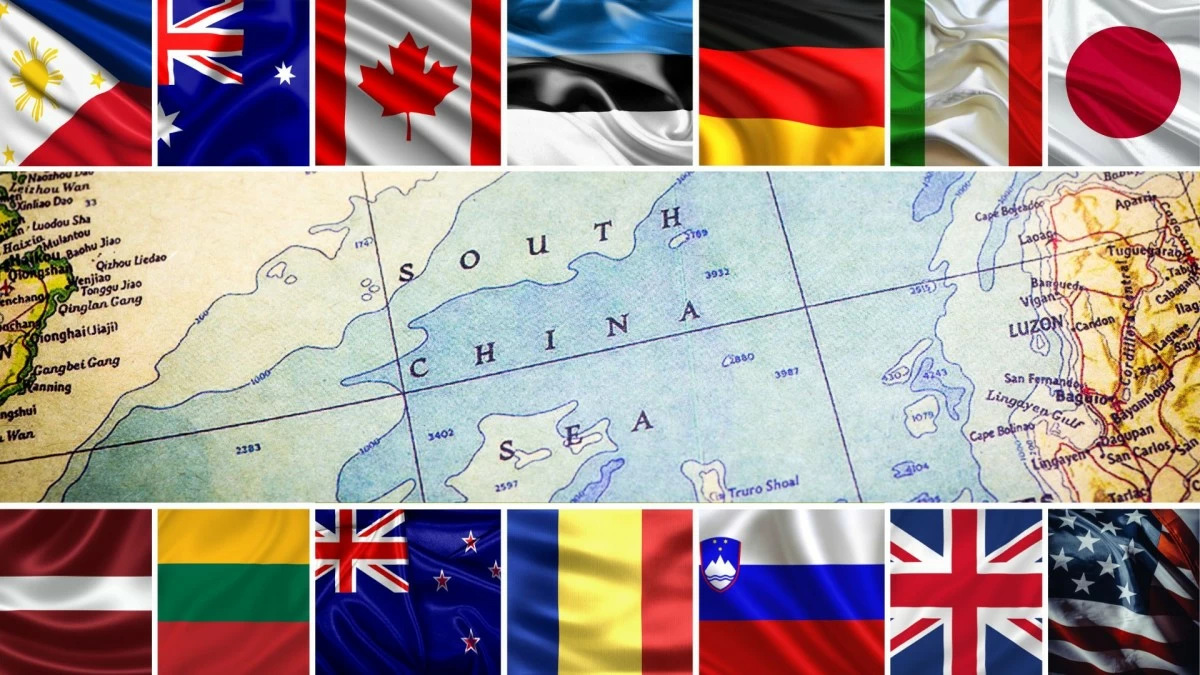
Fourteen countries reaffirmed on Sunday, July 12, the binding nature of the landmark 2016 South China Sea arbitral ruling, declaring once again that there is no legal basis for China's sweeping maritime claims and calling for disputes in the strategic waterway to be resolved peacefully under international law.
In a joint statement marking the 10th anniversary of the Philippines-China South China Sea Arbitral Tribunal Award, the governments of the Philippines, Australia, Canada, Estonia, Germany, Italy, Japan, Latvia, Lithuania, New Zealand, Romania, Slovenia, the United Kingdom, and the United States renewed their commitment to a free, open, and rules-based Indo-Pacific.
"We reaffirm that the Award rendered ten years ago by the Arbitral Tribunal is a significant milestone and is final, legally binding, and definitive between China and the Philippines with respect to the maritime entitlements and claims addressed by the Arbitral Tribunal," the statement read.
The joint declaration came after President Marcos reaffirmed the Philippines' commitment to the 2016 ruling, saying "right is not defined by might" and that international law—not military or economic power—must govern maritime disputes.
No legal basis for China's claims
The 14 countries likewise reiterated the tribunal's conclusion that Beijing's expansive claims in the South China Sea have no legal basis under the 1982 United Nations Convention on the Law of the Sea (UNCLOS).
"We reaffirm the Arbitral Tribunal's decision that there is no legal basis for China's expansive maritime claims in the South China Sea, including those based on 'historic rights,'" the statement read.
The Permanent Court of Arbitration in The Hague ruled on July 12, 2016, that China's so-called "nine-dash line" claim has no legal basis under UNCLOS. It also affirmed the Philippines' sovereign rights within its exclusive economic zone in the West Philippine Sea.
China has consistently rejected the ruling and has refused to recognize the tribunal's jurisdiction.
Opposition to coercion
The signatories also expressed strong opposition to coercive and destabilizing actions that threaten peace and security in the region.
"We reiterate our strong opposition to any destabilizing or unilateral actions, including by force or coercion that threaten peace and stability in the region," the statement read.
The countries also condemned the use of coast guard vessels, military assets, and maritime militia to interfere with lawful activities at sea.
"We reaffirm our strong opposition to the use of coast guard, military, and maritime militia forces to harass, obstruct, or intimidate lawful operations by other States at sea or in the air, and in so doing endanger the safety of personnel and fishermen and seriously degrade regional peace and security."
While the statement did not specifically mention China, it came amid continuing confrontations between Philippine and Chinese vessels in the West Philippine Sea, including incidents involving water cannon attacks, dangerous maneuvers, and obstruction of Philippine resupply and fisheries operations.
Call for peaceful resolution
The countries urged all parties to comply with the arbitral award and resolve maritime disputes through peaceful means.
"We urge the parties to abide by the 2016 Award and resolve disputes peacefully through dialogue and other lawful mechanisms in accordance with international law," the statement said.
They also underscored the importance of protecting freedom of navigation and overflight, as well as other internationally lawful uses of the sea as guaranteed under UNCLOS.
The joint statement concluded with a renewed commitment to preserving a free and open Indo-Pacific anchored in international law and shared principles.
"We remain steadfast in our support for a free and open Indo-Pacific and reiterate our commitment to promoting our shared vision with ASEAN of the South China Sea as a sea of peace, stability, cooperation, and prosperity driven by vibrant lawful commerce."
The latest declaration adds to a series of international statements issued in recent years supporting the 2016 arbitral ruling. Under the Marcos administration, the Philippines has consistently cited the award as the cornerstone of its policy in the West Philippine Sea, with the President repeatedly declaring that the decision is "beyond compromise and beyond negotiation."
It also follows similar reaffirmations made during Marcos' recent official visit to Canada, where Ottawa reiterated its support for the arbitral award as part of the newly established Philippines-Canada Strategic Partnership.