ADVERTISEMENT

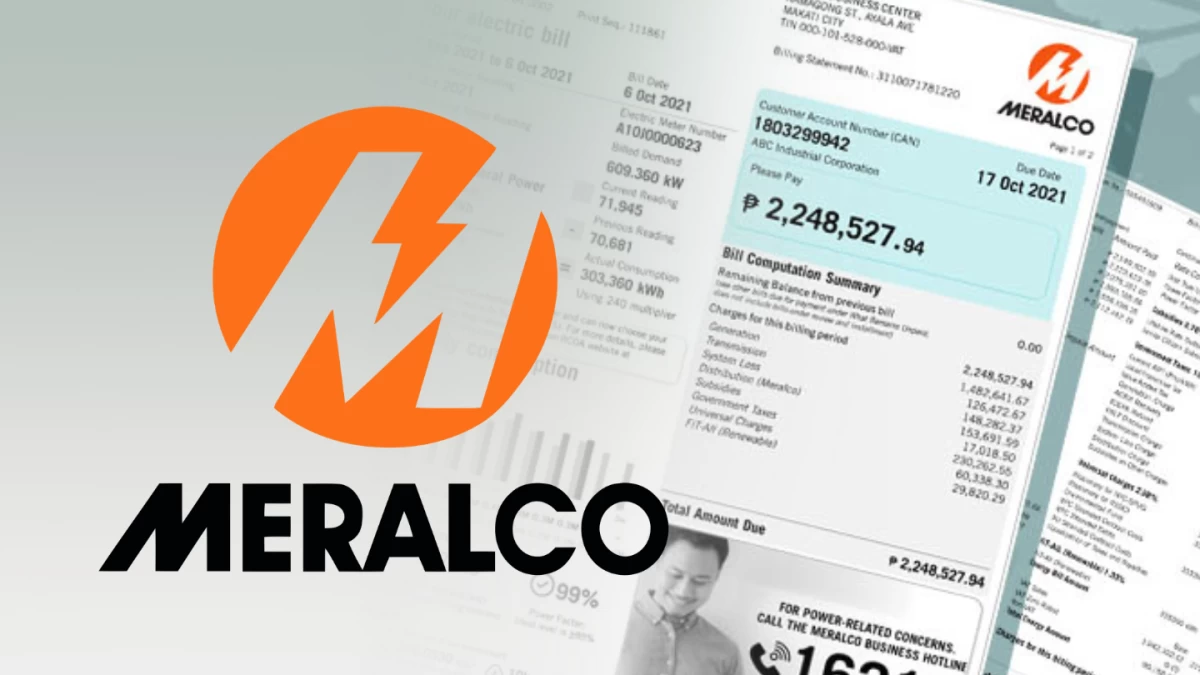
Meralco's ₱9-billion refund may be offset by added charges

Published Jul 9, 2026 04:11 pm

Manila Electric Co.’s (Meralco) plan to refund more than ₱9 billion to customers may not translate into lower electricity bills, as its regulator is also weighing the power utility giant’s request to recover more than ₱9 billion in additional charges.

The Energy Regulatory Commission (ERC) is currently reviewing Meralco’s appeal for refunds of ₱4.69 billion for the period from January to June 2025 and ₱4.32 billion for July to December of the same year.

If approved, this would lead to a reduction of around ₱0.05 per kilowatt-hour (kWh) for customers, which would be implemented over 36 months or three years.

This would appear as a separate line item on the electricity bills of Meralco consumers during the refund period.

While it evaluates this appeal, the ERC is also deliberating on whether to approve Meralco’s request to recover ₱9.43 billion in under-recoveries.

Meralco is seeking recovery charges of ₱8.87 billion for the period from 2020 to 2022 and ₱555.48 million for 2023 to 2025, which would translate into additional charges on power bills.

Alvin Jones Ortega, acting director of the ERC’s regulatory operations service, said it remains to be seen whether both proposals would be implemented at the same time.

“The commission, right now, is still reviewing both cases, so it would depend on when these [decisions] will be issued,” he said in a press briefing on Thursday, July 9.

Meanwhile, ERC Chairman and Chief Executive Officer (CEO) Francis Saturnino Juan said the regulator is on track to issue its decision on Meralco’s proposed rate reset as early as next month.

Meralco is seeking the ERC’s approval to collect a total of ₱532.13 billion from consumers under its first regulatory period, which covers 2027 to 2030.

This would be collected through an increase in the average distribution tariff to ₱2.34/kWh from the current rate of ₱1.35/kWh, equivalent to an increase of ₱0.99/kWh.

Meralco is part of the first entry group of companies under the ERC’s review of their rate reset requests, which include Cagayan Electric Power & Light Co., Cotabato Light & Power Co., and Dagupan Electric Corp.

A rate reset allows power utilities to ensure that electricity rates are updated and reflect current costs rather than outdated charges.

Juan said the ERC is taking a careful approach in evaluating these proposed rate resets to ensure that consumers remain protected, especially amid the rising cost of goods and services.

“We are trying to assess where we stand on each of these issues that will have to be resolved so that we can consolidate all these and come out with a decision,” he said.

Related Tags

Manila Electric Co. (Meralco)
ADVERTISEMENT
.most-popular .layout-ratio{ padding-bottom: 79.13%; } @media (min-width: 768px) and (max-width: 1024px) { .widget-title { font-size: 15px !important; } }

{{ articles_filter_1561_widget.title }}

.most-popular .layout-ratio{ padding-bottom: 79.13%; } @media (min-width: 768px) and (max-width: 1024px) { .widget-title { font-size: 15px !important; } }

{{ static_articles_1562_widget.title }}

.most-popular .layout-ratio{ padding-bottom: 79.13%; } @media (min-width: 768px) and (max-width: 1024px) { .widget-title { font-size: 15px !important; } }

{{ articles_filter_1563_widget.title }}

{{ articles_filter_1564_widget.title }}

.mb-article-details { position: relative; } .mb-article-details .article-body-preview, .mb-article-details .article-body-summary{ font-size: 17px; line-height: 30px; font-family: "Libre Caslon Text", serif; color: #000; } .mb-article-details .article-body-preview iframe , .mb-article-details .article-body-summary iframe{ width: 100%; margin: auto; } .read-more-background { background: linear-gradient(180deg, color(display-p3 1.000 1.000 1.000 / 0) 13.75%, color(display-p3 1.000 1.000 1.000 / 0.8) 30.79%, color(display-p3 1.000 1.000 1.000) 72.5%); position: absolute; height: 200px; width: 100%; bottom: 0; display: flex; justify-content: center; align-items: center; padding: 0; } .read-more-background a{ color: #000; } .read-more-btn { padding: 17px 45px; font-family: Inter; font-weight: 700; font-size: 18px; line-height: 16px; text-align: center; vertical-align: middle; border: 1px solid black; background-color: white; } .hidden { display: none; }
function initializeAllSwipers() { // Get all hidden inputs with cms_article_id document.querySelectorAll('[id^="cms_article_id_"]').forEach(function (input) { const cmsArticleId = input.value; const articleSelector = '#article-' + cmsArticleId + ' .body_images'; const swiperElement = document.querySelector(articleSelector); if (swiperElement && !swiperElement.classList.contains('swiper-initialized')) { new Swiper(articleSelector, { loop: true, pagination: false, navigation: { nextEl: '#article-' + cmsArticleId + ' .swiper-button-next', prevEl: '#article-' + cmsArticleId + ' .swiper-button-prev', }, }); } }); } setTimeout(initializeAllSwipers, 3000); const intersectionObserver = new IntersectionObserver( (entries) => { entries.forEach((entry) => { if (entry.isIntersecting) { const newUrl = entry.target.getAttribute("data-url"); if (newUrl) { history.pushState(null, null, newUrl); let article = entry.target; // Extract metadata const author = article.querySelector('.author-section').textContent.replace('By', '').trim(); const section = article.querySelector('.section-info ').textContent.replace(' ', ' '); const title = article.querySelector('.article-title h1').textContent; // Parse URL for Chartbeat path format const parsedUrl = new URL(newUrl, window.location.origin); const cleanUrl = parsedUrl.host + parsedUrl.pathname; // Update Chartbeat configuration if (typeof window._sf_async_config !== 'undefined') { window._sf_async_config.path = cleanUrl; window._sf_async_config.sections = section; window._sf_async_config.authors = author; } // Track virtual page view with Chartbeat if (typeof pSUPERFLY !== 'undefined' && typeof pSUPERFLY.virtualPage === 'function') { try { pSUPERFLY.virtualPage({ path: cleanUrl, title: title, sections: section, authors: author }); } catch (error) { console.error('ping error', error); } } // Optional: Update document title if (title && title !== document.title) { document.title = title; } } } }); }, { threshold: 0.1 } ); function showArticleBody(button) { const article = button.closest("article"); const summary = article.querySelector(".article-body-summary"); const body = article.querySelector(".article-body-preview"); const readMoreSection = article.querySelector(".read-more-background"); // Hide summary and read-more section summary.style.display = "none"; readMoreSection.style.display = "none"; // Show the full article body body.classList.remove("hidden"); } document.addEventListener("DOMContentLoaded", () => { let loadCount = 0; // Track how many times articles are loaded const offset = [1, 2, 3, 4, 5, 6, 7, 8, 9, 10]; // Offset values const currentUrl = window.location.pathname.substring(1); let isLoading = false; // Prevent multiple calls if (!currentUrl) { console.log("Current URL is invalid."); return; } const sentinel = document.getElementById("load-more-sentinel"); if (!sentinel) { console.log("Sentinel element not found."); return; } function isSentinelVisible() { const rect = sentinel.getBoundingClientRect(); return ( rect.top < window.innerHeight && rect.bottom >= 0 ); } function onScroll() { if (isLoading) return; if (isSentinelVisible()) { if (loadCount >= offset.length) { console.log("Maximum load attempts reached."); window.removeEventListener("scroll", onScroll); return; } isLoading = true; const currentOffset = offset[loadCount]; window.loadMoreItems().then(() => { let article = document.querySelector('#widget_1690 > div:nth-last-of-type(2) article'); intersectionObserver.observe(article) loadCount++; }).catch(error => { console.error("Error loading more items:", error); }).finally(() => { isLoading = false; }); } } window.addEventListener("scroll", onScroll); });

Sign up by email to receive news.