

ADVERTISEMENT

Alan Cayetano says SC petition driven by principles, not power

Published Jun 16, 2026 08:34 pm

At A Glance

  • Sen. Alan Peter Cayetano said the Supreme Court petition filed by his bloc is about defending constitutional principles, not retaining power, as they challenge the validity of the June 3 Senate session and the election of Sen. Sherwin Gatchalian as Senate President Pro Tempore and Acting Senate President.
  • The petition argues that the June 3 quorum was invalid and that Senate officers require at least 13 votes to be elected, maintaining that the Senate still had 24 sitting members at the time and that the 12-vote threshold cited by the opposing bloc was based on a misreading of the Avelino v. Cuenco ruling.
  • Cayetano said he is willing to relinquish the Senate presidency if the opposing bloc secures the required votes, but warned that abandoning constitutional rules could weaken future accountability efforts and claimed the leadership dispute is ultimately linked to the ongoing flood control scandal.
Senator Alan Peter Cayetano said on Tuesday, June 16, that he and his bloc are fighting principle in filing a petition before the Supreme Court challenging the validity of the declaration of quorum in what he described as a “rump” session last June 3 and the election of Senator Sherwin Gatchalian as Senate President Pro Tempore and subsequent designation as Acting Senate President.
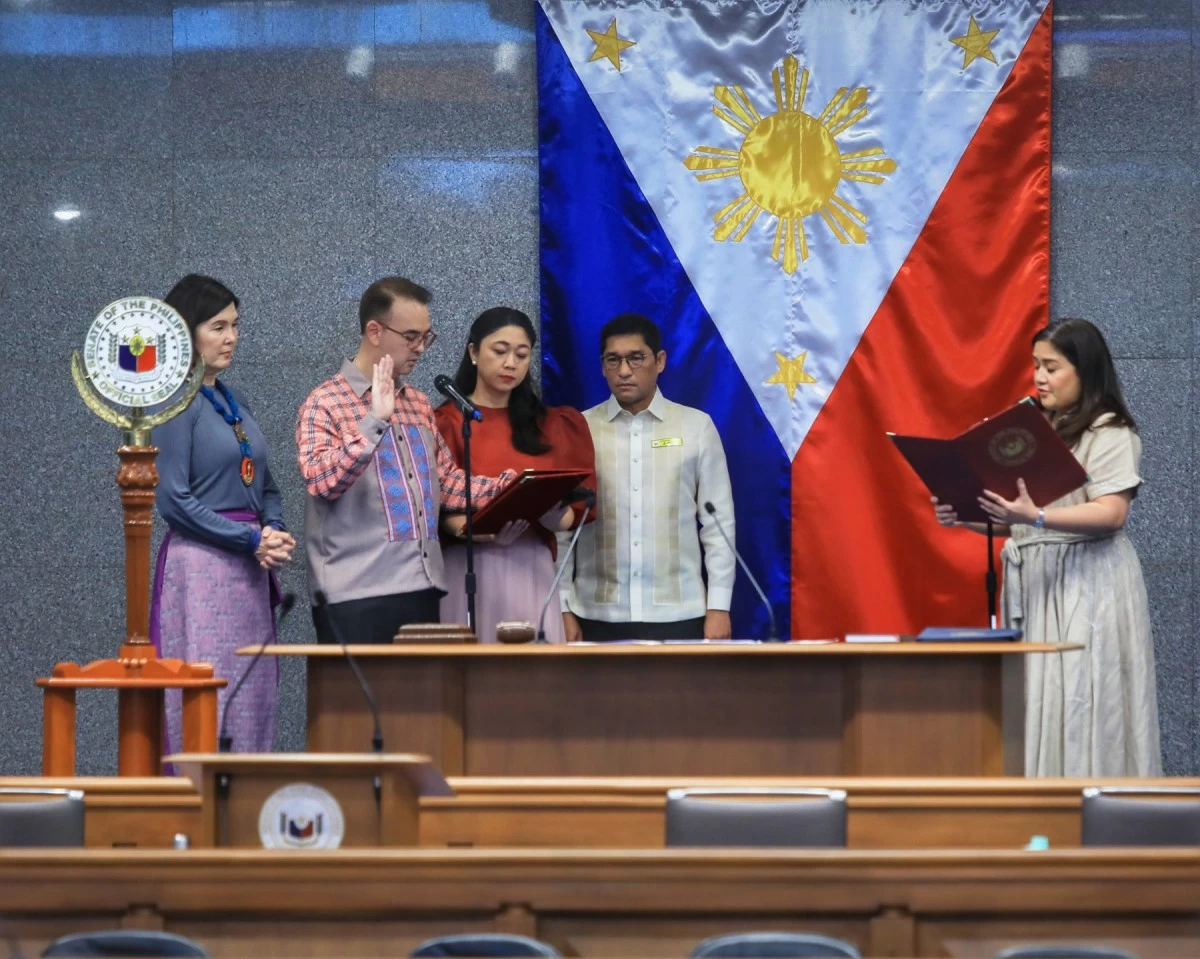
Sen. Alan Peter Cayetano takes his oath as the 33rd Senate President of the Philippines during the chamber’s plenary session on Monday, May 11, 2026.
“Y’ung posisyon, bale-wala sa akin ‘yun. Ang pinaglalaban namin ay prinsipyo, hindi power (The position means nothing to me. We're fighting for principles, not power),” Cayetano said in a Facebook livestream on June 16, 2026.
In their more than 80-page petition for certiorari and prohibition, Cayetano and his colleagues argued that the June 3 quorum was invalid, making all acts that followed invalid as well, including the supposed election of Gatchalian as Senate President Pro Tempore.
The petition rejects the claim that 12 senators were enough under the ruling in Avelino v. Cuenco, saying the respondents mistakenly relied on the case.
According to the petition, Avelino does not automatically allow the quorum base to be lowered simply because some senators are absent. There must be a valid reason, such as senators being outside Philippine jurisdiction, and no such declaration was made during the June 3 session. It maintained that there were 24 sitting senators at the time, and none had died, resigned, or been removed from office.
The petition also argues that even assuming there was a quorum, Gatchalian was still not validly elected Senate President Pro Tempore because 12 votes are not enough to elect Senate officers.
It cites Section 2, Rule II of the Senate Rules, which provides that Senate officers must be elected by a “majority vote of all its members.” Since the Senate has 24 members, the petition says the required majority is 13 votes.
“Questions of this magnitude must be resolved through law, not through pressure or political convenience,” Cayetano said.
He said he had to be “persistent” on the issue, not to hold on to his position but to ensure that the truth under the Constitution is upheld now and in the future.
“If constitutional rules can be disregarded whenever they become inconvenient, then every future investigation, every future oversight function, and every future effort to hold power accountable becomes vulnerable to the same treatment,” he said in an official statement posted on his Facebook page.
Cayetano maintained that he is ready to yield the Senate presidency if the other bloc can muster the required 13 votes, acknowledging that “leadership positions are temporary stewardships.”
However, he warned that the truth behind the flood control scandal could be buried if the next Senate leadership is controlled by Malacañang.
“In the end, it’s all about the flood control scandal and how [they] protect the mastermind and how [they] protect Malacanang,” he added.
Cayetano said he trusts the Supreme Court and its role in settling constitutional disputes for the good of the country.
“The Supreme Court exists precisely for moments like this. Its role is not to choose sides in a political dispute but to determine whether the Constitution was followed,” he said in his post.

Related Tags

Alan Cayetano Supreme Court Sherwin Gatchalian Senate of the Philippines
ADVERTISEMENT
.most-popular .layout-ratio{ padding-bottom: 79.13%; } @media (min-width: 768px) and (max-width: 1024px) { .widget-title { font-size: 15px !important; } }

{{ articles_filter_1561_widget.title }}

.most-popular .layout-ratio{ padding-bottom: 79.13%; } @media (min-width: 768px) and (max-width: 1024px) { .widget-title { font-size: 15px !important; } }

{{ articles_filter_1562_widget.title }}

.most-popular .layout-ratio{ padding-bottom: 79.13%; } @media (min-width: 768px) and (max-width: 1024px) { .widget-title { font-size: 15px !important; } }

{{ articles_filter_1563_widget.title }}

{{ articles_filter_1564_widget.title }}

.mb-article-details { position: relative; } .mb-article-details .article-body-preview, .mb-article-details .article-body-summary{ font-size: 17px; line-height: 30px; font-family: "Libre Caslon Text", serif; color: #000; } .mb-article-details .article-body-preview iframe , .mb-article-details .article-body-summary iframe{ width: 100%; margin: auto; } .read-more-background { background: linear-gradient(180deg, color(display-p3 1.000 1.000 1.000 / 0) 13.75%, color(display-p3 1.000 1.000 1.000 / 0.8) 30.79%, color(display-p3 1.000 1.000 1.000) 72.5%); position: absolute; height: 200px; width: 100%; bottom: 0; display: flex; justify-content: center; align-items: center; padding: 0; } .read-more-background a{ color: #000; } .read-more-btn { padding: 17px 45px; font-family: Inter; font-weight: 700; font-size: 18px; line-height: 16px; text-align: center; vertical-align: middle; border: 1px solid black; background-color: white; } .hidden { display: none; }
function initializeAllSwipers() { // Get all hidden inputs with cms_article_id document.querySelectorAll('[id^="cms_article_id_"]').forEach(function (input) { const cmsArticleId = input.value; const articleSelector = '#article-' + cmsArticleId + ' .body_images'; const swiperElement = document.querySelector(articleSelector); if (swiperElement && !swiperElement.classList.contains('swiper-initialized')) { new Swiper(articleSelector, { loop: true, pagination: false, navigation: { nextEl: '#article-' + cmsArticleId + ' .swiper-button-next', prevEl: '#article-' + cmsArticleId + ' .swiper-button-prev', }, }); } }); } setTimeout(initializeAllSwipers, 3000); const intersectionObserver = new IntersectionObserver( (entries) => { entries.forEach((entry) => { if (entry.isIntersecting) { const newUrl = entry.target.getAttribute("data-url"); if (newUrl) { history.pushState(null, null, newUrl); let article = entry.target; // Extract metadata const author = article.querySelector('.author-section').textContent.replace('By', '').trim(); const section = article.querySelector('.section-info ').textContent.replace(' ', ' '); const title = article.querySelector('.article-title h1').textContent; // Parse URL for Chartbeat path format const parsedUrl = new URL(newUrl, window.location.origin); const cleanUrl = parsedUrl.host + parsedUrl.pathname; // Update Chartbeat configuration if (typeof window._sf_async_config !== 'undefined') { window._sf_async_config.path = cleanUrl; window._sf_async_config.sections = section; window._sf_async_config.authors = author; } // Track virtual page view with Chartbeat if (typeof pSUPERFLY !== 'undefined' && typeof pSUPERFLY.virtualPage === 'function') { try { pSUPERFLY.virtualPage({ path: cleanUrl, title: title, sections: section, authors: author }); } catch (error) { console.error('ping error', error); } } // Optional: Update document title if (title && title !== document.title) { document.title = title; } } } }); }, { threshold: 0.1 } ); function showArticleBody(button) { const article = button.closest("article"); const summary = article.querySelector(".article-body-summary"); const body = article.querySelector(".article-body-preview"); const readMoreSection = article.querySelector(".read-more-background"); // Hide summary and read-more section summary.style.display = "none"; readMoreSection.style.display = "none"; // Show the full article body body.classList.remove("hidden"); } document.addEventListener("DOMContentLoaded", () => { let loadCount = 0; // Track how many times articles are loaded const offset = [1, 2, 3, 4, 5, 6, 7, 8, 9, 10]; // Offset values const currentUrl = window.location.pathname.substring(1); let isLoading = false; // Prevent multiple calls if (!currentUrl) { console.log("Current URL is invalid."); return; } const sentinel = document.getElementById("load-more-sentinel"); if (!sentinel) { console.log("Sentinel element not found."); return; } function isSentinelVisible() { const rect = sentinel.getBoundingClientRect(); return ( rect.top < window.innerHeight && rect.bottom >= 0 ); } function onScroll() { if (isLoading) return; if (isSentinelVisible()) { if (loadCount >= offset.length) { console.log("Maximum load attempts reached."); window.removeEventListener("scroll", onScroll); return; } isLoading = true; const currentOffset = offset[loadCount]; window.loadMoreItems().then(() => { let article = document.querySelector('#widget_1690 > div:nth-last-of-type(2) article'); intersectionObserver.observe(article) loadCount++; }).catch(error => { console.error("Error loading more items:", error); }).finally(() => { isLoading = false; }); } } window.addEventListener("scroll", onScroll); });

Sign up by email to receive news.