






Manila Bulletin
 Philippines
National
Philippines, France back new high seas treaty to safeguard West Philippine Sea
Philippines
National
Philippines, France back new high seas treaty to safeguard West Philippine Sea
Philippines
National
Philippines, France back new high seas treaty to safeguard West Philippine Sea
Philippines, France back new high seas treaty to safeguard West Philippine Sea
A decade after the Philippines' arbitral victory, Manila and Paris support the BBNJ pact as a safeguard for biodiversity and maritime rules
Published Jun 9, 2026 04:39 pm


At A Glance
- The Philippines and France backed the BBNJ Agreement as a tool to protect marine biodiversity and uphold a rules-based maritime order.
- Experts said the treaty builds on the environmental principles established by the 2016 arbitral ruling on the West Philippine Sea.
- Former Justice Antonio Carpio urged the Philippines to formally oppose China's position on high seas jurisdiction in the South China Sea.
Ten years after the Philippines’ landmark arbitral victory in the West Philippine Sea (WPS), French and Philippine officials said a new global treaty on marine biodiversity could further bolster the rules-based international order and strengthen protections for the region’s fragile marine ecosystems.
At a forum on Tuesday, June 9, France and the Philippines underscored the importance of a new global treaty on marine biodiversity as a key tool for protecting the WPS and strengthening the rules-based international order, particularly as the country marks the 10th anniversary of its landmark arbitral victory against China.

France and the Philippines reaffirm support for the BBNJ Agreement, highlighting its role in protecting marine biodiversity, strengthening international law, and safeguarding the West Philippine Sea a decade after the landmark 2016 arbitral ruling. (Photo from Stratbase)
The call was made during a forum on the implementation of the Biodiversity Beyond National Jurisdiction (BBNJ) Agreement, a landmark treaty under the United Nations Convention on the Law of the Sea (UNCLOS) that aims to conserve and sustainably manage marine biodiversity in areas beyond national jurisdiction, commonly known as the high seas.
Organized by the Stratbase Institute and the French Embassy in Manila, the forum brought together diplomats, policymakers, maritime experts, and legal scholars to discuss opportunities for regional cooperation following the treaty's entry into force this year.
French Ambassador Marie Fontanel said the BBNJ Agreement demonstrates that international law remains an effective framework for addressing global challenges, even amid growing geopolitical tensions.

French Ambassador Marie Fontanel underscores France’s commitment to protecting marine biodiversity and upholding a rules-based maritime order, describing the BBNJ Agreement as proof that international law remains an effective framework for addressing global challenges in the Indo-Pacific. (Photo from Stratbase)
Fontanel noted that the “broader signal” is that when states unite around a shared conviction, international law can still move forward.
She emphasized that France, as an Indo-Pacific nation with one of the world's largest exclusive economic zones, shares the Philippines' commitment to protecting marine ecosystems and ensuring sustainable ocean governance.
Fontanel noted that the Philippines “understands better than anyone that this governance is an essential matter.”
She added that France, for its part, is also a “laborer, a partner, a co-responsible actor in the world's second-largest exclusive economic zone, 90 percent of which lies here in the Indo-Pacific. We are not distant observers of what happens in these waters.”
“We share with the Philippines the conviction that protecting these spaces is both an ecological imperative and a matter of justice for future generations,” Fontanel stressed.
Treaty builds on the arbitral award
Stratbase Institute President Victor Andres “Dindo” Manhit said the BBNJ Agreement takes on added significance as the Philippines commemorates the 10th anniversary of the 2016 arbitral ruling that invalidated China's sweeping claims in the WPS.
According to Manhit, the ruling is often remembered for rejecting China's nine-dash-line claim and affirming the Philippines' maritime entitlements, but it also established an important environmental precedent.
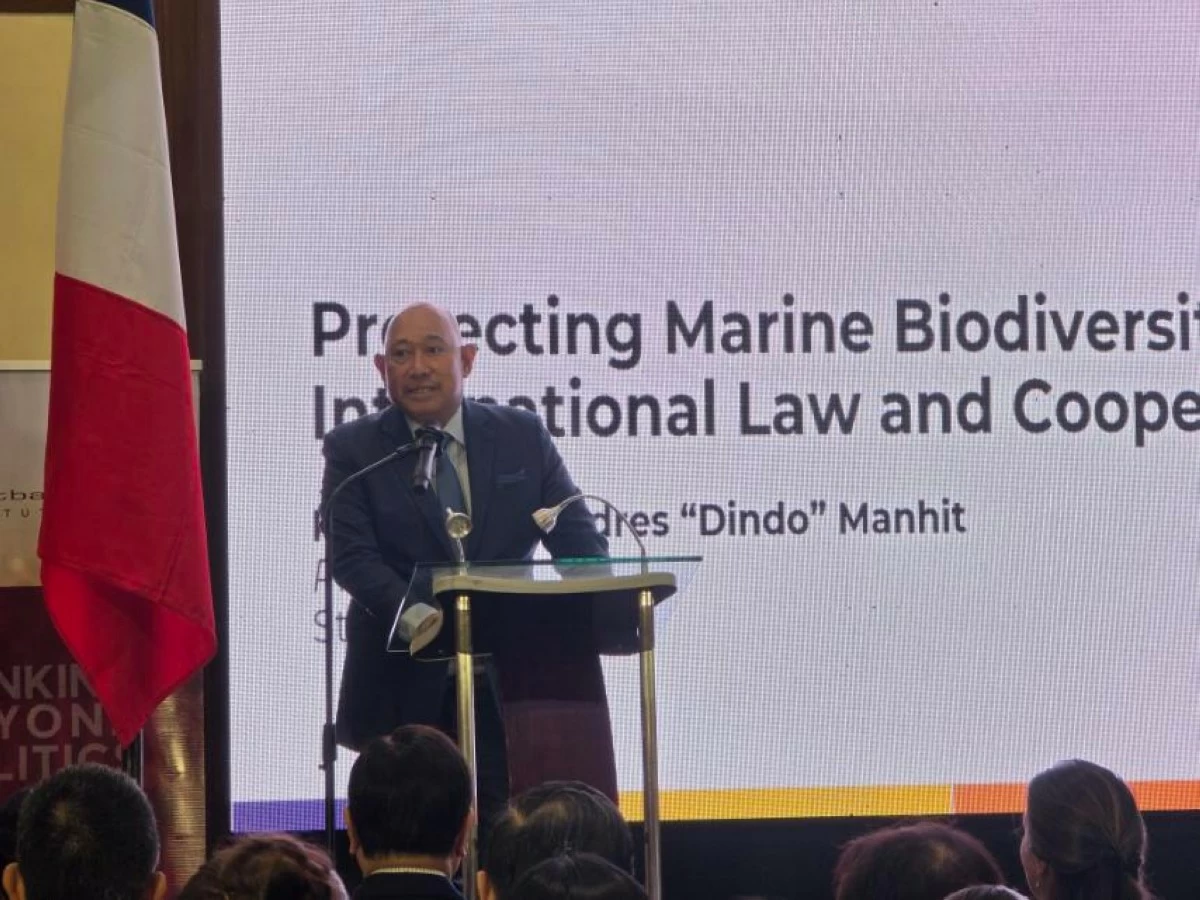
Stratbase Institute President Dindo Manhit says the BBNJ Agreement reinforces the environmental principles established by the 2016 arbitral ruling, stressing the need to translate legal victories into concrete action to protect marine ecosystems in the West Philippine Sea. (Photo from Stratbase)
The arbitral tribunal found that China violated its obligations under UNCLOS by failing to prevent the harvesting of endangered marine species and by causing severe environmental damage through large-scale island-building activities.
Manhit said these findings “made clear that the destruction of coral reefs, the harvesting of endangered marine species, and the degradation of fragile ecosystems are clear violations of international law and are unacceptable under the rules-based international order.”
He added that the BBNJ Agreement strengthens those principles by expanding legal protections for marine biodiversity in international waters.
Carpio warns against acquiescence
Former Senior Associate Justice Antonio Carpio highlighted the treaty's relevance to the South China Sea, noting that approximately one-fourth of its waters are considered high seas.
Carpio pointed out that while China has ratified the BBNJ Agreement, it declared that its ratification was without prejudice to its claims in the South China Sea.
“For China, the High Seas Treaty does not apply to the high seas of the South China Sea,” Carpio said.
He then urged the Philippine government to formally object to China's position to avoid any implication of acquiescence under international law.
“To prevent acquiescence from setting in, the Philippines must timely object to China’s declaration that it has jurisdiction over the high seas in the SCS. We have to file a protest within one year from September 2025,” Carpio said.
“The Philippines must start it because otherwise we will have implicitly acquiesced to it,” he added.
Strengthening ocean protection
Manhit said the arbitral award and the BBNJ Agreement together provide a stronger foundation for protecting marine ecosystems and promoting responsible ocean governance in one of the world's most biodiverse regions.
“The challenge before us is implementation,” Manhit said, noting that the arbitral award must “continue to be defended” and that the BBNJ Agreement “must be translated into concrete action.”
He also highlighted France's role as a key partner in advancing maritime security, marine conservation, and a rules-based order in the Indo-Pacific.
“We believe that the Philippines cannot—and should not—stand alone,” Manhit said. “This is the value of having partners such as France,” he added.
Manhit noted that as an Indo-Pacific resident power, France has been a “steadfast partner of the Philippines in advancing a rules-based maritime order, protecting marine biodiversity, and promoting cooperation for the sustainable governance of our oceans.”
Experts said enforcement of the BBNJ Agreement is particularly important for the Philippines, whose economy, food security, and coastal communities depend heavily on healthy marine resources.
The Philippines became the 65th country to ratify the BBNJ Agreement in 2025, helping bring the treaty into force. The accord supports the global goal of protecting 30 percent of the world's oceans by 2030.
Experts noted that despite the world's growing focus on ocean conservation, less than one percent of the high seas currently enjoy any form of protection.
Officials from both France and the Philippines expressed hope that stronger international cooperation will help preserve marine biodiversity and safeguard the West Philippine Sea for future generations.