

ADVERTISEMENT

Spurs, Thunder set for record-tying fifth Game 7 of the playoffs

Published May 30, 2026 02:33 pm

At A Glance

  • For the fifth time in this year's playoffs, a series is coming down to the ultimate game. San Antonio will visit Oklahoma City on Saturday night, May 30, in Game 7 of the Western Conference finals.
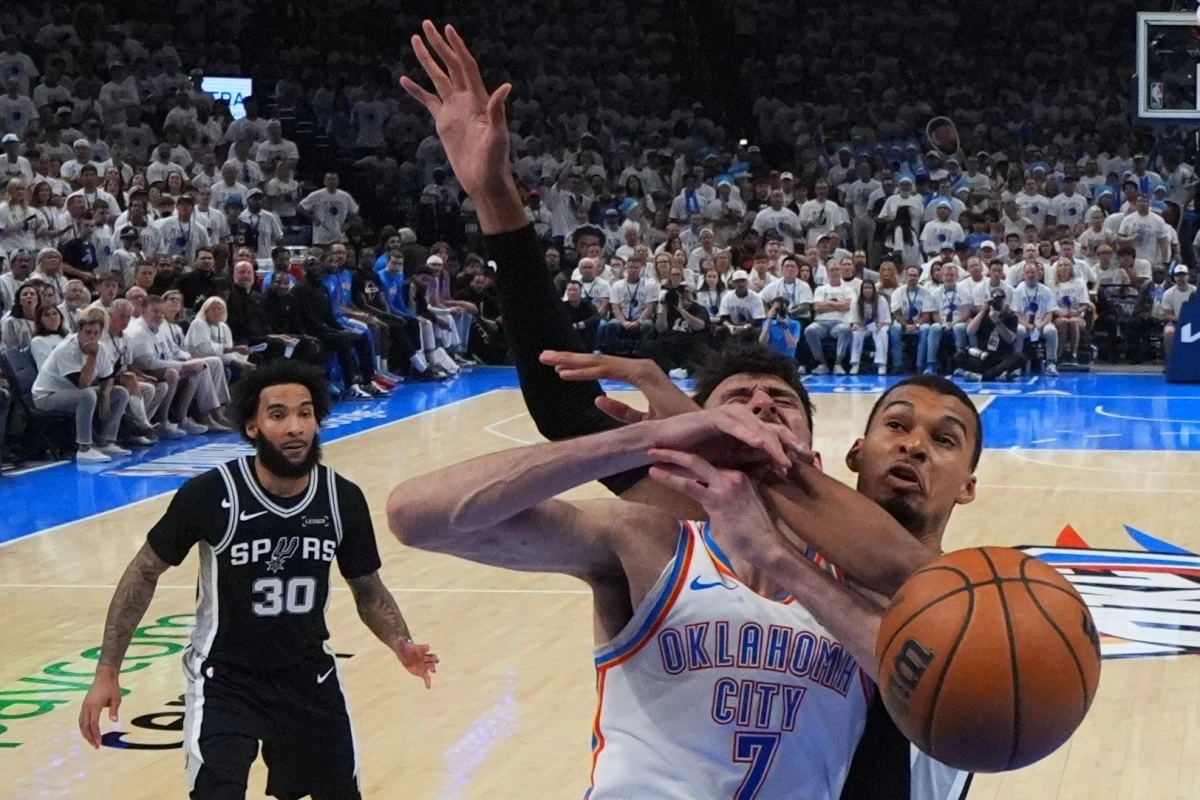
Oklahoma City Thunder center Chet Holmgren (7) shoots against San Antonio Spurs forward Victor Wembanyama (1) in the second half of Game 5 in the Western Conference finals NBA basketball playoffs series, Tuesday, May 26, 2026, in Oklahoma City. (AP Photo/Julio Cortez)
OKLAHOMA CITY (AP) — It is the year of Game 7.
For the fifth time in this year's playoffs, a series is coming down to the ultimate game. San Antonio will visit Oklahoma City on Saturday night, May 30, in Game 7 of the Western Conference finals.
The others this season: Philadelphia beat Boston on the road in Round 1, Cleveland beat Toronto in Round 1, Detroit beat Orlando in Round 1 and Cleveland beat Detroit on the road in Round 2.
The five Game 7s this season tie the most in a single postseason. There also were that many in 1994, 2014 and 2016. And there have never been three instances of Game 7 road winners in the same season; the Spurs will aim to change that on Saturday.
Home teams have gone 117-42 in the previous 159 instances of Game 7s in the NBA playoffs.
Game 7 records
A look at the histories in Game 7 for Oklahoma City and San Antonio, two franchises that have never before gone head-to-head in such a game:
— Thunder, since moving to Oklahoma City: 4-2 overall, 4-0 at home.
The four home wins — the last of which was Game 7 of last season's NBA Finals — were all by double digits and the margin averaged 17.5 points. The two losses were both on the “road,” though one of those was simply classified as a road game because Oklahoma City was lower seeded than Houston when those teams met in the bubble playoffs of 2020.
— Spurs: 4-7 overall, 1-5 on the road.
The lone road Game 7 win in franchise history was at New Orleans in 2008. The Spurs have never played a West finals Game 7 on the road — but played on the road in Game 7 of the Eastern Conference finals in 1979, losing to Washington.
Game 7 birthday matters
Spurs forward Harrison Barnes turns 34 on Saturday. This could be a good sign for San Antonio.
No player has ever appeared in a Game 7 during the NBA playoffs on his birthday and lost. Paul George turned 36 on May 2 and Philadelphia beat Boston. And Barnes has been in this position once before; he turned 24 on May 30, 2016, and his Golden State team beat Oklahoma City.
The other birthday winners of Game 7s:
— Pablo Prigoni turned 35 on May 17, 2015; he and Houston beat the Los Angeles Clippers.
— Udonis Haslem turned 32 on June 9, 2012; he and Miami beat Boston.
— Kevin Garnett turned 28 on May 19, 2004; he and Minnesota beat Sacramento.
— Scott Hastings turned 30 on June 3, 1990; he and Detroit beat Chicago.
— Walt Hazzard turned 24 on April 15, 1966; he and the Los Angeles Lakers beat St. Louis.
The best-of-12 season series
Saturday night will be the 12th matchup between Oklahoma City and San Antonio this season. San Antonio went 7-4 in the first 11 games between the clubs.
Golden State and Houston played 12 times last season between four regular-season games, an additional game tacked on because of the NBA Cup, and then a seven-game playoff matchup in Round 1.
Other than that, the last time — before now — that two teams met 12 times in the same season was 1994-95, when San Antonio and Houston faced off on that many occasions.
The league has used a scheduling model for the last three decades that doesn't have any teams meeting more than four times in the regular season, which capped the total number of head-to-head meetings at 11 even if they went the distance in a seven-game playoff series. But the addition of NBA Cup now makes a 12-game season series possible.
And technically, teams could meet as many as 13 times.
It's theoretically possible for teams to play four regular-season games, plus a fifth time in NBA Cup, then meet in the No. 7 vs. No. 8 game in the play-in tournament, then play a seven-game playoff series.
Regardless, the record for head-to-head meetings will probably never be broken. In 1959-60, the Minneapolis Lakers and St. Louis Hawks played 20 times and in 1960-61, the Los Angeles Lakers played the Hawks 20 more times. The league had only eight teams then and played a 75-game schedule.

Related Tags

San Antonio Spurs Victor Wembanyama OKC Thunder Shai Gilgeous-Alexander NBA Playoffs
ADVERTISEMENT
.most-popular .layout-ratio{ padding-bottom: 79.13%; } @media (min-width: 768px) and (max-width: 1024px) { .widget-title { font-size: 15px !important; } }

{{ articles_filter_1561_widget.title }}

.most-popular .layout-ratio{ padding-bottom: 79.13%; } @media (min-width: 768px) and (max-width: 1024px) { .widget-title { font-size: 15px !important; } }

{{ articles_filter_1562_widget.title }}

.most-popular .layout-ratio{ padding-bottom: 79.13%; } @media (min-width: 768px) and (max-width: 1024px) { .widget-title { font-size: 15px !important; } }

{{ articles_filter_1563_widget.title }}

{{ articles_filter_1564_widget.title }}

.mb-article-details { position: relative; } .mb-article-details .article-body-preview, .mb-article-details .article-body-summary{ font-size: 17px; line-height: 30px; font-family: "Libre Caslon Text", serif; color: #000; } .mb-article-details .article-body-preview iframe , .mb-article-details .article-body-summary iframe{ width: 100%; margin: auto; } .read-more-background { background: linear-gradient(180deg, color(display-p3 1.000 1.000 1.000 / 0) 13.75%, color(display-p3 1.000 1.000 1.000 / 0.8) 30.79%, color(display-p3 1.000 1.000 1.000) 72.5%); position: absolute; height: 200px; width: 100%; bottom: 0; display: flex; justify-content: center; align-items: center; padding: 0; } .read-more-background a{ color: #000; } .read-more-btn { padding: 17px 45px; font-family: Inter; font-weight: 700; font-size: 18px; line-height: 16px; text-align: center; vertical-align: middle; border: 1px solid black; background-color: white; } .hidden { display: none; }
function initializeAllSwipers() { // Get all hidden inputs with cms_article_id document.querySelectorAll('[id^="cms_article_id_"]').forEach(function (input) { const cmsArticleId = input.value; const articleSelector = '#article-' + cmsArticleId + ' .body_images'; const swiperElement = document.querySelector(articleSelector); if (swiperElement && !swiperElement.classList.contains('swiper-initialized')) { new Swiper(articleSelector, { loop: true, pagination: false, navigation: { nextEl: '#article-' + cmsArticleId + ' .swiper-button-next', prevEl: '#article-' + cmsArticleId + ' .swiper-button-prev', }, }); } }); } setTimeout(initializeAllSwipers, 3000); const intersectionObserver = new IntersectionObserver( (entries) => { entries.forEach((entry) => { if (entry.isIntersecting) { const newUrl = entry.target.getAttribute("data-url"); if (newUrl) { history.pushState(null, null, newUrl); let article = entry.target; // Extract metadata const author = article.querySelector('.author-section').textContent.replace('By', '').trim(); const section = article.querySelector('.section-info ').textContent.replace(' ', ' '); const title = article.querySelector('.article-title h1').textContent; // Parse URL for Chartbeat path format const parsedUrl = new URL(newUrl, window.location.origin); const cleanUrl = parsedUrl.host + parsedUrl.pathname; // Update Chartbeat configuration if (typeof window._sf_async_config !== 'undefined') { window._sf_async_config.path = cleanUrl; window._sf_async_config.sections = section; window._sf_async_config.authors = author; } // Track virtual page view with Chartbeat if (typeof pSUPERFLY !== 'undefined' && typeof pSUPERFLY.virtualPage === 'function') { try { pSUPERFLY.virtualPage({ path: cleanUrl, title: title, sections: section, authors: author }); } catch (error) { console.error('ping error', error); } } // Optional: Update document title if (title && title !== document.title) { document.title = title; } } } }); }, { threshold: 0.1 } ); function showArticleBody(button) { const article = button.closest("article"); const summary = article.querySelector(".article-body-summary"); const body = article.querySelector(".article-body-preview"); const readMoreSection = article.querySelector(".read-more-background"); // Hide summary and read-more section summary.style.display = "none"; readMoreSection.style.display = "none"; // Show the full article body body.classList.remove("hidden"); } document.addEventListener("DOMContentLoaded", () => { let loadCount = 0; // Track how many times articles are loaded const offset = [1, 2, 3, 4, 5, 6, 7, 8, 9, 10]; // Offset values const currentUrl = window.location.pathname.substring(1); let isLoading = false; // Prevent multiple calls if (!currentUrl) { console.log("Current URL is invalid."); return; } const sentinel = document.getElementById("load-more-sentinel"); if (!sentinel) { console.log("Sentinel element not found."); return; } function isSentinelVisible() { const rect = sentinel.getBoundingClientRect(); return ( rect.top < window.innerHeight && rect.bottom >= 0 ); } function onScroll() { if (isLoading) return; if (isSentinelVisible()) { if (loadCount >= offset.length) { console.log("Maximum load attempts reached."); window.removeEventListener("scroll", onScroll); return; } isLoading = true; const currentOffset = offset[loadCount]; window.loadMoreItems().then(() => { let article = document.querySelector('#widget_1690 > div:nth-last-of-type(2) article'); intersectionObserver.observe(article) loadCount++; }).catch(error => { console.error("Error loading more items:", error); }).finally(() => { isLoading = false; }); } } window.addEventListener("scroll", onScroll); });

Sign up by email to receive news.