






 Philippines
National
Halo-halo diplomacy: Filipino dessert sweetens Marcos' Japan visit
Philippines
National
Halo-halo diplomacy: Filipino dessert sweetens Marcos' Japan visit
Halo-halo diplomacy: Filipino dessert sweetens Marcos' Japan visit


At A Glance
- President Marcos gifted Japanese Emperor Naruhito a halo-halo glass, spoon, and recipe during his State Visit to Japan.
- Marcos said the Japanese monarch had become fond of halo-halo after trying it at the Philippine Embassy.
- Malacañang said the dessert became a lighthearted symbol of the deepening ties between the Philippines and Japan.
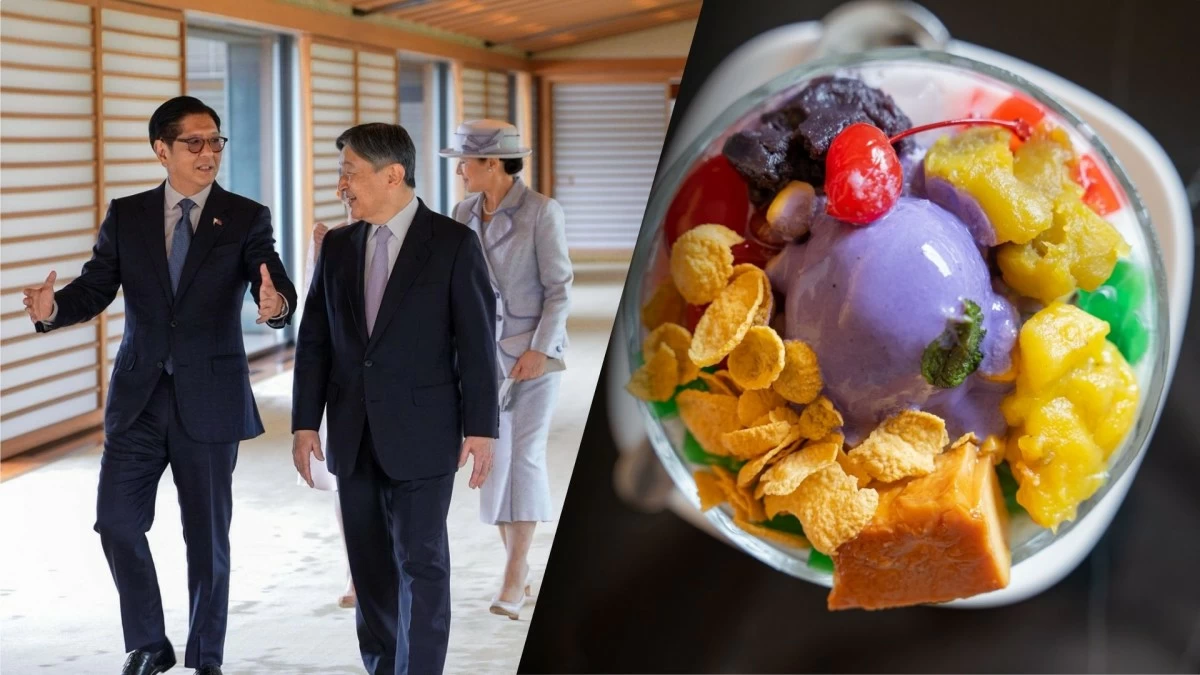
A bowl of halo-halo became an unlikely bridge between the Philippines and Japan during President Marcos’ State Visit to Tokyo after the Filipino dessert reportedly became a favorite of Japanese Emperor Naruhito.
Speaking before the Philippine media delegation in Tokyo, Marcos shared how he learned about the Emperor’s fondness for halo-halo and how it inspired one of the more personal moments of the trip.
According to the President, he was informed that the Japanese monarch ate halo-halo at the Philippine Embassy and ended up loving the dessert.
“So nung narinig ko ‘yon, tinanong ko sa — hanapin niyo yung pinakamagaling na gumawa ng halo-halo padala natin sa Emperor (So when I heard that, I told them: Find the best halo-halo maker and let’s send some to the Emperor),” he said.
However, Marcos said palace protocol prevented the Emperor from consuming food prepared by anyone other than his own staff.
“Ang ginawa namin, pinadala namin. Tapos, sinabi sa amin na hindi puwede. Hindi siya puwedeng kumain ng hindi niluto ng staff niya (We sent it, but we were told it was not allowed. He could not eat food that was not prepared by his staff),” he said.
Instead, Marcos decided to give Emperor Naruhito a traditional halo-halo glass and spoon during their meeting, and a recipe for the traditional Filipino dessert the following day.
“So, ang niregalo ko sa kanya kahapon was yung baso na mahaba tsaka yung kutsara pang-halo-halo (So what I gifted him yesterday was the tall halo-halo glass and the halo-halo spoon),” he said.
“Tapos today binigyan ko siya ng recipe. Sabihin mo sa chef mo na lutuin niya ito (Then today I gave him the recipe. I told him: Tell your chef to prepare this),” he added.
“So ayun, tuwang-tuwa naman siya (And he was very delighted),” he continued.
President Marcos joked that halo-halo had now become part of the “intimate connection” between the Philippines and Japan.
“So yung emperor ng Japan, hindi lang kumakain, paborito ang halo-halo (So the Emperor of Japan does not just eat halo-halo — it is actually his favorite),” he said.
“So, yun ang intimate connection ngayon natin (So that is now our intimate connection),” he added. “Mabuhay ang halo-halo (Long live halo-halo)!”
Warm ties with Imperial Family
President Marcos and First Lady Liza Araneta-Marcos paid a state call and held a subsequent farewell courtesy call on Japanese Emperor Naruhito and Empress Masako at the Imperial Palace in Tokyo. The meetings highlighted the enduring friendship between the Philippines and Japan.
The state call on May 27 featured a formal welcome ceremony, exchange of highest imperial and national decorations, and intimate discussions between the leaders.
Marcos conferred the Order of Lakandula with the rank of Supremo on Emperor Naruhito, while Empress Masako received the Order of Gabriela Silang. The Imperial Couple reciprocated by bestowing Japan’s highest decorations upon the Philippine President and First Lady.
The two couples also shared warm conversations regarding their time studying at Oxford University and their mutual appreciation for classical music.
Emperor Naruhito and Empress Masako also hosted a state banquet for the Philippine First Couple. The banquet was a key event during Marcos’s four-day state visit, which coincided with the 70th anniversary of the normalization of diplomatic ties between the Philippines and Japan.
Approximately 90 guests attended the event, including Japanese Prime Minister Takaichi Sanae and Prince Hisahito.
Marcos used his toast remarks to celebrate Japan’s role as a valued partner in development, security, agriculture, and infrastructure. Naruhito, for his part, expressed gratitude for the meaningful contributions of Filipinos working in Japan, honoring the two nations' enduring friendship.
Following a highly productive summit with Japanese Prime Minister Takaichi, President Marcos and the First Lady held a warm, intimate farewell courtesy visit with the Emperor and Empress.
The Imperial Household Agency reported that Marcos noted at the outset that he personally enjoyed his stay in Japan and was able to achieve significant results in official government talks.
The agency added that Emperor Naruhito expressed regret over the lives lost during the war with the Philippines. He reportedly said he is now pleased to see the two countries forming a great relationship.
Presidential Communications Office (PCO) Acting Secretary Dave Gomez said the warm exchange reflected the deepening friendship between the two countries as they mark 70 years of diplomatic relations this year.
Gomez noted the visible camaraderie between Marcos and Emperor Naruhito during the State Banquet hosted by the Imperial Family.
“At nakakatuwang panoorin ang Pangulo at ang Emperor dahil makikita mo kung gaano na kalalim yung bond (It was heartwarming to watch the President and the Emperor because you could see how deep their bond has become),” he said.
Gomez said Marcos’ State Visit to Japan was only the second State Visit hosted by Emperor Naruhito since the Covid-19 pandemic.
Despite the lighter halo-halo moment, Gomez emphasized that the trip also produced concrete gains in trade, infrastructure, defense, energy, and strategic cooperation between Manila and Tokyo.