






 Philippines
National
Marcos seeks stronger Philippines-Japan ties; pushes upgrade of economic pact
Philippines
National
Marcos seeks stronger Philippines-Japan ties; pushes upgrade of economic pact
Marcos seeks stronger Philippines-Japan ties; pushes upgrade of economic pact


At A Glance
- President Marcos said the Philippines and Japan are now bound by "deep mutual trust" 70 years after restoring diplomatic ties.
- The President called for the modernization of the Philippines-Japan Economic Partnership Agreement (PJEPA).
- Marcos also pushed for deeper cooperation in security, maritime affairs, AI, clean energy, and resilient supply chains.
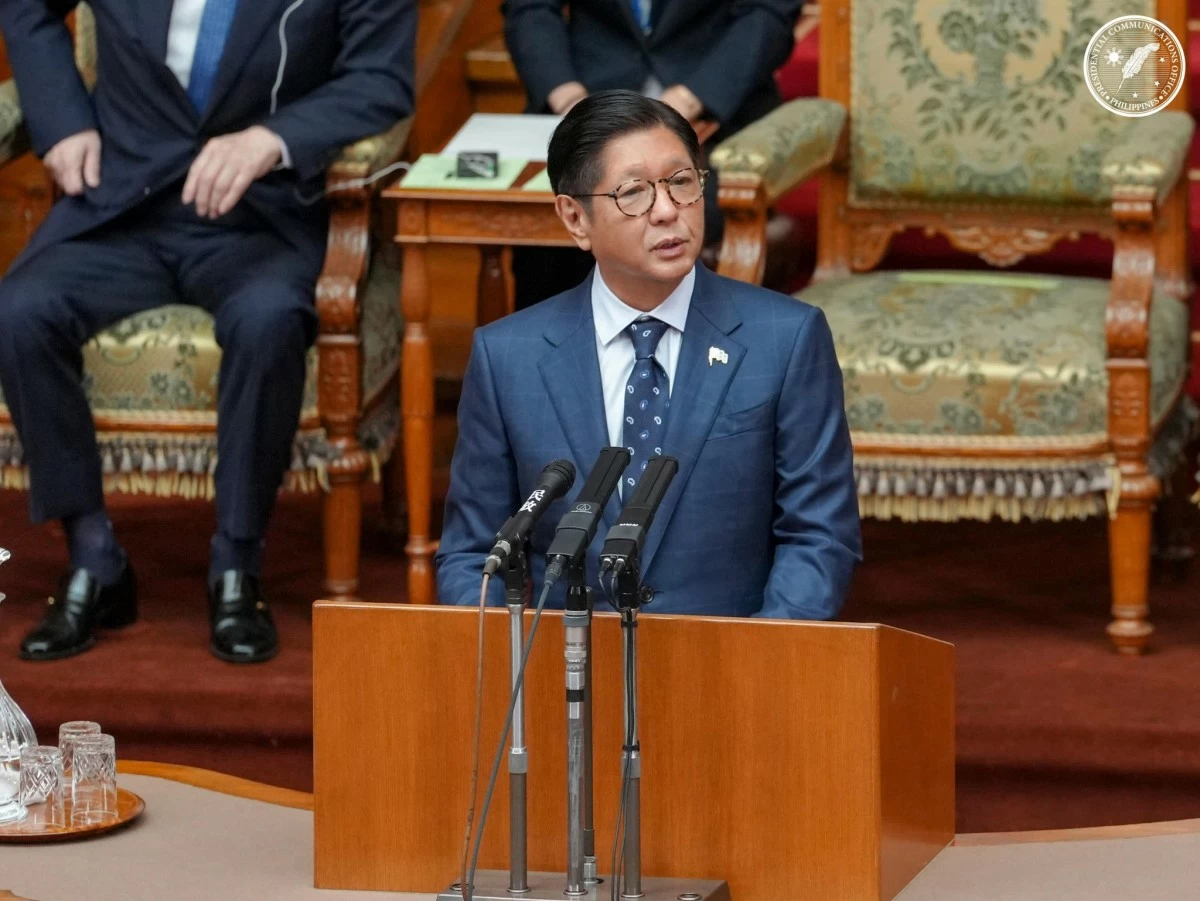
President Marcos has called for stronger Philippines-Japan cooperation and the modernization of the countries’ economic partnership agreement as both nations marked 70 years of normalized diplomatic relations.
Speaking before the National Diet as part of his State Visit in Tokyo, Marcos said the relationship between Manila and Tokyo has evolved from post-war reconciliation into a strategic partnership now driven by “deep mutual trust.”
“The relationship between the Philippines and Japan is, at its core, a story of transformation — from reconciliation to deep mutual trust,” the President said on May 28.
“Seventy years after reconciliation, we have reached a point where mutual trust is no longer just a result of our partnership—it is the very force that drives our relations above and beyond,” he added.
Marcos said Japan remains the Philippines’ leading source of investments and among its top trading partners, while also serving as the country’s largest provider of development assistance.
PJEPA upgrade
The President also pushed for the modernization of the Philippines-Japan Economic Partnership Agreement (PJEPA), saying the deal must evolve alongside changing global economic realities.
“The Philippines-Japan Economic Partnership Agreement, concluded two decades ago, underpins our economic engagement,” he noted.
“As our bilateral cooperation expands into new frontiers, such as digital innovation, energy transition, resilient supply chains, and smart agriculture, we must modernize this framework to meet rapidly evolving geoeconomic realities,” he added.
Marcos stressed the need for both countries to work together to reduce “undue dependencies” and ensure that economic progress would not be disrupted by coercion or instability.
“We must work together to reduce undue dependencies and ensure that progress is not held hostage to disruptions or to coercion,” he said.
Security, maritime cooperation
The President also highlighted growing defense and maritime cooperation between the Philippines and Japan amid tensions in the Indo-Pacific region.
“In an increasingly complex Indo-Pacific, where tensions test the resilience of a rules-based order, our two nations remain unwavering in our commitment to uphold international law, to promote stability, and advocate for the peaceful settlement of disputes,” he said.
Marcos said the Philippines and Japan, as maritime democracies, remain committed to strengthening maritime security and ensuring that seas remain “open, secure, and governed by rules—not by force.”
He also pointed to existing bilateral mechanisms such as the Reciprocal Access Agreement, the Acquisition and Cross-Servicing Agreement, and Japan’s Official Security Assistance Program.
The President likewise noted that the Philippines would mark the 10th anniversary of the South China Sea arbitral ruling in July.
AI, clean energy, space
President Marcos also identified artificial intelligence, clean energy, and space cooperation as emerging areas for deeper bilateral collaboration.
“We see this in our growing multi-sectoral engagement in emerging technologies, including in clean energy, artificial intelligence, and space cooperation—ensuring that innovation serves humanity and supports sustainable and inclusive development,” he said.
The President added that the Philippines and Japan also have significant potential for cooperation in critical minerals, defense industries, and technological advancement.
ASEAN, Indo-Pacific
Marcos said the Philippines and Japan continue to work together within the Association of Southeast Asian Nations (ASEAN) and other multilateral platforms to promote a “free, open, and inclusive Indo-Pacific.”
He also underscored Japan’s longstanding support for peace and development efforts in Mindanao, as well as cooperation on humanitarian assistance, disaster response, and law enforcement.
“As natural partners, whose partnership was founded on shared values and principles, we will continue working hand in hand for our common aspiration for a region that is peaceful, secure, and prosperous,” the President said.