






 Business
Banking & Finance
BPI targets 50 million customers through financial inclusion push
Business
Banking & Finance
BPI targets 50 million customers through financial inclusion push
BPI targets 50 million customers through financial inclusion push


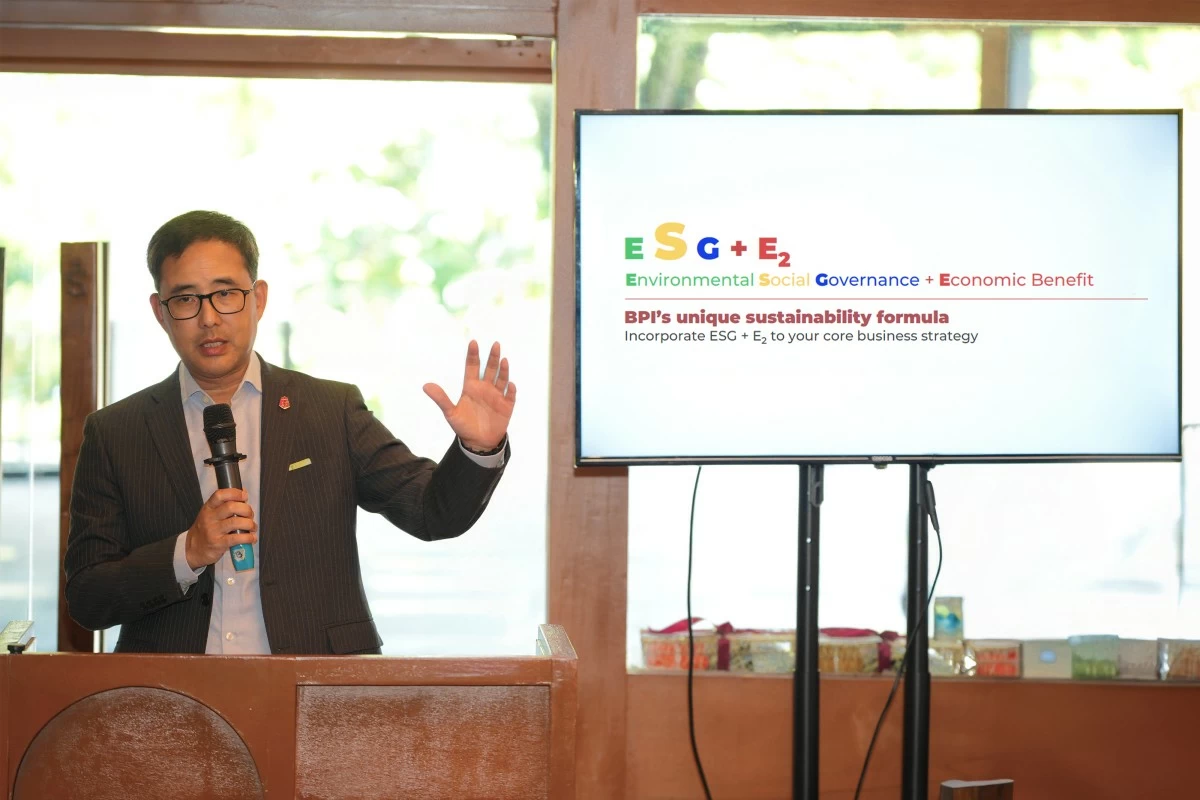
Zobel-led Bank of the Philippine Islands (BPI) is aiming to reach 50 million customers, of which 20 million will be underbanked and underserved Filipinos, as part of its financial inclusion commitment.
In a press conference, BPI Chief Finance Officer (CFO) and Chief Sustainability Officer Eric Roberto M. Luchangco said, “BPI will help advance economic growth by making our banking solutions affordable and accessible to every Filipino.”
While sustainability usually focuses on the environment as part of a company’s environmental, social, and governance (ESG) framework, he said BPI is also focusing on the social aspect as it relates to people, adding that sustainability efforts must also have economic benefit.
“We want to highlight the emphasis on the S… how people really come first, even though E is the first letter of ESG, the S is what we believe that we can truly focus on, which is the people side of it,” he explained.
Thus, Luchangco noted “the spectacular growth that we’ve seen at BPI in our social portfolio. We’ve seen a 400-percent increase in products sold for agents and partner stores and a 100-percent increase in teachers’ loans.”
Through BanKo, BPI’s microfinance arm, and other digital platforms, the bank continues to provide accessible financial solutions tailored for everyday Filipinos, particularly those in far-flung communities and the informal sector.
Legazpi Savings Bank (LSB), a BPI subsidiary, continued to strengthen its commitment to financial inclusion by serving more than 69,000 teachers nationwide.
As of end-2025, LSB doubled its outstanding loan portfolio to ₱15.5 billion, reflecting its sustained support for educators through accessible and responsive financial solutions tailored to their needs.
May BPI Dito, BPI agency banking’s flagship program, further expanded financial access by enabling partner stores to facilitate banking transactions, bringing essential financial services closer to more Filipinos. To date, agency banking has more than 7,000 partner stores nationwide.
In 2025, BPI also disbursed ₱24 billion in microfinance loans to self-employed micro-entrepreneurs (SEMEs) and grew its small and medium enterprises (SMEs) loan portfolio by 80 percent to ₱64 billion in outstanding loans, helping expand livelihood and business opportunities for Filipinos nationwide.
“These really point towards BPI’s commitment towards social side in terms of uplifting the Philippines from a social perspective. In fact, it shows our general desire to make banking services accessible and affordable to all Filipinos, regardless of their economic class or their geographic location,” Luchangco said.
BPI continues to strengthen its commitment to financial inclusion, positioning accessible banking services, financial education, and inclusive economic opportunities as key drivers of sustainable progress for more underserved Filipinos.
Anchored on the bank’s Sustainability Awareness Month (SAM) 2026 theme, “Sustainable Progress for All,” BPI reinforced its mission of building a better Philippines by scaling access to financial services and empowering more Filipinos across the country to participate meaningfully in the formal economy.
“We are committed to creating opportunities that enable more Filipinos to participate confidently in the formal economy and improve their quality of life through accessible and affordable banking,” Luchangco said.
“The heart of SAM is in our wide range of activities throughout June. We have curated a diverse calendar of engagements that bring together industry, communities, and clients—covering financial literacy, sustainability dialogue, and on-the-ground environmental action,” said BPI Public Affairs and Communications Head Maria Elena R. Torrijos.
She noted that “a key strength of this year’s program is the breadth of our partnerships. We are working closely with leading organizations across sustainability, finance, and development sectors.”
“These collaborations allow us to amplify impact, align with global standards, and contribute meaningfully to the broader sustainability ecosystem in the Philippines,” Torrijos noted.