







Sole searching in Marikina City
A shoemaking workshop in Marikina becomes an unexpected lesson on craftsmanship, connection, and finding meaning beyond social media
Published May 14, 2026 04:07 pm


Recent studies show that people around the world are experiencing digital fatigue. More and more are choosing to disconnect from the endless cycle of online consumption in search of a slower and more meaningful way of living. Slowly, especially among the youth, doom scrolling is being replaced by a renewed interest in analog experiences and hands-on hobbies.
(Photo: Risque Manufacturing)
If I were not a journalist, I probably would have left social media already. Constant exposure to carefully curated lives online can quietly plant pressure and self-doubt. There were moments when I found myself questioning my own pace in life while everyone else seemed to be moving ahead. Perhaps that is why I started seeking ways to improve myself outside the internet and away from the exhausting vanity metrics of likes, shares, and comments.
Last year, I enrolled in a makeup artistry certification course at SoFA Design Institute and joined a Google AI class. This year, I found myself searching for another workshop that would allow me to create something tangible with my own hands.
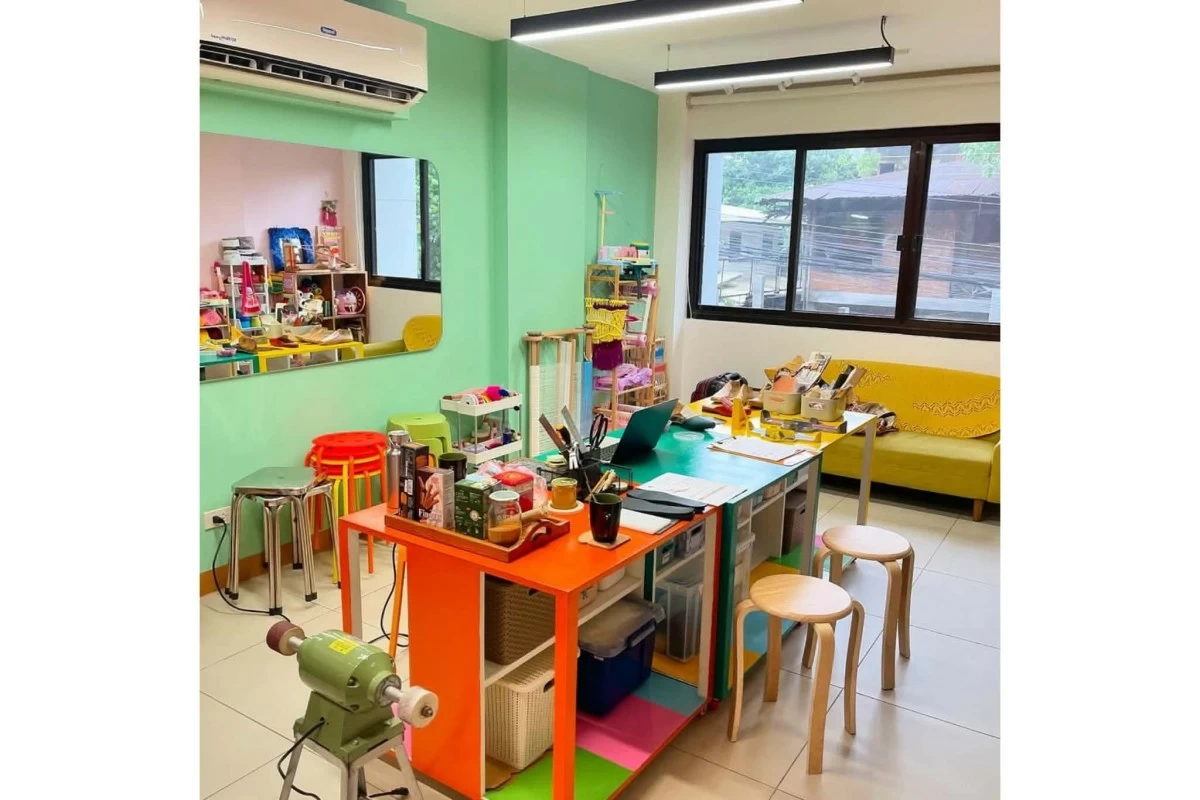
That search led me to Workshop by Tal, a shoemaking workshop in Marikina City headed by educator and Risque Manufacturing founder Tal de Guzman. More than simply teaching people how to make shoes, the workshop introduces participants to the artistry, labor, and stories behind one of the country’s proudest crafts.
The workshop offers different levels depending on your experience. Beginners can start with Level 0, a basic sandal-making class that lasts around three to four hours. By the end of the session, students go home with a comfortable pair of sandals they made themselves.
I enrolled in Level 1, the prerequisite for those who want to pursue higher courses. Unlike the shorter introductory class, this one took an entire Saturday, running from 10 a.m. to 6 p.m. Each student was tasked to design and create their own pair of mules from scratch.
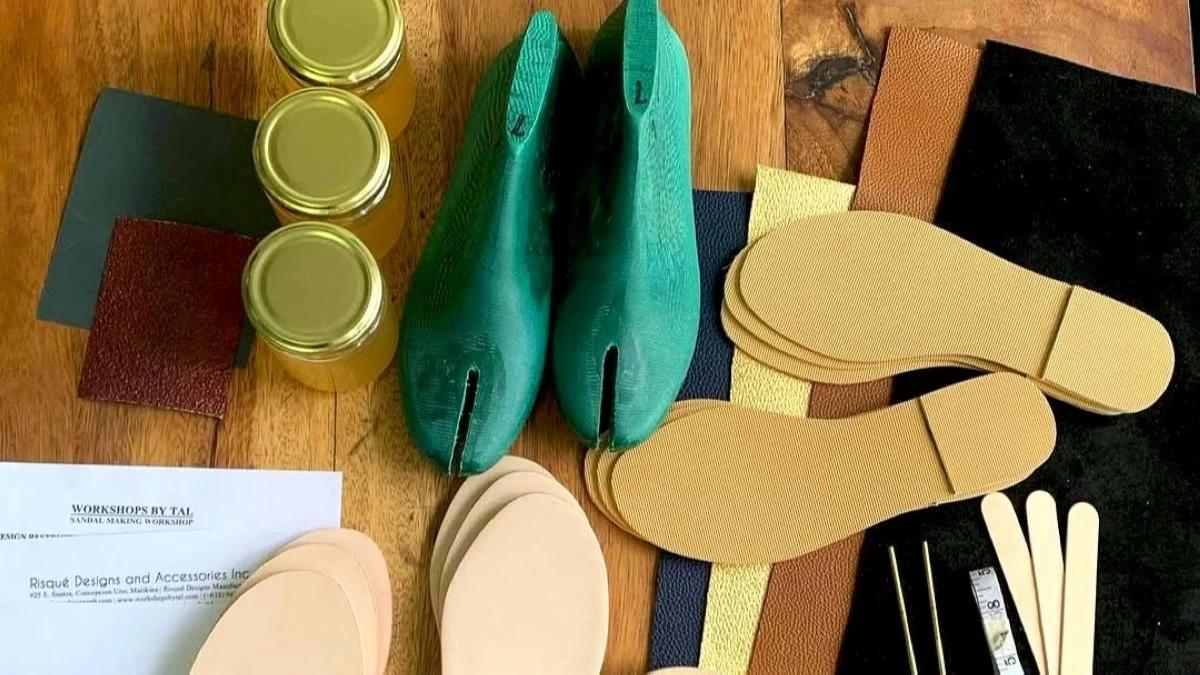
To make the process even more meaningful, Tal encouraged us to combine leather with local weaves. Before we even began sketching designs, she patiently introduced us to different materials and explained the stories behind each weave. There were so many textures, colors, and patterns to choose from that selecting one became an experience in itself.
(Photo: Risque Manufacturing)
Before the actual shoemaking began, Tal familiarized us with the tools of the trade, from cobbler’s hammers and lasting pliers to shoe lasts molded according to size. She shared that Filipino shoemakers have their own local terminologies for these tools, hundreds of them, in fact, and revealed that she is currently working on a book documenting these terms.
Then came the real work.
Tal moved around the room, guiding each student one by one. There were eight of us in class that day. Five were foreigners working at the US Embassy. Two were married doctors, an OB-GYN and a radiologist. Then there was I, a journalist quietly trying to figure things out in life.
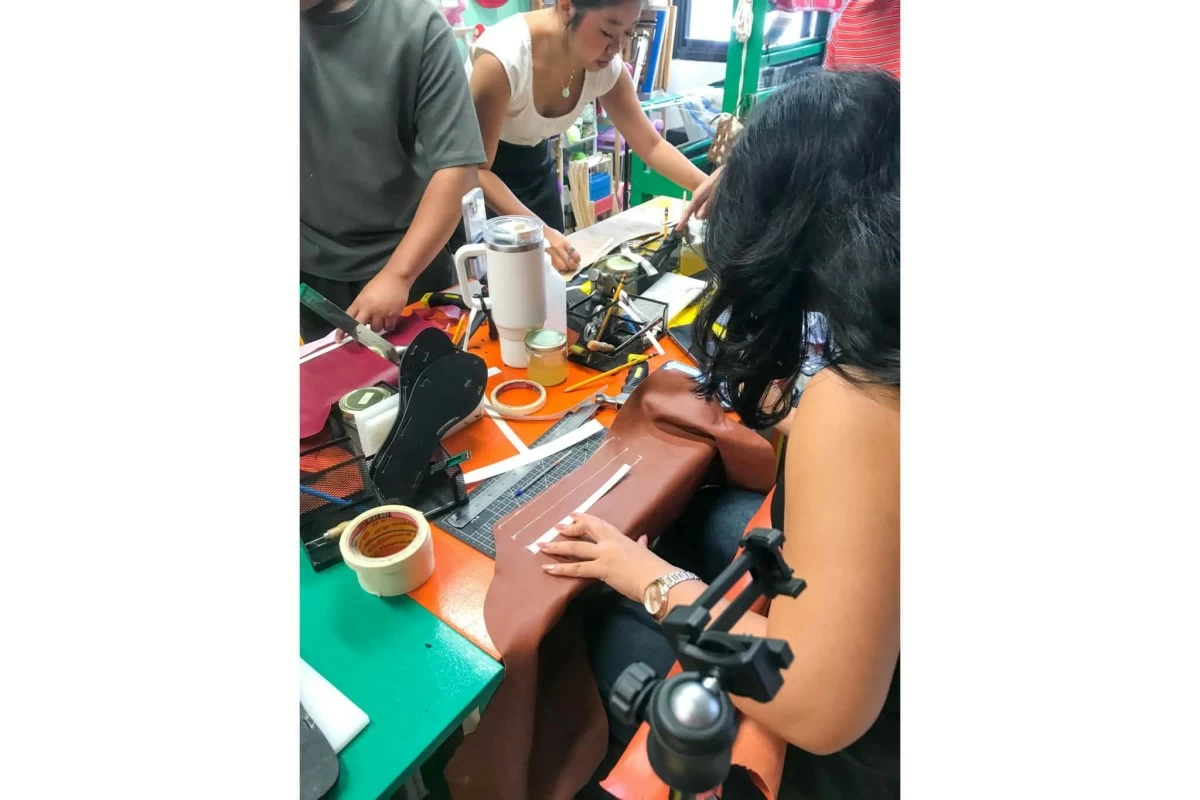
As we traced patterns, cut leather, and pieced together our designs, I found myself entering a strange but calming rhythm. My hands stayed busy while conversations naturally flowed around the room. We talked about our professions, our personal struggles, and what brought us to the workshop in the first place.
It made me realize how rare genuine conversations have become. In a world where introductions often begin with social media profiles and silent judgments, workshops like this create space for people to connect without preconceived notions. Here, conversations started not with followers or job titles but with shared curiosity and the willingness to learn something new.
One of the most memorable parts of the workshop was pulling and stretching the leather over the shoe last, which acts as a mold. Several staff members from Risque Manufacturing stepped in to guide us through the physically demanding process. That was when I met Kuya Ariel.
As he taught me how to carefully pull and smooth the leather before securing it with nails, we began talking. He told me he had been a shoemaker for more than 40 years and that the craft had sent his children to school.
When I asked whether he wanted his children to continue the trade, he quickly answered no. There was pain in his honesty. He spoke about how fast fashion, large corporations, and the lack of government support continue to weaken the shoemaking industry in Marikina City. Some of his fellow shoemakers, he shared, had already lost their jobs.
Then there was Ate Neth, who has worked on sewing machines for more than two decades. Inside the hot factory, she continued stitching materials together with quiet precision despite the summer heat.
(Photo: Risque Manufacturing)
At one point, while smoothing the leather’s surface, I realized that every finished pair of shoes carries invisible sacrifices beneath it. Behind every polished exterior are calloused hands, exhaustion, patience, and years of labor that most people never get to see.
And then came another lesson.
After hammering more than 25 nails into each shoe and waiting for the glue to dry, we were told to pull every single nail out again. I remember staring at my pair in disbelief. All that effort, only for the nails to be removed in the end.
But perhaps life works that way, too. Some difficult processes are necessary not because they are permanent, but because they shape us into something stronger before eventually letting go.
As the workshop neared its final stages, everyone moved with renewed energy. Tal instructed us through the finishing touches while the staff helped assemble the final details. By the end of the day, all eight of us had successfully finished our pairs. Proud of what we had accomplished, Tal gathered us together for a class photo.
I went home that evening carrying more than just a new pair of handmade shoes.
I came home with a deeper appreciation for Filipino shoemakers, for craftsmanship, and for the quiet beauty of creating something slowly with your own hands. But more than anything, I left with a renewed appreciation for life beyond the screen.