






Manila Bulletin
 Philippines
National
Philippines, Paraguay ink diplomatic training, visa-waiver agreements; Marcos' Paraguay visit eyed
Philippines
National
Philippines, Paraguay ink diplomatic training, visa-waiver agreements; Marcos' Paraguay visit eyed
Philippines
National
Philippines, Paraguay ink diplomatic training, visa-waiver agreements; Marcos' Paraguay visit eyed
Philippines, Paraguay ink diplomatic training, visa-waiver agreements; Marcos' Paraguay visit eyed
Published May 11, 2026 01:15 pm


At A Glance
- The Philippines and Paraguay signed agreements on diplomatic training and visa-free travel for ordinary passport holders.
- President Marcos said he hopes to visit Paraguay after President Santiago Peña Palacios' historic Manila trip.
- The two leaders also discussed trade, agriculture, renewable energy, and ASEAN-MERCOSUR ties.
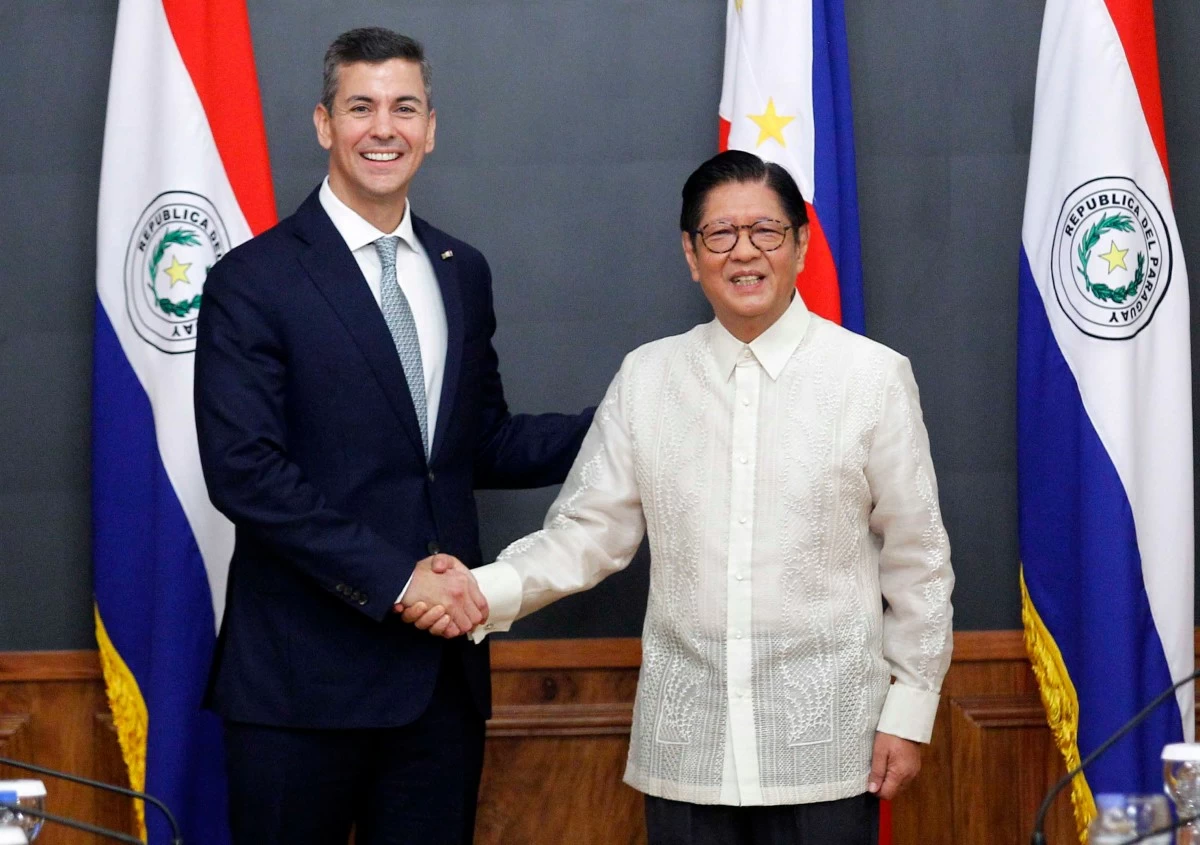
President Ferdinand 'Bongbong' Marcos Jr. and Paraguayan President Santiago Peña Palacios shake hands prior to their bilateral meeting in Malacañan on May 11, 2026. (Mark Balmores)
The Philippines and Paraguay have signed agreements on diplomatic training cooperation and visa-free travel, as both countries look forward to having President Marcos and his delegation visit Paraguay “in the near future.”
Speaking during a joint press statement in Malacañang, Marcos described Paraguayan President Santiago Peña Palacios’ trip to Manila as historic, noting that it marked the first presidential visit between the two countries since diplomatic relations were established in 1962.
“Since Paraguay has taken the first step, I think it is important that the Philippines soon return the favor,” Marcos said on Monday, May 11.
Peña, for his part, expressed optimism about future Philippines-Paraguay relations and invited Marcos to visit the Latin American country.
“We are looking forward to respond to this in the near future with a possible visit of yourself and your delegation,” Peña said.
The Paraguayan leader likewise said that his visit to the Philippines is beyond protocol as it carries "historic significance" that cannot be overlooked.
“It is the clearest expression of the political will of both governments to inaugurate a new phase in our bilateral relations, grounded in shared principles and values such as mutual respect, the rule of law, and a commitment to the economic development of our peoples,” he said.
“I have the confidence that we both came to this first meeting with high expectations. But I'm leaving this great nation with even greater expectations about the future of our two nations and our people,” he added.
Agreements signed
The two leaders witnessed the signing of an agreement waiving visa requirements for holders of ordinary passports and a memorandum of understanding on diplomatic training cooperation between the two countries’ foreign ministries.
According to the agreement, the visa waiver arrangement aims to facilitate business, tourism, and people-to-people exchanges between Filipinos and Paraguayans.
The diplomatic training memorandum of understanding (MOU), meanwhile, seeks to strengthen cooperation through training, skills development, information exchange, and academic cooperation projects involving diplomats from both countries.
The two agreements were signed by Department of Foreign Affairs (DFA) Secretary Ma. Theresa Lazaro and Paraguayan Minister of Foreign Affairs Rubén Ramírez Lezcano.
Trade, agriculture discussed
During their joint press statement, President Marcos said bilateral talks also covered agriculture, trade, renewable energy, and investment opportunities.
He said he raised the possibility of exporting Philippine products such as tuna, sardines, and milkfish to Paraguay to help boost local industries.
Peña, for his part, welcomed the Philippines’ opening of its market to Paraguayan beef, pork, and poultry imports, saying the first shipment had already arrived in the country.
“We aspire for this trade flow to expand and diversify in a sustained manner,” he said.
The Paraguayan leader also said his country hopes to expand exports of grains, maize, oilseeds, and agro-industrial products to support Philippine food security needs.
ASEAN-MERCOSUR ties
The two leaders also discussed strengthening ties between the Association of Southeast Asian Nations (ASEAN) and the South American trade bloc MERCOSUR (Mercado Comun del Sur/Southern Common Market).
Peña noted that Paraguay currently holds the presidency of MERCOSUR while the Philippines chairs ASEAN this year.
“This convergence is not coincidental. It is an opportunity that we must face with determination,” Peña said.
The Paraguayan president also announced that Paraguay had formally conveyed its intention to accede to the Treaty of Amity and Cooperation in Southeast Asia (TAC).
‘Gateway’ nations
President Marcos said discussions revealed “remarkable parallels” between the Philippines and Paraguay, particularly in how both countries see themselves as gateways to their respective regions.
“The Philippines views itself as a gateway to Asia and Paraguay a gateway to Latin America,” Marcos said.
“And that connection, should we make it and should we strengthen it, will be a remarkable boon not only to your country and mine, but also to the regions from where we come from,” he added.
Marcos referred to the Philippines as the only Latin country in Asia, which Peña has acknowledged.
“As the only country in Asia with Latino roots, I have no doubt that the role that you can play as a leader of this region will be fundamental for bringing together two regions that share a lot in terms of expectations about the future,” Peña said.