






Manila Bulletin
 Philippines
National
₱2.7-B in cash assistance for drivers in crisis could have been lost without stricter validation — DSWD
Philippines
National
₱2.7-B in cash assistance for drivers in crisis could have been lost without stricter validation — DSWD
Philippines
National
₱2.7-B in cash assistance for drivers in crisis could have been lost without stricter validation — DSWD
₱2.7-B in cash assistance for drivers in crisis could have been lost without stricter validation — DSWD
Published Apr 23, 2026 05:14 pm


DSWD
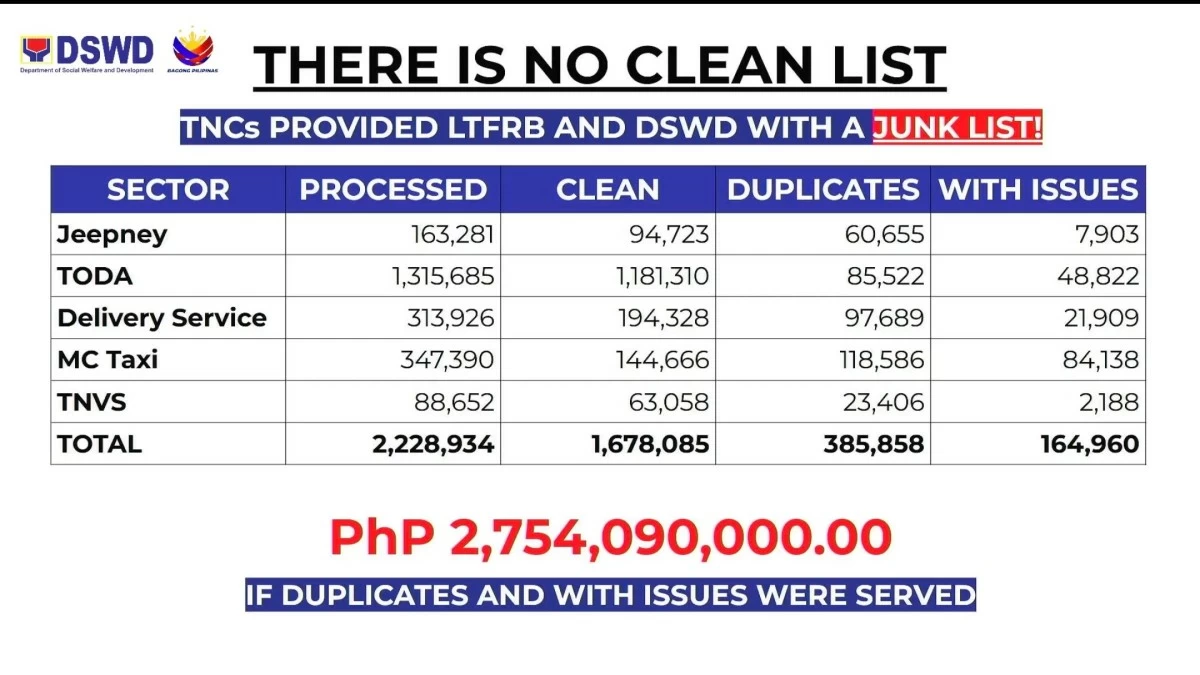
The Department of Social Welfare and Development (DSWD) said as much as ₱2.7 billion in financial assistance for transport network vehicle service (TNVS), motorcycle taxi, and delivery drivers could have been lost to duplicate or questionable entries if payouts were coursed through e-wallets without stricter validation.
DSWD Secretary Rex Gatchalian said the decision to conduct physical payouts in the initial round of cash relief assistance was driven by the need to verify the identities and eligibility of beneficiaries, amid what he described as flawed beneficiary lists submitted by transport network companies (TNCs).
The agency has so far distributed P5.33 billion in cash relief to 1,067,976 drivers in crisis nationwide, out of the ₱30-billion fund allocated for the program. Each beneficiary received ₱5,000.
“We are not averse to using e-wallets in DSWD. In fact, our other programs, like 4Ps, already have e-wallets,” Gatchalian said in a press briefing on Thursday, April 23.
“Now, why don’t we use e-wallets in this round? Because we need to verify and validate, first, are the people we are talking about real? Second, are they real drivers? Because in this scenario, we are not the ones making the list,” he added.
According to Gatchalian, the lists provided by TNCs contained errors, missing details, and a significant number of duplicate entries.
“If you look at the submission, there are more than 385,000 duplicates,” he said, noting that this could have translated to an estimated ₱2.7 billion in losses had the funds been directly transferred through e-wallet platforms.
He said inconsistencies in the data ranged from variations in names, such as the presence or absence of suffixes, to identical names with missing middle initials or differing birthdates, making it difficult to determine whether entries referred to one individual or multiple people.
In some cases, identical names shared the same birthday but appeared twice in submissions, while others had the same name but different birthdates.
There were also beneficiaries listed despite being inactive drivers or currently working abroad.
“Almost 20 percent are not claiming assistance for various reasons. Because they are duplicated, because they are not active, because some are in other countries,” Gatchalian said.
He added that some registered riders were seafarers who only become active drivers when in the country.
“Around ₱2.7 billion worth of financial assistance might have gone to ghost riders, ghost drivers, duplicates. That’s how big it is,” he reiterated.
The DSWD chief said physical verification at payout sites allows the agency to confirm whether beneficiaries are real individuals and active drivers, including checking for valid driver’s licenses.
“For us to be able to do a good payout, the list should also be clean,” he said.
Gatchalian pointed out that the DSWD is considering e-wallets in succeeding rounds once data issues are resolved.
Long queues, misinformation
The DSWD chief also acknowledged logistical challenges during the special payout in Metro Manila on April 18-19, where four major sites were set up.
These were located at the Caloocan Sports Complex (serving drivers from Caloocan, Malabon, Navotas, and Valenzuela City); Makati Coliseum (serving drivers from Makati, Mandaluyong, Manila, and Pasay City); Mercado del Lago in Taguig (serving drivers from Las Piñas, Muntinlupa, Parañaque, Taguig, and Pateros); and Quezon City Memorial Circle (serving drivers from Marikina, Pasig, San Juan, and Quezon City).
Gatchalian said DSWD had initially projected that 60,000 to 80,000 drivers would claim assistance over two days.
However, turnout exceeded expectations due to a combination of factors, including misinformation and beneficiaries arriving outside their scheduled times.
Gatchalian said some drivers who had already received assistance returned to queue again, while others showed up despite not being included in the official list released ahead of the payout.
He also noted that some beneficiaries arrived as early as 2 a.m., even though distribution only began at 7 a.m., contributing to long queues.
In one payout site in Taguig, he said many drivers converged at a single location despite advisories to stagger their visits across the two-day period.
“We were fighting misinformation, that’s why so many came that day. We are not saying that the department is perfect. We could have done better,” Gatchalian said.