






 Business
The Stock Market
Philippine real estate market running out of gas after facing 6 crises in 7 years
Business
The Stock Market
Philippine real estate market running out of gas after facing 6 crises in 7 years
Philippine real estate market running out of gas after facing 6 crises in 7 years


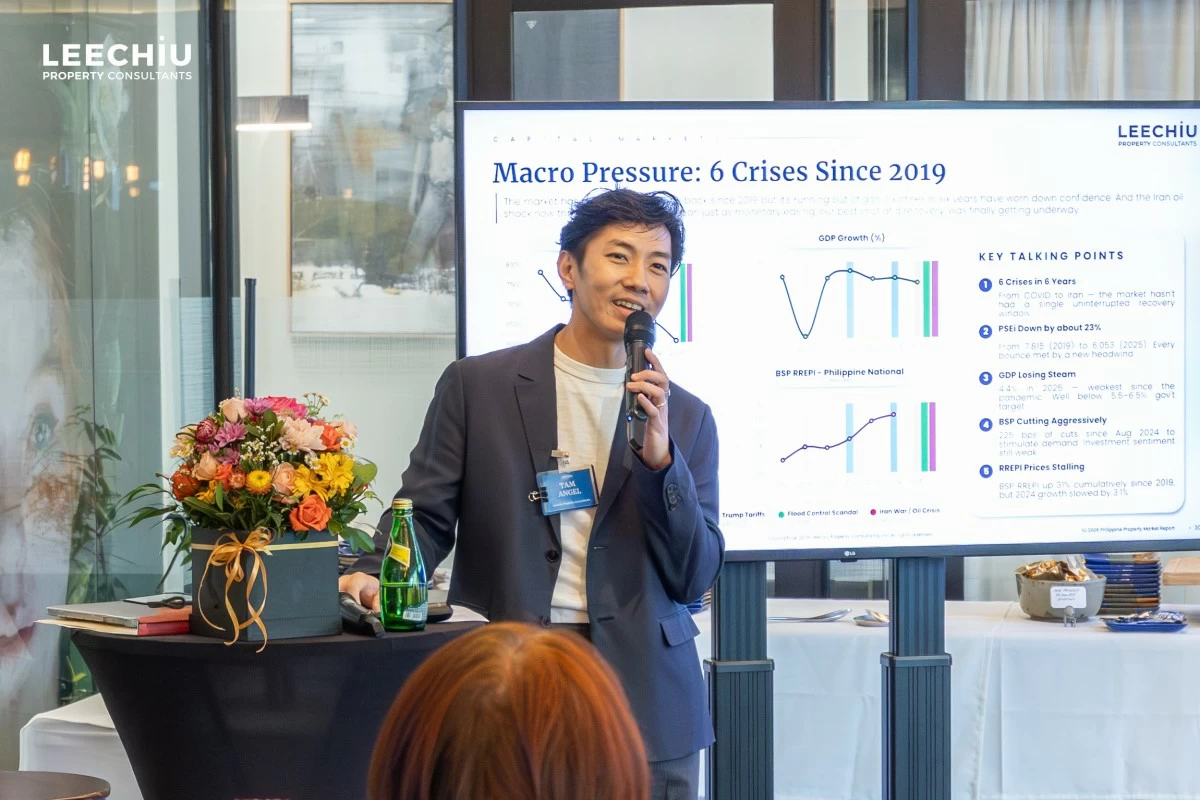
While the local real estate market has demonstrated remarkable resilience through six consecutive crises since 2019, Leechiu Property Consultants (LPC) warns that it is now running out of gas because of the Iran war.
“The market has been clawing its way back since 2019, but it is running out of gas. The Iran oil shock now threatens to reignite inflation just as monetary easing—our best shot at a recovery—was finally getting underway,” said LPC director of investment sales Tam Angel.
He noted, however, that while the market is running out of gas, “the engine is sound. The fundamentals that made 2019 a great year are still here, just buried under six layers of crisis.”
Office and residential demand showed signs of recovery in the first quarter of 2026, but the Iran oil shock threatens the Bangko Sentral ng Pilipinas’ (BSP) easing cycle, prompting LPC to urge investors to lock in financing now.
Since 2019—the last uninterrupted year for Philippine real estate—the market has endured six consecutive external and domestic shocks: the Covid-19 pandemic in 2020, the Ukraine war and inflation spike in 2022, the Philippine offshore gaming operators (POGO) ban in 2024, Trump tariffs in January 2025, the flood-control scandal in mid-2025, and the Iran war and Strait of Hormuz closure in February 2026.
Key macro indicators reflect the cumulative damage. The Philippine Stock Exchange index (PSEi) has declined 23 percent from its 2019 level of 7,815 to 6,053. Gross domestic product (GDP) growth slowed to 4.4 percent in 2025, the weakest since the pandemic, while the BSP residential real estate price index (RREPI), now residential property price index (RPPI), growth decelerated from 8.5 percent to 1.9 percent, essentially flat after inflation.
LPC highlighted that the Iran crisis differs from the previous five shocks in four critical ways. First, it physically cuts the supply line through the Strait of Hormuz, which carries 20 percent of global oil.
Since the Philippines imports 98 percent of its fuel, primarily from the Middle East, the government has declared a state of national energy emergency—a first for any of the six crises.
Second, it hits every Filipino consumer simultaneously, as gasoline prices have surged 63 percent and diesel 146 percent since the conflict began. These increases flow directly into transport fares, electricity bills, and food costs within weeks.
Third, it threatens the overseas Filipino workers (OFWs) lifeline, since about 1.1 million Filipinos work in the Middle East. As of April 2026, 4,200 have been repatriated, 40,000 are affected by deployment bans, and LPC estimates a potential $3.5 billion to $4 billion annual hit to remittances—a direct threat to household consumption and real estate purchasing power.
Fourth, it neutralizes the recovery tool. The BSP has cut rates by 225 basis points (bps) since August 2024, bringing the key policy rate to 4.25 percent. However, the central bank has raised its 2026 inflation forecast to 5.1 percent, and S&P expects a 25-bp hike later this year.
While the real estate sector’s recovery was underway at the start of the year, LPC’s proprietary data now shows mixed signals across sectors.
In the office market, first-quarter 2026 net demand surged 70 percent year-on-year, with vacated spaces down 62 percent, but Metro Manila office vacancy remains at 17.8 percent, with about 800,000 square meters (sqm) of pipeline supply. The trajectory is positive, but normalization will take two to three more years.
In the residential market, first-quarter 2026 demand recovered to 7,700 units, up 19 percent year-on-year. However, 81,000 unsold condominium units represent 31 months of supply, while rental yields have compressed to 3.8 percent for primary and 4.6 percent for secondary markets, as borrowing costs remain at seven to eight percent.
Angel said, however, that the market still has structural advantages unique to the Philippine market: prices have not crashed, the market is 95-percent locally owned, the country has the youngest population in Asia, and the consumption engine remains intact—although the Iran oil shock could reduce remittances by up to $4 billion annually and push inflation above the BSP’s two- to four-percent target range.
LPC identified industrial and retail as the standout sectors through all six crises. Industrial rents have risen 45 percent since 2019, while the top three retail developers posted ₱61.1 billion in first-half 2025 revenue, up 7.5 percent year-on-year, with LPC’s outlook positive for both the short and long term.