ADVERTISEMENT

Oil firms agree to spread record price hikes over 3 to 7 days

Published Mar 9, 2026 02:26 pm
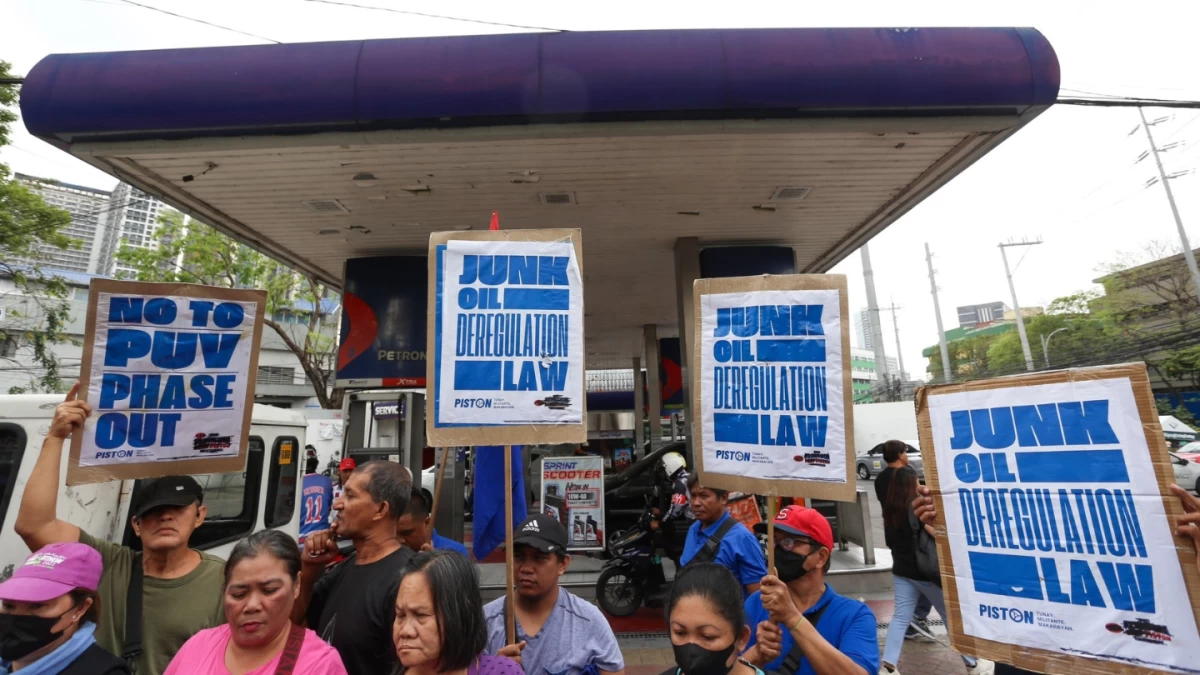
Members of the transport group PISTON lead a protest at a gas station along East Avenue, Quezon City, on Monday, March 9, 2026. The group is demanding the immediate removal of Value Added Tax (VAT) and excise tax on petroleum products to cushion the impact of a historic “price shock” scheduled for Tuesday. With diesel prices projected to jump by as much as ₱24.25 per liter due to escalating Middle East tensions, drivers warn that the looming hikes will severely deplete the daily earnings of public utility vehicle operators. (Photo by Santi San Juan | MB)
Consumers are facing the prospect of the largest fuel price increases on record as an intensifying conflict in the Middle East roils global energy markets and threatens supply stability through the Strait of Hormuz.
The Department of Energy (DOE) on Monday warned of a looming “price shock” for petroleum products, with kerosene leading the surge. Prices for the lighting and cooking fuel are projected to rise by ₱32 to ₱38.50 per liter, the steepest adjustment among the three main fuel categories.
Diesel prices are expected to climb by ₱17.50 to ₱24.25 per liter, while gasoline is set for a spike between ₱7 and ₱13 per liter.
To prevent a “one-time, big-time” financial blow to consumers, Energy Secretary Sharon Garin announced that several major retailers—including Shell Pilipinas Corp., Petron Corp., Chevron Philippines Inc., Jetti Petroleum Inc., and Seaoil Philippines Inc.—have agreed to implement the hikes in a staggered manner.
Chevron and Jetti will spread the increases over the longest periods of seven and six days, respectively, while other firms will adjust prices over two to three days.
The adjustments are scheduled to begin Tuesday, March 10. While the staggered approach aims to temper the blow, the initial round of hikes will be the most severe.
On the first day of the new pricing regime, gasoline is expected to trade between ₱60.90 and ₱66.40 per liter. Diesel could range from ₱63 to as high as ₱82.39 per liter, a level that analysts say leaves public utility vehicle operators particularly vulnerable to margin compression. Kerosene prices are forecast to leap into a range of ₱92.17 to ₱122.67 per liter.
Under the Philippines’ Oil Deregulation Law, the government has limited authority to intervene in pricing, as private firms are permitted to set rates based on international benchmarks.
Garin said that while domestic fuel inventories remain stable, the use of a replacement cost pricing system means consumers will feel the impact of global volatility almost immediately.
Under this system, companies calculate prices based on what it would cost to replenish their stock at current market rates rather than the historical cost of existing inventory.
“As a practice now, we compute it using the historical weekly average,” Garin said. “That average is what we assume as the cost of purchasing new stock. They don’t actually fix the price on the date of delivery; it’s based on the replacement cost of the stocks.”
To bolster energy security, the DOE is moving to diversify its supply chain by seeking importers outside the Middle East.
Garin identified potential sources including Brazil, Venezuela, the US, Canada, India, and Africa.
While the outlook for the coming week remains negative, the DOE expects prices to normalize once geopolitical tensions subside and global crude benchmarks retreat.
ADVERTISEMENT
.most-popular .layout-ratio{ padding-bottom: 79.13%; } @media (min-width: 768px) and (max-width: 1024px) { .widget-title { font-size: 15px !important; } }

{{ articles_filter_1561_widget.title }}

.most-popular .layout-ratio{ padding-bottom: 79.13%; } @media (min-width: 768px) and (max-width: 1024px) { .widget-title { font-size: 15px !important; } }

{{ articles_filter_1562_widget.title }}

.most-popular .layout-ratio{ padding-bottom: 79.13%; } @media (min-width: 768px) and (max-width: 1024px) { .widget-title { font-size: 15px !important; } }

{{ articles_filter_1563_widget.title }}

{{ articles_filter_1564_widget.title }}

.mb-article-details { position: relative; } .mb-article-details .article-body-preview, .mb-article-details .article-body-summary{ font-size: 17px; line-height: 30px; font-family: "Libre Caslon Text", serif; color: #000; } .mb-article-details .article-body-preview iframe , .mb-article-details .article-body-summary iframe{ width: 100%; margin: auto; } .read-more-background { background: linear-gradient(180deg, color(display-p3 1.000 1.000 1.000 / 0) 13.75%, color(display-p3 1.000 1.000 1.000 / 0.8) 30.79%, color(display-p3 1.000 1.000 1.000) 72.5%); position: absolute; height: 200px; width: 100%; bottom: 0; display: flex; justify-content: center; align-items: center; padding: 0; } .read-more-background a{ color: #000; } .read-more-btn { padding: 17px 45px; font-family: Inter; font-weight: 700; font-size: 18px; line-height: 16px; text-align: center; vertical-align: middle; border: 1px solid black; background-color: white; } .hidden { display: none; }
function initializeAllSwipers() { // Get all hidden inputs with cms_article_id document.querySelectorAll('[id^="cms_article_id_"]').forEach(function (input) { const cmsArticleId = input.value; const articleSelector = '#article-' + cmsArticleId + ' .body_images'; const swiperElement = document.querySelector(articleSelector); if (swiperElement && !swiperElement.classList.contains('swiper-initialized')) { new Swiper(articleSelector, { loop: true, pagination: false, navigation: { nextEl: '#article-' + cmsArticleId + ' .swiper-button-next', prevEl: '#article-' + cmsArticleId + ' .swiper-button-prev', }, }); } }); } setTimeout(initializeAllSwipers, 3000); const intersectionObserver = new IntersectionObserver( (entries) => { entries.forEach((entry) => { if (entry.isIntersecting) { const newUrl = entry.target.getAttribute("data-url"); if (newUrl) { history.pushState(null, null, newUrl); let article = entry.target; // Extract metadata const author = article.querySelector('.author-section').textContent.replace('By', '').trim(); const section = article.querySelector('.section-info ').textContent.replace(' ', ' '); const title = article.querySelector('.article-title h1').textContent; // Parse URL for Chartbeat path format const parsedUrl = new URL(newUrl, window.location.origin); const cleanUrl = parsedUrl.host + parsedUrl.pathname; // Update Chartbeat configuration if (typeof window._sf_async_config !== 'undefined') { window._sf_async_config.path = cleanUrl; window._sf_async_config.sections = section; window._sf_async_config.authors = author; } // Track virtual page view with Chartbeat if (typeof pSUPERFLY !== 'undefined' && typeof pSUPERFLY.virtualPage === 'function') { try { pSUPERFLY.virtualPage({ path: cleanUrl, title: title, sections: section, authors: author }); } catch (error) { console.error('ping error', error); } } // Optional: Update document title if (title && title !== document.title) { document.title = title; } } } }); }, { threshold: 0.1 } ); function showArticleBody(button) { const article = button.closest("article"); const summary = article.querySelector(".article-body-summary"); const body = article.querySelector(".article-body-preview"); const readMoreSection = article.querySelector(".read-more-background"); // Hide summary and read-more section summary.style.display = "none"; readMoreSection.style.display = "none"; // Show the full article body body.classList.remove("hidden"); } document.addEventListener("DOMContentLoaded", () => { let loadCount = 0; // Track how many times articles are loaded const offset = [1, 2, 3, 4, 5, 6, 7, 8, 9, 10]; // Offset values const currentUrl = window.location.pathname.substring(1); let isLoading = false; // Prevent multiple calls if (!currentUrl) { console.log("Current URL is invalid."); return; } const sentinel = document.getElementById("load-more-sentinel"); if (!sentinel) { console.log("Sentinel element not found."); return; } function isSentinelVisible() { const rect = sentinel.getBoundingClientRect(); return ( rect.top < window.innerHeight && rect.bottom >= 0 ); } function onScroll() { if (isLoading) return; if (isSentinelVisible()) { if (loadCount >= offset.length) { console.log("Maximum load attempts reached."); window.removeEventListener("scroll", onScroll); return; } isLoading = true; const currentOffset = offset[loadCount]; window.loadMoreItems().then(() => { let article = document.querySelector('#widget_1690 > div:nth-last-of-type(2) article'); intersectionObserver.observe(article) loadCount++; }).catch(error => { console.error("Error loading more items:", error); }).finally(() => { isLoading = false; }); } } window.addEventListener("scroll", onScroll); });

Sign up by email to receive news.