






Manila Bulletin
 Business
Banking & Finance
Japan backs MRT-3 upgrade with fresh ₱8.2-billion loan to cut delays, ease crowding
Business
Banking & Finance
Japan backs MRT-3 upgrade with fresh ₱8.2-billion loan to cut delays, ease crowding
Business
Banking & Finance
Japan backs MRT-3 upgrade with fresh ₱8.2-billion loan to cut delays, ease crowding
Japan backs MRT-3 upgrade with fresh ₱8.2-billion loan to cut delays, ease crowding
Published Mar 4, 2026 10:40 am


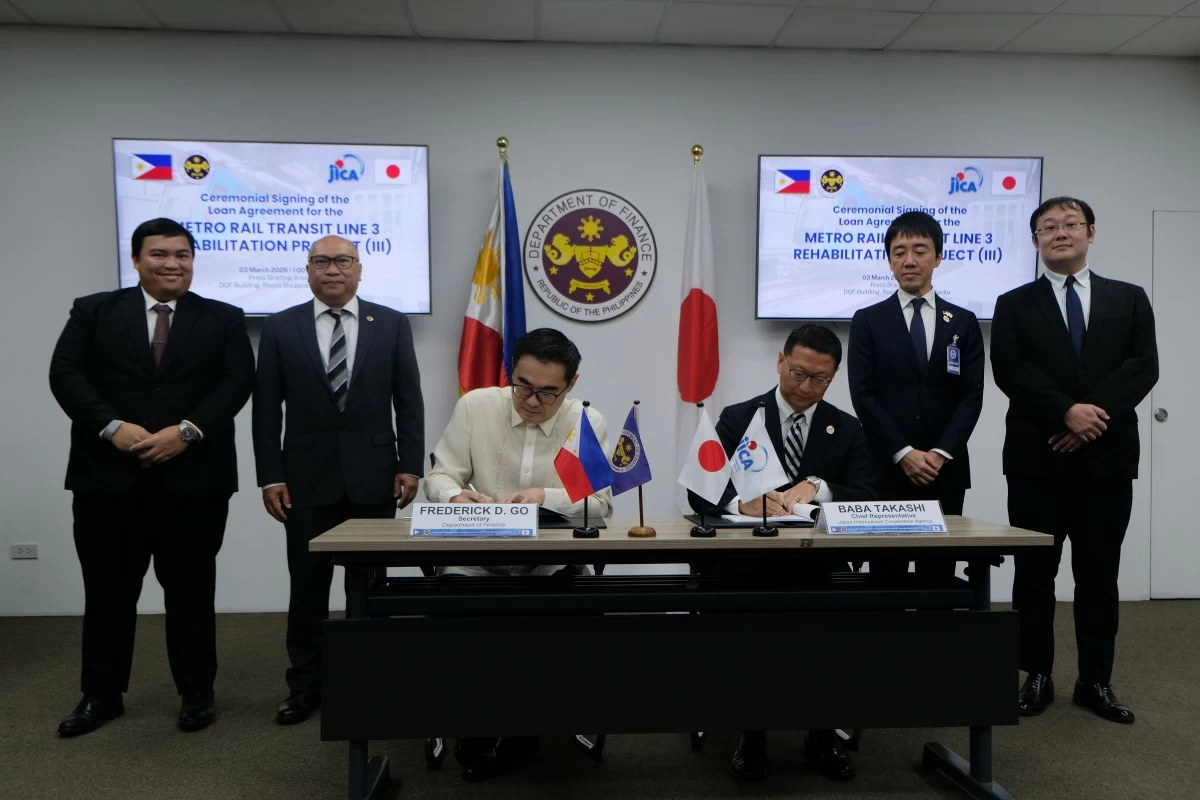
The Philippines has secured fresh Japanese funding for the continued rehabilitation and upgrade of Metro Rail Transit Line 3 (MRT-3), with the Japan International Cooperation Agency (JICA) and the Department of Finance (DOF) signing a new loan agreement on Tuesday, March 3.
Under the agreement, JICA will extend a 21.6-billion-yen loan—equivalent to about ₱8.2 billion—to support the next phase of the MRT-3 Rehabilitation Project.
DOF Secretary Frederick Go and JICA Philippines chief representative Takashi Baba signed the loan agreement in Manila, witnessed by Japanese Embassy minister Naobumi Yokota, Department of Transportation (DOTr) Assistant Secretary Eduardo Macabulos, and other officials.
The new financing will fund ongoing maintenance and additional system improvements, including upgrades to the power supply system, procurement of new bogie frames, ballast replacement, station renovation works, and the acquisition of depot and maintenance equipment. It will also cover repairs and upgrades to tracks, signals, overhead lines, communications systems, and station facilities.
The project includes the transition to four-car trains, which will accommodate 394 more passengers per train and help reduce waiting times, particularly during peak hours.
“For the Filipinos, this means three important things: First, it means fewer delays. Second, it means shorter waiting times. Third, it means a more comfortable and predictable ride to work, to school, and back home to family,” Go said during the signing ceremony.
He added: “At the DOF, we treat projects like MRT-3 as strategic investments in productivity, mobility, and opportunity. When commuters save even 20 minutes a day, that is more time for family and rest. When employees arrive on time, productivity improves. When transportation is reliable, businesses grow and jobs are created.”
JICA’s involvement in MRT-3’s rehabilitation began in 2018 with a 38.1-billion-yen loan to fund comprehensive rehabilitation and proper maintenance of the line. The first phase was completed in December 2021. In 2023, an additional 17.4-billion-yen loan was signed to extend maintenance and introduce further enhancements. Together, the earlier loans—totaling about 55 billion yen—restored key infrastructure and established a sustainable maintenance framework.
Following the full rehabilitation, MRT-3 resumed operations at its design speed of 60 kilometers (km) per hour, with significantly fewer service interruptions. The replacement of rail tracks and overhaul of rolling stock improved system reliability and ride quality for commuters along EDSA.
Baba emphasized the importance of sustaining these gains and strengthening operations and maintenance systems.
“It is our sincere expectation that this continued cooperation will help establish a sustainable, safe, and reliable operations and maintenance structure,” he said, adding that MRT-3 remains “an essential pillar of Metro Manila’s public transport system.”
He also said: “Allow me to express my deepest appreciation to the Philippine government who have contributed to this outstanding cooperation. The progress we celebrate today is a testament to the stakes of our vital partnership and shared commitment to delivering safe, efficient and high-quality infrastructure transportation for the people of the Philippines.”
The new loan will also support the transition toward future private sector operation and maintenance of MRT-3, with continued oversight and targeted upgrades seen as critical to preventing operational setbacks and protecting previous investments.
The latest financing comes as Japan and the Philippines mark 70 years of diplomatic relations, with JICA reaffirming its commitment to supporting key transport initiatives, including upgrades to existing Light Rail Transit (LRT) lines, the North-South Commuter Railway (NSCR), the Metro Manila Subway, and the establishment of the Philippine Railways Institute (PRI).