






Manila Bulletin
 Philippines
Mindanao
US Embassy exec reiterates country's commitment to education partnerships
Philippines
Mindanao
US Embassy exec reiterates country's commitment to education partnerships
Philippines
Mindanao
US Embassy exec reiterates country's commitment to education partnerships
US Embassy exec reiterates country's commitment to education partnerships
By Ivy Tejano
Published Feb 26, 2026 10:23 pm


EWING
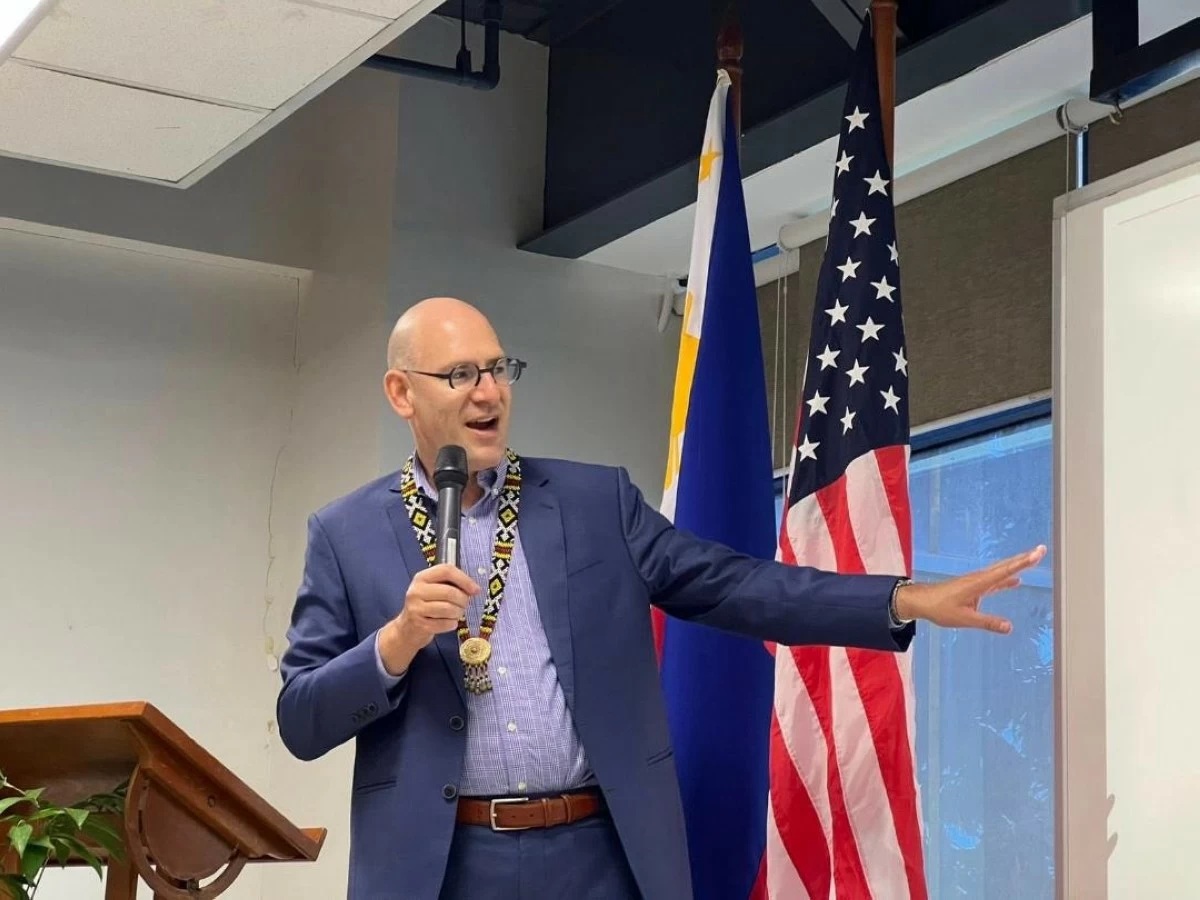
United States Embassy in the Philippines Chargé d’Affaires Y. Robert Ewing highlighted their commitment to strengthening education partnerships during his meeting with 50 scholars of the English Access Microscholarship Program in Davao City.
Speaking before public school student beneficiaries at the Ateneo de Davao University on Thursday, Feb. 26, Ewing described his role as a “bridge” between the United States and the Philippines, helping maintain cooperation in education, jobs, disaster response, security, and youth programs.
Funded by the US Department of State’s Bureau of Educational and Cultural Affairs, the English Access Program helps improve English skills and develop digital literacy, leadership, and critical thinking among students aged 13 to 15. The Regional English Language Office launched the 2026 edition in January.
Ewing said the program is rooted in the belief that “talent is everywhere.” However, the opportunity is not always evenly distributed. Thus, he added, the US government supports English-language initiatives in the Philippines, and for the first time in Davao City.
The envoy emphasized the significance of the subject. He described English as more than a school subject, calling it a global tool used in science, technology, business, aviation, diplomacy, and online communication.
“When you improve your English, you’re not just learning words and grammar. You’re opening doors for opportunities. Practice your English. Choose education over giving up, and you’re already acting like a leader,” Ewing told the students from the districts of Bunawan and Malabog.
Ewing noted that 2026 marks 80 years of diplomatic relations between the United States and the Philippines and 250 years since US independence, anniversaries he said reflect enduring ties rooted in people-to-people connections.
The envoy cited the presence of about 4.5 million Filipinos in the United States and thousands of Americans living in the Philippines as evidence of deep social and family links between the two countries.
Rebecca Sagot, assistant schools division superintendent of the Department of Education in Davao City, said the English Access Microscholarship Program currently operates in two learning hubs (Malabog National High School and Pablo Empiatos National Integrated School), serving nine schools.
Sagot said the program, which began on Jan. 8, caters to Grade 8 and Grade 9 students who attend four-hour Saturday sessions over approximately two school years. She described the program as an activity-based learning supplement to the one-hour English class students receive in regular classes.
Participants receive transportation and food allowances, learning materials, insurance coverage, and off-site learning activities, such as museum visits, while teachers receive training and instructional resources funded through a US Embassy grant.
Sagot said the initiative benefits students from remote areas and Indigenous Peoples communities, including those from Sitio Betan. She added that they do not screen student beneficiaries through examinations, but only based on their commitment to complete the program and attend classes consistently.
The school official noted that the program’s management by the Association of Public Schools District Supervisors in Davao City enables the sharing of best practices and learning resources with other districts, enabling replication.
“For job opportunities and future ambitions, improving English proficiency is important,” Sagot said. “No learner must be left behind.”
Jeffrey McIlevenna, Regional English Language Officer covering the Philippines, Japan, South Korea, Taiwan, and Brunei, said the program has been implemented in the Philippines since 2014, with nearly 1,500 scholars graduating from 37 sites, gaining communication and leadership skills.
McIlevenna said interaction with American leaders is an essential component of the program, as communication underpins the broader US-Philippine partnership. He underscored the role of language in sustaining bilateral ties.
Ewing said the US Embassy is committed to expanding engagement in Mindanao, including promoting investment in agriculture, energy, and infrastructure, as he met with members of the American Chamber of Commerce in Mindanao to discuss economic opportunities and skills partnerships.
He added that outreach initiatives and a possible Education USA fair in Davao are being considered, noting that many students from the city have previously traveled to Manila to attend such events. “We will continue to be here,” Ewing said, referring to embassy outreach teams that regularly visit Davao.