






Manila Bulletin
 Philippines
National
AFP: No Chinese reclamation, missile deployment monitored in Bajo de Masinloc
Philippines
National
AFP: No Chinese reclamation, missile deployment monitored in Bajo de Masinloc
Philippines
National
AFP: No Chinese reclamation, missile deployment monitored in Bajo de Masinloc
AFP: No Chinese reclamation, missile deployment monitored in Bajo de Masinloc
Published Feb 24, 2026 04:08 pm


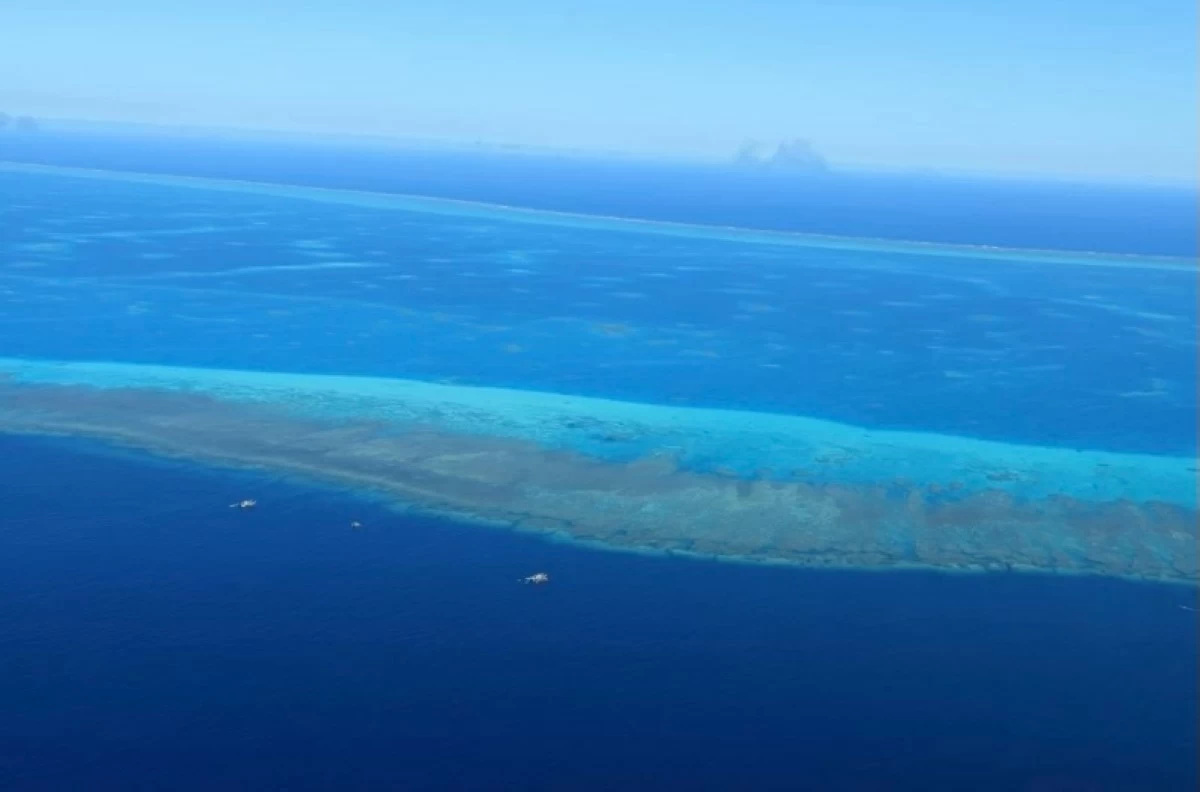
Filipino fishing boats are monitored near Bajo de Masinloc in the West Philippine Sea during an aerial search of the Philippine Coast Guard (PCG) on Oct. 6, 2022. (Photo: PCG)
The Armed Forces of the Philippines (AFP) on Tuesday, feb. 24, disclosed that it has not monitored any construction of an outpost or missile deployment in Bajo de Masinloc (Scarborough or Panatag Shoal) in the West Philippine Sea (WPS), contrary to claims online by a diplomat that China has built a military installation in the area.
AFP spokesperson for WPS spokesperson Rear Adm. Roy Vincent Trinidad said the military’s monitoring shows only the continued presence of Chinese vessels around the shoal.
“Our monitoring is that the presence of the PLA [People’s Liberation Army]-Navy, the China Coast Guard (CCG), and the maritime militia in Scarborough is there. We have not monitored any construction on Scarborough Shoal except for the presence of the PLA-Navy, the Chinese Coast Guard, and the maritime militia,” Trinidad said.
“For the military, we don't monitor any military base in Scarborough Shoal,” he added.
Trinidad clarified that the vessels were monitored around the shoal and not inside its lagoon.
Philippine Ambassador to the United States Jose Manuel “Babes” Romualdez earlier said in an interview that the Chinese government “has already deployed missiles in Scarborough Shoal.”
“The photos that we have seen show that it’s now a military base. We have been warning people about that for many, many years, that all of this buildup of these reefs and turning it into a base is now a fact. Intelligence photos show that it’s clearly now a military base,” he said over One News PH’s “Storycon” last week.
Trinidad, however, said missiles may be aboard Chinese warships but not deployed within the shoal itself.
“It is safe to assume that warships would be armed with different missiles. So missiles aboard warships could also be the same that would have been what the good ambassador was referring to. Not inside the shoal but on board the ships,” he said.
Scarborough Shoal, located about 124 nautical miles from Zambales, has long been a flashpoint between Manila and Beijing.
In the 1990s, Philippine authorities arrested Chinese fishermen in the area, prompting diplomatic protests from Beijing.
Tensions escalated in 2012 when a standoff between the Philippine Navy and Chinese maritime forces ended with China taking de facto control of the shoal. Since then, Chinese vessels have maintained a constant presence in the area.
The shoal is located approximately 124 nautical miles west of Masinloc, Zambales, and forms part of the WPS, the portion of the South China Sea within the Philippines’ 200-nautical mile exclusive economic zone (EEZ).
Trinidad said Chinese ships continue to maintain a “semi-permanent presence” not only in Bajo de Masinloc but across other features in the WPS.
“Their presence in our EEZ, their illegal presence is not only limited to Bajo de Masinloc but even the other features in the West Philippine Sea. They have a semi-permanent presence already in the West Philippine Sea and in Bajo de Masinloc,” he said.
He said the AFP has adjusted its posture in response to the Chinese presence.
“We have increased our patrols. We have improved our support and sustainment capability. We have developed the capability of the islands to sustain our forces. These are all geared towards the maritime domain and securing and protecting what is rightfully and legally ours,” Trinidad said.
Chinese presence
For the period of Feb. 15 to 22, the AFP monitored 18 Chinese vessels in strategic areas in WPS.
The AFP spotted four PLA-Navy ships and five CCG vessels in Bajo de Masinloc; four CCG ships in Ayungin Shoal; two PLA-Navy ships and one CCG vessel in Escoda Shoal; and one PLA-Navy ship and one CCG vessel near Pag-asa Island.
“Compared to the previous report, I think the other week, there has been a dip in the number of ships. We are not looking at it on a week-to-week basis, we are looking at it from a broader time frame. What is important is their illegal presence is still there in our EEZ,” Trinidad said.
He also said the AFP has not monitored any Chinese construction activity in the shoal despite
US missile deployment
Ambassador Romualdez’s remarks came as Manila and Washington deepen military cooperation. In a recent bilateral strategic dialogue, the Philippines and the United States agreed to increase the deployment of American “cutting-edge missile” systems in the country.
The US has been rotating missile systems such as the Typhon mid-range capability (MRC), Navy‑Marine Expeditionary Ship Interdiction System (NMESIS), and High Mobility Artillery Rocket Systems (HIMARS) precision strike missiles in the Philippines as part of joint exercises.
The planned deployments have drawn criticism from Beijing, which warned against actions that could heighten tensions in the region.
But Trinidad said the AFP welcomes the opportunity to train with modern weapons from its treaty ally.
“The AFP welcomes every opportunity to be able to train with modern weapons, that includes missile systems. This is a great stopgap, a great filler while awaiting our modernization program,” he said.