






Manila Bulletin
 Philippines
National
Rising stars: How 2 Filipinas turn childhood curiosity into careers in space science
Philippines
National
Rising stars: How 2 Filipinas turn childhood curiosity into careers in space science
Philippines
National
Rising stars: How 2 Filipinas turn childhood curiosity into careers in space science
Rising stars: How 2 Filipinas turn childhood curiosity into careers in space science
Published Feb 18, 2026 02:28 pm


At A Glance
- Hillary Diane Andales and Florence Pauline Basubas are channeling their childhood curiosity into careers in space science, encouraging the next generation to explore, learn, and pursue their dreams
Photo from Pixabay
For many children, gazing at the night sky is just a fleeting wonder.
But for Hillary Diane Andales and Florence Pauline Basubas, it was the beginning of something much bigger.
This February, as the Philippines marks the 33rd National Astronomy Week, their journeys from childhood curiosity to careers in space science remind us that the stars can lead to extraordinary paths.
Vast universe
Andales, an astrophysicist-in-training, science communicator, and education advocate, first captured global attention when she won the 2017 Breakthrough Junior Challenge.
Out of more than 11,000 students from 178 countries, her explanation of relativity and reference frames stood out.
Since then, Andales has become a strong advocate for science education, accessibility, and youth participation in STEM (Science, Technology, Engineering, and Mathematics).
“The title of my talk is ‘Unraveling Our Astronomical Story,’ because that’s really what I want to do. My whole mission has been to unravel our story as human beings,” Andales said during the opening for the 33rd National Astronomy Week celebration.
Her love for the universe started under the clear, unpolluted night sky of Leyte, where she grew up.
“I lived in this coastal municipality with no light pollution. Every night I would stare up at the sky and I could see all of the stars. That was also one of the things that really inspired me to go into astronomy because I was very curious about what these stars were,” she recalled.
A childhood book gifted by her parents further fueled her curiosity.
“This book was way taller than me. It was the reason why I learned the scale of things in the universe. This was the first time I saw a scale model of the solar system,” Andales said.
She honed her passion for science at Philippine Science High School-Eastern Visayas, then earned a Bachelor of Science in Physics at the Massachusetts Institute of Technology (MIT) in 2023, receiving multiple research recognitions.
Now pursuing a PhD in astronomy and astrophysics at the University of Chicago, she focuses on advanced astrophysics, computational studies, and the formation of galaxies.
“After MIT, I decided to go to the University of Chicago because this university would provide me access to the world’s best observatories where I could actually use these telescopes for my own research,” she said.
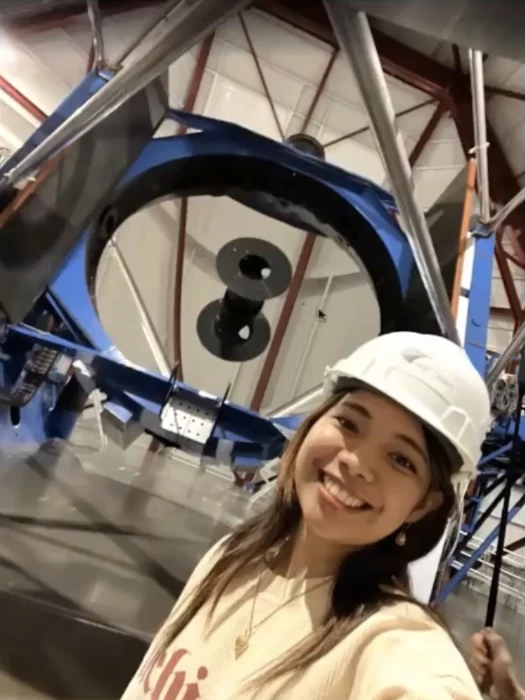
Hillary Diane Andales (PAGASA)
Her work has already taken her to Spain and Chile, where she operated some of the world’s most advanced telescopes.
One of her most exciting discoveries involved a star so chemically unique it challenged previous understandings of stellar history.
“We had just discovered this really, really cool star that was very poor in metals. The sun we think is old, it’s four billion years old. But when you compare it with other stars, it’s actually quite young. There are stars born almost right after the Big Bang, 13 billion years ago. One way you can tell if a star is young or old is by its chemical composition. Stars born later have more heavy elements like carbon, iron, or gold. Those born earlier have very little beyond hydrogen and helium. It tells us something about the early universe,” she said.
While sharing her experiences with young Filipinos during Astronomy Week, Andales also took the opportunity to offer advice to aspiring scientists and dreamers.
She encouraged them to find mentors and role models in their communities, as support from others had been key to her own journey.
“Find mentors, role models in your community. I would not be here if not for my mentors, my role models, and my community. Your mentor could be anyone—it could be a parent, a teacher, or someone in a club. And then it’s very important to have your own community as well. It’s lonely to achieve your goals alone, so having people who understand your goals and support you makes a big difference,” she said.
Andales also shared lessons she has learned along the way, urging young dreamers to view failure as a learning opportunity, unravel their own story, and practice gratitude.
“Failure is not really failure. I always call it a learning opportunity,” she said.
She reminded them to stay on their own path and avoid comparison.
“Our stories are our own. We don't have to succumb to comparison. Now with social media, it becomes very easy to compare our own journeys with other people's highlight reels,” she said.
“But we just have to remember that we are on our own path. There is no winning or losing. You just have to move forward or fall forward,” she added.
Where curiosity takes flight
Like Andales, Basubas’ path to space biology started in her home province, growing up in a rural farming family in Cebu.
“We grew up in quite a rural lifestyle. In the evenings, we would see a very bright night sky. Seeing the stars inspired me to become an astronaut,” she recalled.
A teacher once discouraged her dream, telling her that no Filipino had ever become an astronaut.
“I thought to myself, okay, what do I do now if I cannot become an astronaut? I decided that I’ll just try to figure it out,” she said.
That curiosity led her to explore multiple paths—law, teaching, medicine—but a childhood experience with dengue only strengthened her interest in biomedical science.
“Being in the hospital with so many sick children made me think if there’s anything I could do about this. I was really curious about how diseases work, and this inspired me to potentially become a biomedical scientist,” she said.
Basubas earned a dual bachelor’s degree in natural sciences and applied biochemistry from Minerva University, traveling to a different country each semester, interning in virology labs whenever she could.
She pursued a master’s in multidisciplinary research in experimental science at the Barcelona Institute of Science and Technology and University of Pompeu Fabra, with a major in biomedicine and molecular virology and a minor in space biology.
Basubas’ first love for science and discovery eventually guided her to space biology, the field she had always been drawn to.
“While doing my master’s, a space biology lab opened up in the same building. They were looking for someone who could intern and do experiments, and I applied. They chose me because I had experience in big labs,” she said.
Her first project involved processing microorganisms from the International Space Station.
“One of the projects has spun off to a startup where I am working right now,” she said.
Basubas’ work extends beyond research into advocacy and outreach.
She serves as the Philippines’ national point of contact for the Space Generation Advisory Council, leads national mentoring and space education programs, and has supported analog missions including Asclepius, MDRS, and Chill Ice.
She also participated in the NASA Space Academy under the UNOSA Space for Youth program and completed a parabolic flight, gaining firsthand astronaut training experience.
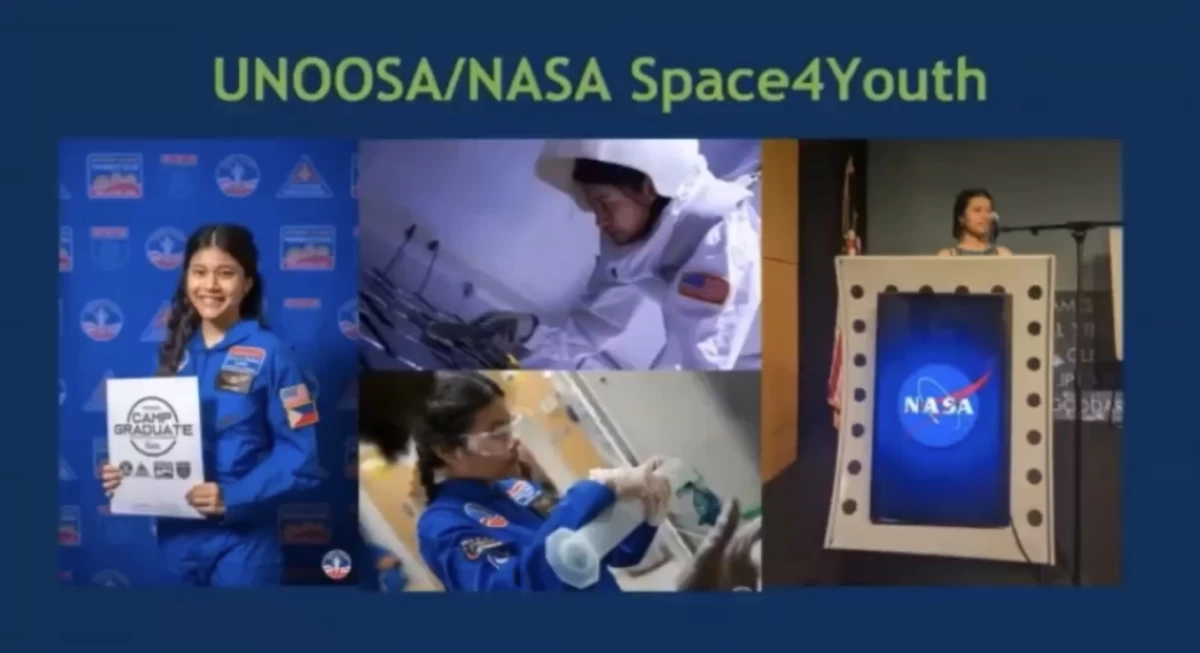
Florence Pauline Basubas (PAGASA)
Speaking at the opening of Astronomy Week, Basubas stressed that space science is not just theoretical, but has practical importance in everyday life
“Basically, we see everything in space. We see the weather. It’s important to develop space technology, satellites, to monitor typhoons and other events. Astronomy has applications in sustainable development, agriculture, fisheries, and even medical technologies. For example, adaptive optics in astronomy inspired LASIK eye surgery, and algorithms developed to study star clusters have been used for cancer screening,” she said.
Basubas urged young people to pursue science with perseverance, reminding them that curiosity and dedication can turn knowledge into solutions that benefit everyday life.
“Take initiative, put yourself out there, volunteer, find people with the same interests. Focus on developing your skills, teach, inspire, help others, and trust God. He will lead you where you need to go,” she said.
Youth leading Philippine astronomy
During the National Astronomy Week celebration from Feb. 15 to 21, officials highlighted how astronomy connects to everyday life and the role of young Filipinos in shaping the field.
Science and Technology Secretary Dr. Renato Solidum Jr. noted that while astronomy may look far into the skies, its impact is deeply grounded here on Earth.
“By making astronomy accessible and meaningful, we allow science to truly resonate with the public,” he said.
PAGASA Deputy Administrator for Research and Development Dr. Marcelino Q. Villafuerte II explained the event’s theme, “Rising Stars, Youth Leading the Future of Philippine Astronomy,” emphasizing the importance of nurturing young talent.
“This theme underscores the vital role of young people in shaping the future of astronomy and space science in the Philippines. Rising Stars is both a recognition and a call to action, encouraging institutions, educators, scientists, and organizations to continue creating opportunities that nurture talent and inspire lifelong engagement in astronomy,” he said.
The theme came to life through the stories of Andales and Basubas, whose journeys show that the next rising stars of Philippine astronomy may already be gazing at the sky tonight, ready to chart their own paths among the stars.