







SC gets donated audio-visual equipment to fight cybercrimes
Published Feb 18, 2026 12:22 pm


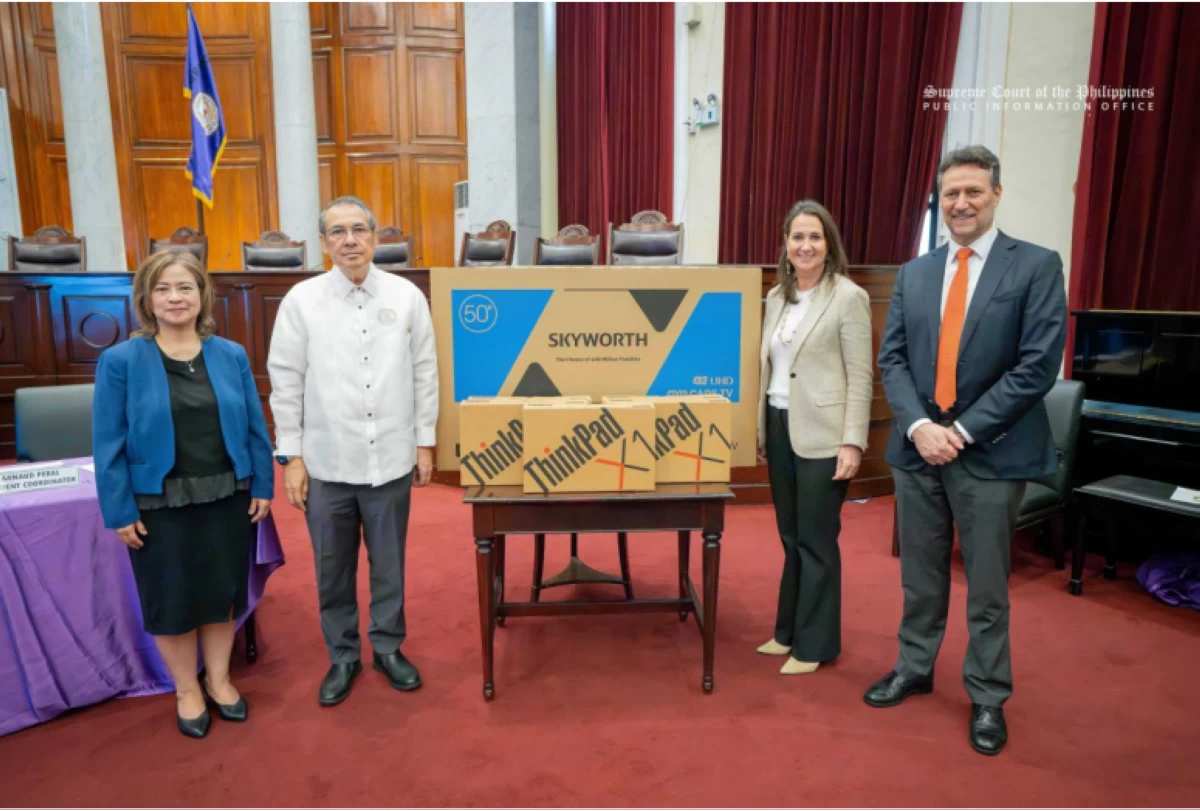
Thirty cybercrime courts in the country are recipients of the upgraded audio-visual equipment donated by the Netherlands government to enhance the handling of cases of online child sexual abuse, unlawful data access and interference, and sophisticated financial or crypto-enabled crimes.
Chief Justice Alexander G. Gesmundo received, on behalf of the Supreme Court (SC), the donation which was turned over by the government of the Kingdom of the Netherlands through Ambassador Maria Alfonsa Magdalena Geraedts.
Gesmundo said the upgraded audio-visual capabilities of the donated equipment would strengthen evidentiary safeguards, reduce logistical constraints, and allow the secure and efficient presentation of digital evidence in accordance with established legal standards.
The equipment was provided through the support of the Kingdom of the Netherlands, in partnership with the United Nations Office on Drugs and Crime (UNODC) represented by UN Resident Coordinator Arnaud Peral, the SC’s Office of the Spokesperson said on Wednesday, Feb. 18.
During the turnover ceremony, Chief Justice Gesmundo underscored the support of the Netherlands and the UNODC as a shared international commitment to confront cybercrime, especially offenses that harm children and exploit the vulnerable.
Gesmundo noted: “As international studies have observed, technology has expanded not only the reach of criminal activity, but also its scale, speed, and sophistication. These developments demand more than reactive adjustments; they call for structural reform.”
He also said the turnover of the equipment forms part of a broader institutional reform agenda under the Strategic Plan for Judicial Innovations 20222-2027 (SPJI), which aims to ensure that the Philippine judiciary remains effective, credible, and resilient amid rapidly evolving technological realities.
The SC said the turnover of the equipment was done after the conclusion of an intensive training program on the Guidelines for Cybercrime Investigation and Prosecution.
It also said the guidelines were developed in partnership with the Department of Justice and the UNODC, in collaboration with the Kingdom of the Netherlands and the Philippine Judicial Academy.
The guidelines provide a framework that reinforces the principles of chain of custody, authenticity, reliability, and due process, it added.
In her remarks during the ceremony, Ambassador Geraedts said the Netherlands chose to support the Philippines despite the geographical distance because they believe that “justice anywhere strengthens justice everywhere.”
She added: “In the Netherlands, ‘Rule of Law’ is not merely a legal framework, but a cornerstone of our society and our democracy. We believe that due process is not a privilege, but a right. And we believe that courts must be equipped, not only with independence and integrity, but with the tools necessary to establish truth in an increasingly digital world.”
She pointed out that no country could combat cybercrime alone, for it requires a multisectoral response involving courts, law enforcement, prosecutors, legislators, tech companies, civil society, and international partners.
Peral, on the other hand, noted that cybercrime is now at the center of global concerns, affecting countries in different ways and often targeting the most vulnerable.
He said: “It is only through international cooperation and collaborations that we can tackle the scourge of our times. Global challenges should be treated by global solutions.”
SC Court Administrator Ma. Theresa Dolores C. Gomez-Estoesta highlighted that the donation represents true collaboration and mutual respect between institutions.
She said: “We accept this support, not merely as a transfer of material resources, but as a testament to a shared commitment that in an age where crime evolves with technology, justice, too, must evolve with competence, precision, and resolve. Above all, we accept this donation on the strong foundation of partnership -- a partnership grounded in trust, shared values, and the rule of law.”
Deputy Court Administrator (DCA) Rainelda H. Estacio-Montesa closed the event by supporting Court Administrator Gomez-Estoesta’s message and reiterating that the donated equipment represents not only tools, but a firm resolve and collective commitment to ensure that justice keeps pace with technology.
Photo Caption:
Chief Justice Alexander G. Gesmundo (second from left) and Court Administrator Ma. Theresa Dolores C. Gomez-Estoesta (leftmost) receive the equipment donated by the Kingdom of the Netherlands, represented by Her Excellency Maria Alfonsa Magdalena Geraedts, Ambassador of the Kingdom of the Netherlands to the Philippines, and United Nations Resident Coordinator Arnaud Peral, during the recent symbolic turnover ceremony at the Supreme Court (SC) in Manila. (Photo courtesy of the SC Communications Office)