






Manila Bulletin
 Philippines
National
Philippine healthcare education crisis: 56% of students never make it to workforce
Philippines
National
Philippine healthcare education crisis: 56% of students never make it to workforce
Philippines
National
Philippine healthcare education crisis: 56% of students never make it to workforce
Philippine healthcare education crisis: 56% of students never make it to workforce
EDCOM II flags 'leaky' education pipeline behind 290,000 healthcare worker shortage; Workforce Development Plan pushes medical education and scholarship reforms
Published Feb 15, 2026 09:05 pm


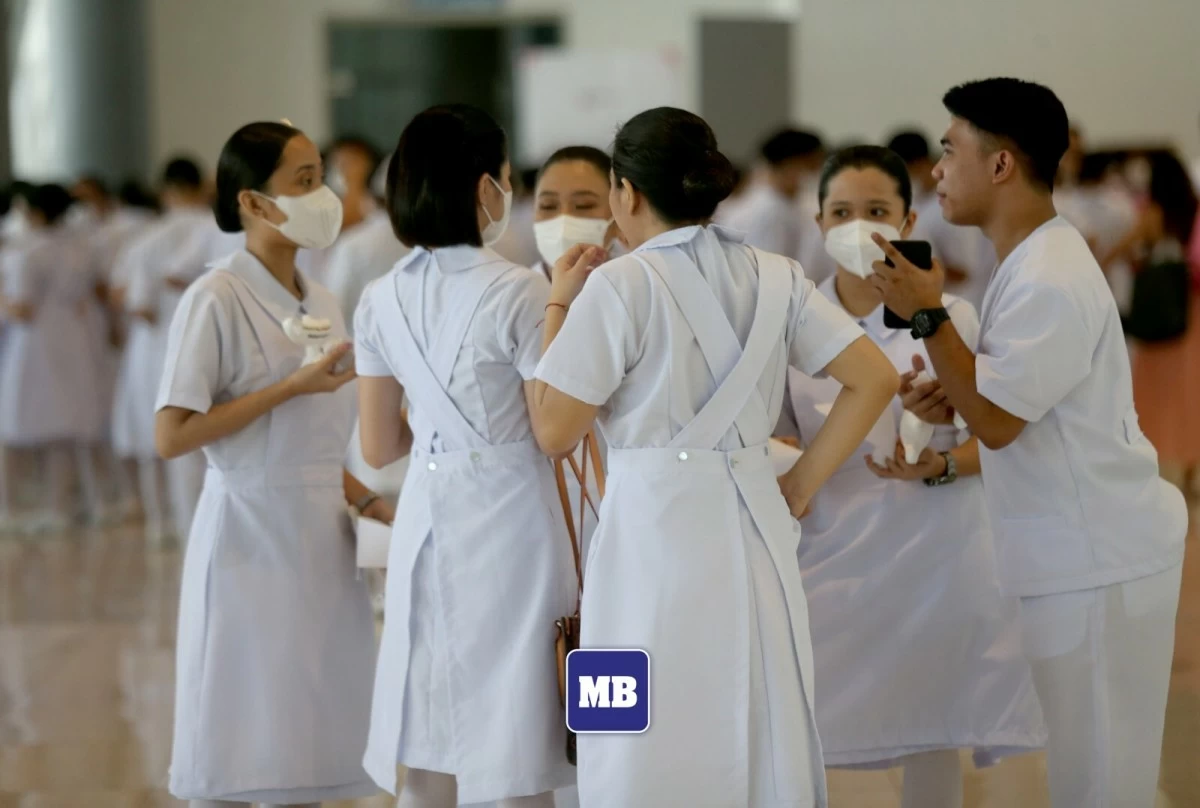
Over half of healthcare students in the Philippines never enter the workforce, fueling a 290,000-worker shortage, according to data analyzed by EDCOM II. (Manila Bulletin / file)
The Philippines’ worsening shortage of healthcare workers is rooted not only in migration but also in a failing education and training pipeline, with an estimated 290,000 additional professionals needed nationwide, according to the Second Congressional Commission on Education (EDCOM II).
In its final report, Turning Point: A Decade of Necessary Reform 2026–2035, the commission said the country’s education system is unable to produce enough doctors, nurses, and allied health professionals, leaving the Philippines with only 21.2 healthcare workers per 10,000 people—less than half of the 44.5 benchmark recommended by the World Health Organization (WHO).
“Estimates indicate that roughly 56 percent of students entering healthcare degree programs—about 33,000 individuals annually—never reach the workforce,” EDCOM II said in a statement issued Sunday, February 15.
“Without immediate and strategic intervention, the country faces a shortage of approximately 290,000 healthcare professionals needed to meet the needs of the population,” it added.
‘Leaky’ education pipeline fails to produce enough professionals
At the center of the crisis is what the commission described as a “leaky” healthcare education pipeline, where large numbers of students fail to complete their training or enter professional practice.
Citing data it analyzed, EDCOM II pointed out that each year, around 59,000 students enroll in healthcare degree programs. About 15,000 drop out before graduation, and around 11,000 graduates fail licensure examinations—leaving only 32,000 who become licensed professionals.
This means that about 56 percent of healthcare students never enter the workforce, EDCOM II said.
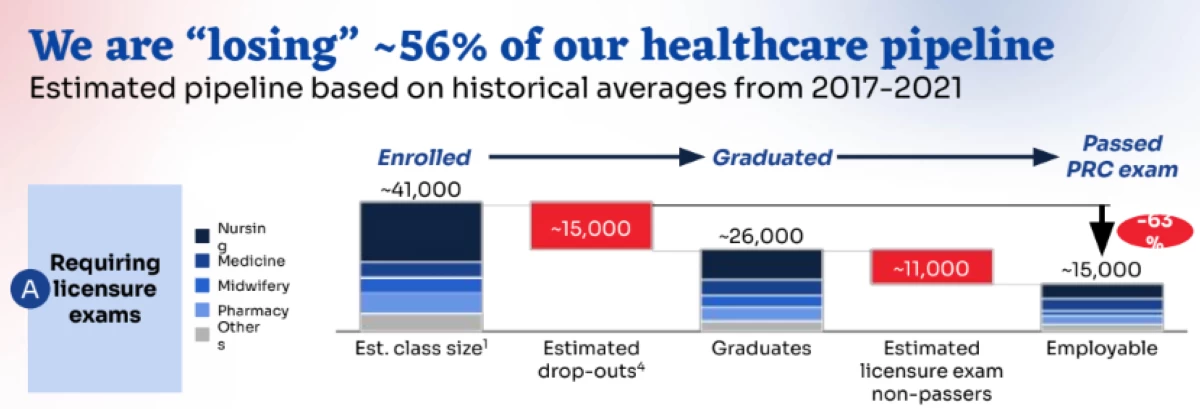
(Courtesy of EDCOM II)
Migration and attrition further offset gains, with nearly 27,000 healthcare workers leaving the country annually, the commission added.
As a result, the Philippines faces a projected shortage of 94,000 doctors, 196,000 nurses, and thousands more midwives and allied health professionals.
EDCOM II also warned that even with high enrollment, the education sector is not producing enough qualified professionals to meet national demand.
Limited access to public medical education worsens inequality
The commission also highlighted major disparities in access to healthcare education, especially outside major cities.
Of the country’s 80 medical schools, only 28 are public institutions, limiting affordable options for students from low-income and provincial backgrounds. Some regions—including Region 10 and the Cordillera Administrative Region—still have no public medical schools.
Dental education is even more uneven, with only 34 dental schools nationwide. Nearly one-third are located in Metro Manila, and 12 regions—including BARMM, MIMAROPA, and Region V—have “virtually no access to dental education providers.”
These gaps contribute to the uneven distribution of healthcare workers and persistent shortages in rural and underserved communities.
“This scarcity of qualified professionals has led to a crisis in public health staffing,” EDCOM II said.
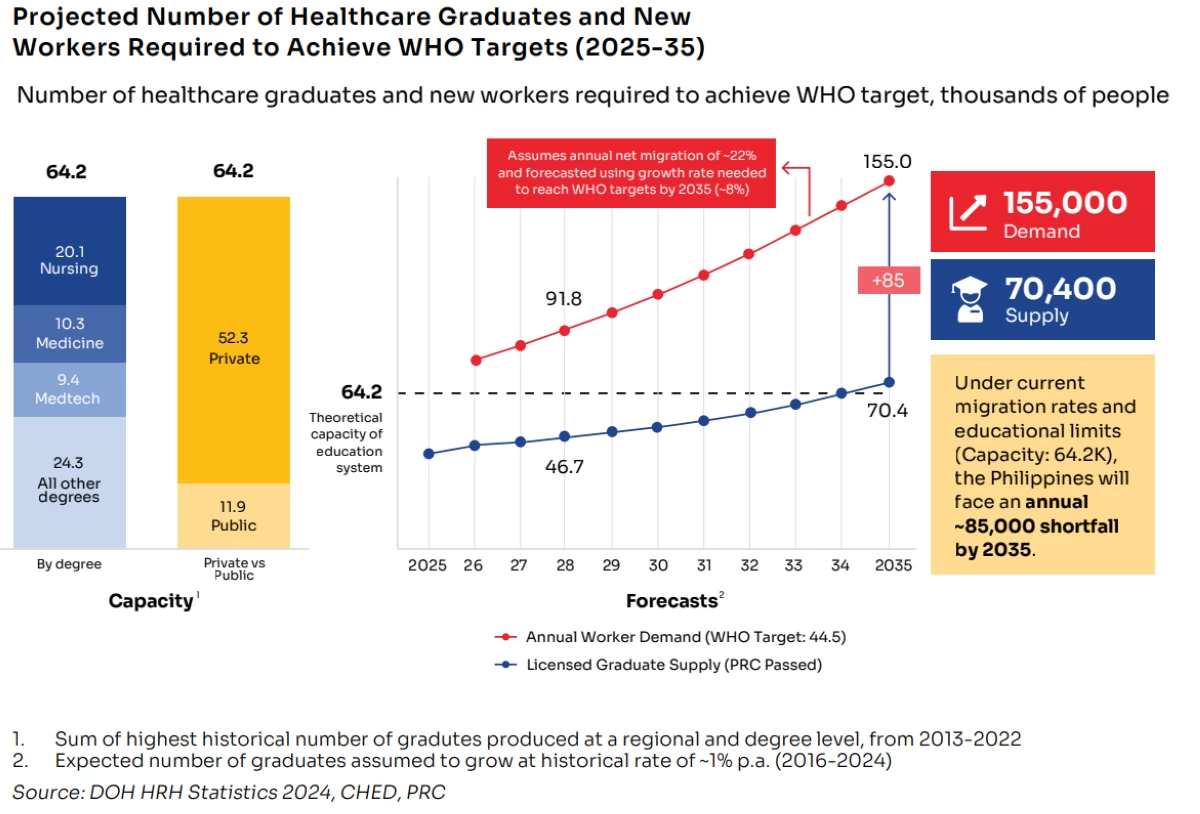
(Courtesy of EDCOM II)
The commission also noted that 3,300 Department of Health plantilla positions remain unfilled, leaving government hospitals and rural health units “chronically understaffed and unable to deliver optimal care” to the poorest Filipinos.
Education reforms target scholarships, training, and return service
To address the crisis, EDCOM II said the Workforce Development Plan calls for transforming healthcare education into a “demand-driven” system aligned with labor market needs.
Key education reforms include expanding scholarships for medical and allied health students, improving training facilities and program quality, revising licensure policies to help more graduates qualify, and strengthening return service requirements for government scholars.
EDCOM II stressed that expanding the "Doktor Para Sa Bayan" program, which funds medical education in exchange for mandatory service in underserved areas, should be an urgent priority.
The commission also pointed out that education agencies are aligning reforms, with the Department of Education (DepEd) introducing healthcare electives in senior high school, the Technical Education and Skills Development Authority (TESDA) developing advanced allied health certifications, and the Commission on Higher Education (CHED) prioritizing healthcare programs in its scholarship initiatives.
Workforce Development Plan: Education as key to solving healthcare crisis
EDCOM II emphasized that fixing the education pipeline is essential to resolving long-term workforce shortages.
The Workforce Development Plan, a key part of the commission’s report, underscores that the country’s current number of health professionals is insufficient, leaving millions of Filipinos without adequate care.
As a strategic roadmap, the plan aims to shift the Philippine education system from a “supply-driven” approach to a “demand-driven” model aligned with actual labor market needs. Its main goal is to ensure that graduates from DepEd, CHED, and TESDA have the skills needed to secure immediate and meaningful employment.
Under the plan, healthcare has been identified as a priority sector, alongside digital technology, financial services, advanced manufacturing, and tourism.
With healthcare identified as a priority sector, EDCOM II underscored the need to strengthen medical education, training, and retention to ensure Filipinos have access to adequate healthcare in the years ahead.