







Stocks snap rally as US labor data chills rate hopes
Published Feb 12, 2026 05:03 pm


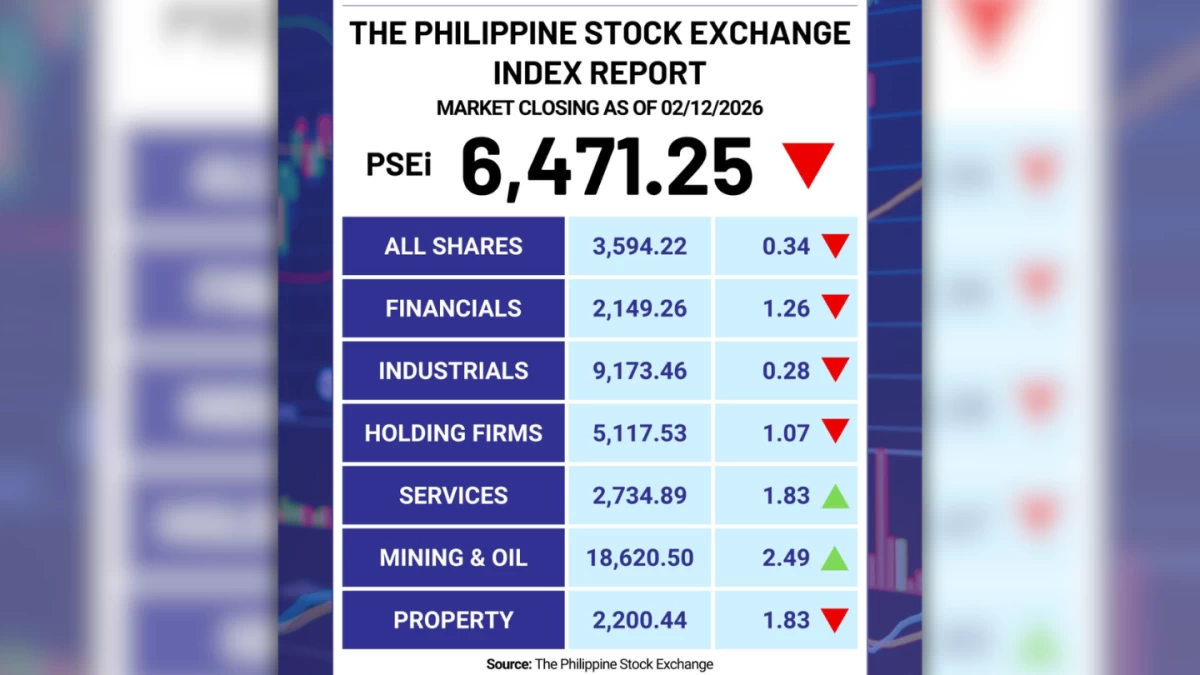
Local equities snapped a two-day winning streak on Thursday, Feb. 12, as investors moved to lock in gains from recent rally, tracking the broader retreat in global markets following strong United States (US) labor data.
The Philippine Stock Exchange index (PSEi) declined 27.57 points, or 0.42 percent, to close at 6,471.25. The property sector led the downturn among sub-indices, while the mining and services sectors managed to buck the trend and sustain their recent momentum.
Trading activity cooled, with volume falling to 1.46 billion shares valued at ₱6.87 billion. Market breadth was negative, with 122 stocks declining, 78 advancing, and 65 remaining unchanged.
Analysts said the movement was a technical pullback rather than fundamental shift in sentiment.
Luis Limlingan, managing director at Regina Capital Development Corp., said the session was a healthy correction, noting profit-taking persisted after a series of buying sessions across the index, which weighed on overall sentiment and dragged down key heavyweights.
The decline follows the benchmark index's earlier testing of higher resistance levels during the week.
External factors also played a role in the local bourse’s performance as Japhet Tantiangco, research manager at Philstocks Financial, explained that negative spillovers from Wall Street weighed on investor appetite.
US markets have faced pressure as robust economic data led traders to scale back expectations for the timing and frequency of Federal Reserve interest rate cuts. Better-than-expected US employment figures have fueled concerns that the Fed may keep borrowing costs elevated for longer to ensure inflation remains on a downward path.
Meanwhile, Michael Ricafort, chief economist at Rizal Commercial Banking Corp., noted that the PSEi’s slight correction also followed a rise in global crude oil prices, which reached 4.5-month highs amid escalating tensions between the US and Iran.
Higher oil prices typically act as a headwind for the domestic economy, given its status as a net energy importer, and often stir inflationary concerns that can dampen corporate earnings projections.