






Manila Bulletin
 Philippines
National
Chinese embassy questions 'treason' brand on those supporting China's WPS claims
Philippines
National
Chinese embassy questions 'treason' brand on those supporting China's WPS claims
Philippines
National
Chinese embassy questions 'treason' brand on those supporting China's WPS claims
Chinese embassy questions 'treason' brand on those supporting China's WPS claims
Published Feb 8, 2026 03:45 pm


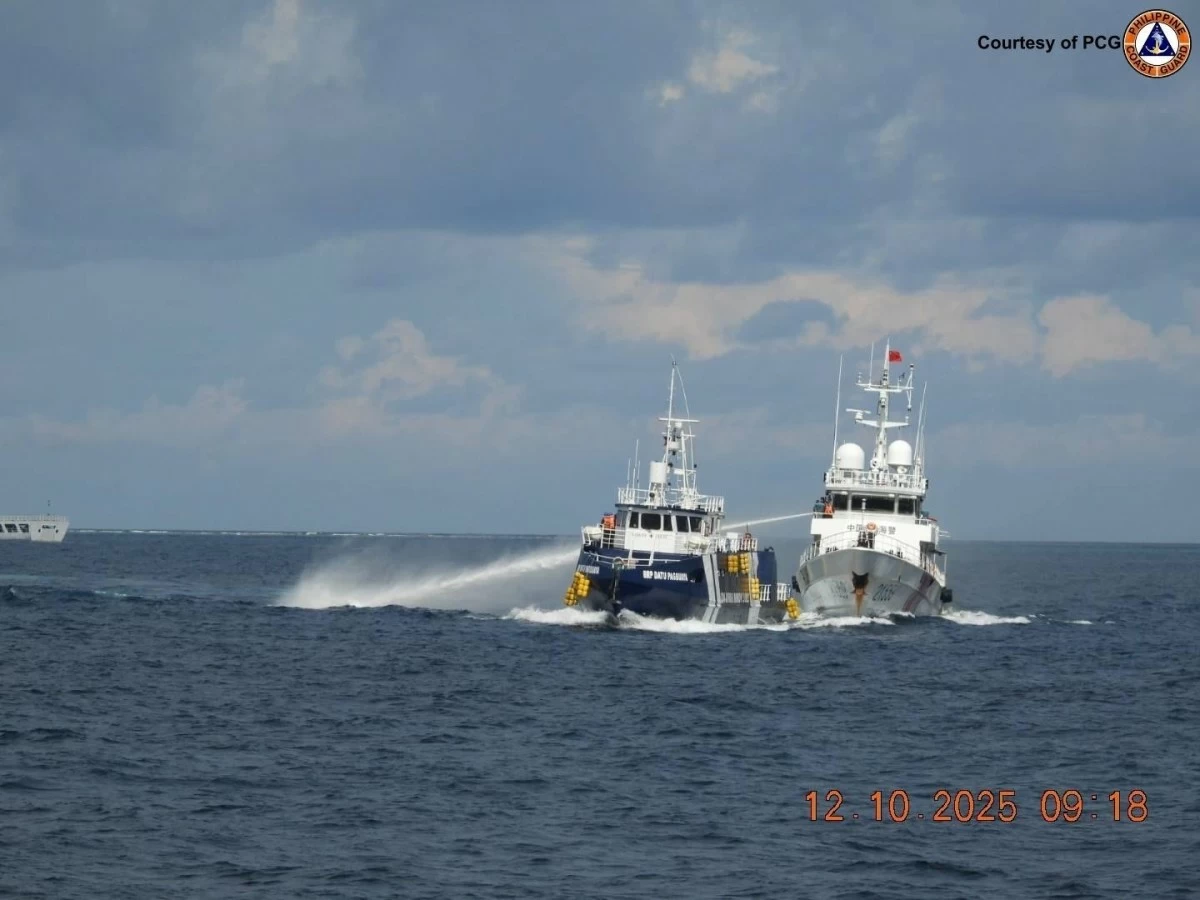
A China Coast Guard (CCG) ship fires a water cannon and rams a Bureau of Fisheries and Aquatic Resources (BFAR) vessel anchored in the territorial waters of Pag-asa (Thitu) Island in the West Philippine Sea (WPS) on Oct. 12, 2025, according to the Philippine Coast Guard (PCG). (Photo: PCG)
A Chinese Embassy official has criticized the Philippine Coast Guard (PCG) for saying that supporting China’s claims in the West Philippine Sea (WPS) while undermining the Philippines’ claims amounts to treason.
Deputy Spokesperson Wei Guo of the Chinese Embassy in the Philippines took aim at PCG Spokesperson Jay Tarriela, questioning his repeated public emphasis on freedom of speech as a constitutional right, arguing that such principles appear to be selectively applied.
"Why is it that Filipino voices calling for stable China–Philippines relations and deeper cooperation are instantly branded as 'treason'?" the Chinese official questioned.
"Is this not coercion straight out of the political repression handbook? Or did you somehow overlook Article III, Section 4 of the 1987 Philippine Constitution, the part that explicitly guarantees freedom of speech?" Guo added.
Guo further said that incitement of hatred and confrontation does not serve the Philippines’ national interest.
"By relentlessly inciting hatred and confrontation, you’re not defending the nation. You’re dragging the Philippines closer to the edge of conflict and reducing it to a disposable pawn in major-power strategic competition. If this is your idea of 'patriotism,' one has to wonder who exactly you’re serving," the official said.
Civic leader Jose Antonio Goitia said there are moments when a nation must speak plainly, and this is one of them.
“Recent attacks on the Philippines’ legal position, especially those aimed at the Philippine Coast Guard and the Armed Forces of the Philippines, demand an unequivocal response,” Goitia said.
“When institutions tasked with defending the Republic are undermined, neutrality ceases to be prudence. It becomes surrender,” he added.
The civic leader, who serves as a Chairman Emeritus of groups, including the Alyansa ng Bantay sa Kapayapaan at Demokrasya (ABKD), stressed that such attacks "weaken the country precisely when resolve is required to defend sovereignty under international law."
“Those who argued for retreat never thought of themselves as traitors. They wrapped surrender in the language of pragmatism, only for history to expose the cost,” he said.
“This is how nations lose territory without firing a shot,” Goitia emphasized. “They surrender the argument before it is even heard.”
According to Goitia, the Philippines does not require separate coordinates to establish its Exclusive Economic Zone. Under UNCLOS, maritime zones arise by operation of law from archipelagic baselines.
"By questioning settled maritime rights and amplifying narratives crafted by a foreign power, they compromise the country’s legal position at a time when firmness is required," Goitia said.