








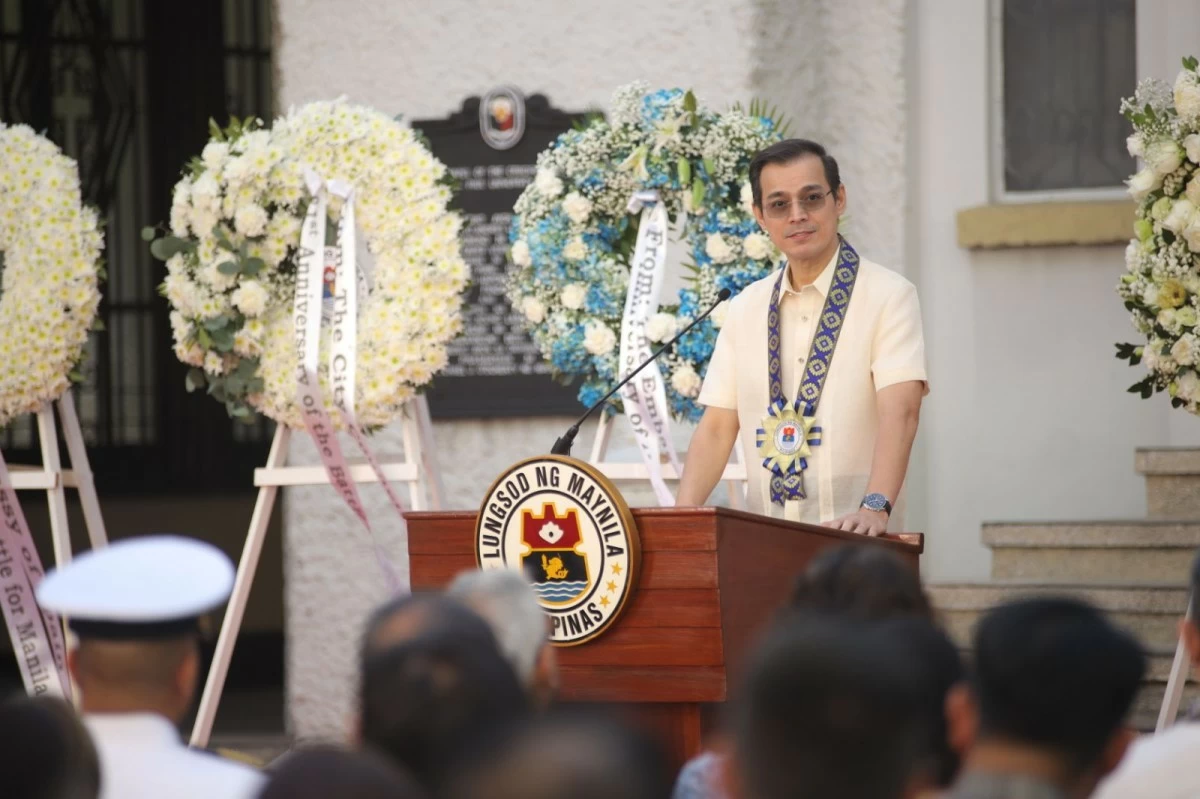
The commemoration was held at St. Paul University Manila and attended by diplomats, veterans, government officials, and city leaders.
Domagoso said the observance was not merely about recalling a historical date but about standing on “sacred ground” that once sheltered civilians during the darkest days of the 1945 battle, when large parts of Manila were destroyed.
“Eighty years ago, the city was devastated, but it was also liberated. The cost was unimaginable: lives lost, families broken, a city reduced to rubble,” the mayor said.
He described Manila’s postwar recovery as a defining lesson for the present, saying resilience does not mean forgetting pain but choosing to rebuild despite it.
“From the ravages of war, Manila rose. And in doing so, showed the world what true resilience means,” Domagoso said.
The mayor said the city remembers the Battle for Manila not to reopen wounds but to learn from history, heal as a people, and move forward together, stressing the role of forgiveness guided by faith and conscience.
“We do not forget, but we forgive. In not forgetting, you will be reminded of what happened in the past so that the decisions we make today will carry the lessons of that story,” he said.
Domagoso paid tribute to Filipino veterans present at the ceremony, calling them living witnesses whose sacrifices made today’s freedoms possible.
“Freedom is not free. These veterans paid, most of them, the ultimate price of our independence and freedom that we enjoy today,” he said.
Turning to present-day governance, the mayor said the threats facing Manila may no longer come in the form of war but remain serious, citing disasters intensified by climate change, public health emergencies, as well as disinformation and cyber threats that undermine trust and social cohesion.
“For a city like Manila, dense, coastal, and deeply interconnected, these risks are not abstract; they are part of our everyday governance,” Domagoso said.
He said the central lesson of the Battle for Manila remains that no city survives alone, adding that modern resilience must be anchored on preparedness and bayanihan.
Domagoso noted that Manila’s postwar rebuilding was achieved through cooperation among local, national, and international partners — a spirit he said remains vital in addressing today’s challenges.
Closing his remarks, the mayor appealed for unity and cooperation.
“Tulungan niyo po ako (Please help me). Build, rebuild, make Manila prosperous. Because with your help, all of us here together, we can make Manila great again,” Domagoso said.