ADVERTISEMENT

From journey to global stage: The journey of a young innovator

Published Jan 31, 2026 05:15 pm
FAALA
FAALA
BACOLOD CITY – What began as a simple curiosity has grown into a journey that continues to reshape the life of a young innovator from Negros Occidental.
More than the awards and recognitions, Ceejay Faala's story is rooted in a desire to learn, create, and make education more accessible for others.
Today, he hopes to inspire fellow students of Carlos Hilado Memorial State University (CHMSU) and young innovators to collaborate on projects that respond to real challenges in education and beyond.
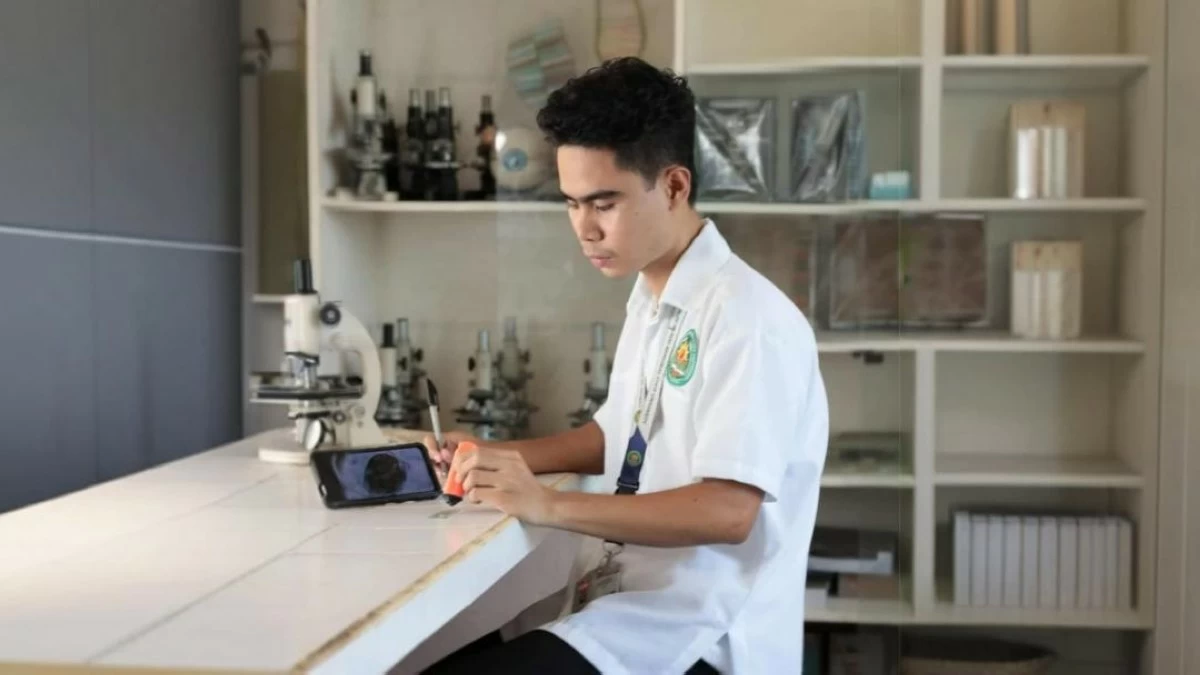
He took Bachelor of Secondary Education major in Science from the CHMSU Binalbagan Campus, and developed what he describes as “one of the smallest, pen-sized digital microscopes” using recycled materials, including scrap electronics, under the guidance of research adviser Alberto de la Cruz.
Faala shared that the idea for the Pencroscope was to give every student, no matter where they are, the chance to explore the microscopic world with their own eyes. “Because curiosity shouldn’t be limited by lack of resources – and every child deserves to see what they’re learning,” he said.
Driven by that vision, Faala created a tool that lets users explore the microscopic world in real-time. The Pencroscope houses a high-resolution camera sensor behind a powerful lens capable of magnifying objects up to 400 times.
It captures live images and streams them wirelessly to a phone, tablet, or computer screen. An attachable LED light ensures clarity, and the device is powered by a rechargeable battery with wireless charging, eliminating the need for cords. Notably, it’s also IP66 waterproof, making it suitable for real-world learning environments.
While traditional digital microscopes tend to be bulky, wired, and industry-focused, the Pencroscope is handheld, portable, and built for students, teachers, and science enthusiasts. It reimagines science learning by bringing interactive exploration directly into the hands of learners – no lab required.
Faala plans to continue refining the Pencroscope’s magnification, battery life, and user interface, and hopes to collaborate with local schools and science programs for wider adoption. For business development, he aims to partner with educational suppliers and seek funding for small-scale manufacturing.
“Eventually, I want the Pencroscope to become a standard tool in science education – not just in the Philippines, but globally,” he shared.
Faala’s invention, the Pencroscope – now in the process of securing a patent – represents countless hours of trial, learning, and perseverance.
Each milestone has affirmed his belief that innovation does not require perfection, only purpose.
That belief carried him to the international stage when he was named a student finalist in the Times Higher Education (THE) Awards Asia, held on April 23, 2025, at the Galaxy International Convention Center in Cotai, Macau.
Selected from over 500 entries across 49 countries, Faala stood among seasoned academics and experts – an experience that left a lasting mark.
“I may not win, but being the youngest nominee standing among experts and professors is already a great experience. I hope this becomes my next open door,” he said.
The Pencroscope had also officially entered into the prestigious James Dyson Award (JDA) 2025, which primarily targets students and graduates in engineering, industrial design, or product design.
It was organized by the James Dyson Foundation, a global competition celebrating innovative designs that can solve real world problems, and highlights and supports emerging inventors and engineers.
Faala’s entry is now featured in the JDA Gallery and is available for global public viewing among over 2,000 entries worldwide.
His journey is still unfolding. Yet his story already serves as a reminder that curiosity can spark innovation, perseverance can overcome doubt, and one student’s idea – guided by purpose –can begin to change lives.

Related Tags

MB126
ADVERTISEMENT
.most-popular .layout-ratio{ padding-bottom: 79.13%; } @media (min-width: 768px) and (max-width: 1024px) { .widget-title { font-size: 15px !important; } }

{{ articles_filter_1561_widget.title }}

.most-popular .layout-ratio{ padding-bottom: 79.13%; } @media (min-width: 768px) and (max-width: 1024px) { .widget-title { font-size: 15px !important; } }

{{ articles_filter_1562_widget.title }}

.most-popular .layout-ratio{ padding-bottom: 79.13%; } @media (min-width: 768px) and (max-width: 1024px) { .widget-title { font-size: 15px !important; } }

{{ articles_filter_1563_widget.title }}

{{ articles_filter_1564_widget.title }}

.mb-article-details { position: relative; } .mb-article-details .article-body-preview, .mb-article-details .article-body-summary{ font-size: 17px; line-height: 30px; font-family: "Libre Caslon Text", serif; color: #000; } .mb-article-details .article-body-preview iframe , .mb-article-details .article-body-summary iframe{ width: 100%; margin: auto; } .read-more-background { background: linear-gradient(180deg, color(display-p3 1.000 1.000 1.000 / 0) 13.75%, color(display-p3 1.000 1.000 1.000 / 0.8) 30.79%, color(display-p3 1.000 1.000 1.000) 72.5%); position: absolute; height: 200px; width: 100%; bottom: 0; display: flex; justify-content: center; align-items: center; padding: 0; } .read-more-background a{ color: #000; } .read-more-btn { padding: 17px 45px; font-family: Inter; font-weight: 700; font-size: 18px; line-height: 16px; text-align: center; vertical-align: middle; border: 1px solid black; background-color: white; } .hidden { display: none; }
function initializeAllSwipers() { // Get all hidden inputs with cms_article_id document.querySelectorAll('[id^="cms_article_id_"]').forEach(function (input) { const cmsArticleId = input.value; const articleSelector = '#article-' + cmsArticleId + ' .body_images'; const swiperElement = document.querySelector(articleSelector); if (swiperElement && !swiperElement.classList.contains('swiper-initialized')) { new Swiper(articleSelector, { loop: true, pagination: false, navigation: { nextEl: '#article-' + cmsArticleId + ' .swiper-button-next', prevEl: '#article-' + cmsArticleId + ' .swiper-button-prev', }, }); } }); } setTimeout(initializeAllSwipers, 3000); const intersectionObserver = new IntersectionObserver( (entries) => { entries.forEach((entry) => { if (entry.isIntersecting) { const newUrl = entry.target.getAttribute("data-url"); if (newUrl) { history.pushState(null, null, newUrl); let article = entry.target; // Extract metadata const author = article.querySelector('.author-section').textContent.replace('By', '').trim(); const section = article.querySelector('.section-info ').textContent.replace(' ', ' '); const title = article.querySelector('.article-title h1').textContent; // Parse URL for Chartbeat path format const parsedUrl = new URL(newUrl, window.location.origin); const cleanUrl = parsedUrl.host + parsedUrl.pathname; // Update Chartbeat configuration if (typeof window._sf_async_config !== 'undefined') { window._sf_async_config.path = cleanUrl; window._sf_async_config.sections = section; window._sf_async_config.authors = author; } // Track virtual page view with Chartbeat if (typeof pSUPERFLY !== 'undefined' && typeof pSUPERFLY.virtualPage === 'function') { try { pSUPERFLY.virtualPage({ path: cleanUrl, title: title, sections: section, authors: author }); } catch (error) { console.error('ping error', error); } } // Optional: Update document title if (title && title !== document.title) { document.title = title; } } } }); }, { threshold: 0.1 } ); function showArticleBody(button) { const article = button.closest("article"); const summary = article.querySelector(".article-body-summary"); const body = article.querySelector(".article-body-preview"); const readMoreSection = article.querySelector(".read-more-background"); // Hide summary and read-more section summary.style.display = "none"; readMoreSection.style.display = "none"; // Show the full article body body.classList.remove("hidden"); } document.addEventListener("DOMContentLoaded", () => { let loadCount = 0; // Track how many times articles are loaded const offset = [1, 2, 3, 4, 5, 6, 7, 8, 9, 10]; // Offset values const currentUrl = window.location.pathname.substring(1); let isLoading = false; // Prevent multiple calls if (!currentUrl) { console.log("Current URL is invalid."); return; } const sentinel = document.getElementById("load-more-sentinel"); if (!sentinel) { console.log("Sentinel element not found."); return; } function isSentinelVisible() { const rect = sentinel.getBoundingClientRect(); return ( rect.top < window.innerHeight && rect.bottom >= 0 ); } function onScroll() { if (isLoading) return; if (isSentinelVisible()) { if (loadCount >= offset.length) { console.log("Maximum load attempts reached."); window.removeEventListener("scroll", onScroll); return; } isLoading = true; const currentOffset = offset[loadCount]; window.loadMoreItems().then(() => { let article = document.querySelector('#widget_1690 > div:nth-last-of-type(2) article'); intersectionObserver.observe(article) loadCount++; }).catch(error => { console.error("Error loading more items:", error); }).finally(() => { isLoading = false; }); } } window.addEventListener("scroll", onScroll); });

Sign up by email to receive news.