ADVERTISEMENT

Philippine leads regional push to revive investor confidence after 2025 headwinds

Published Jan 28, 2026 11:21 pm
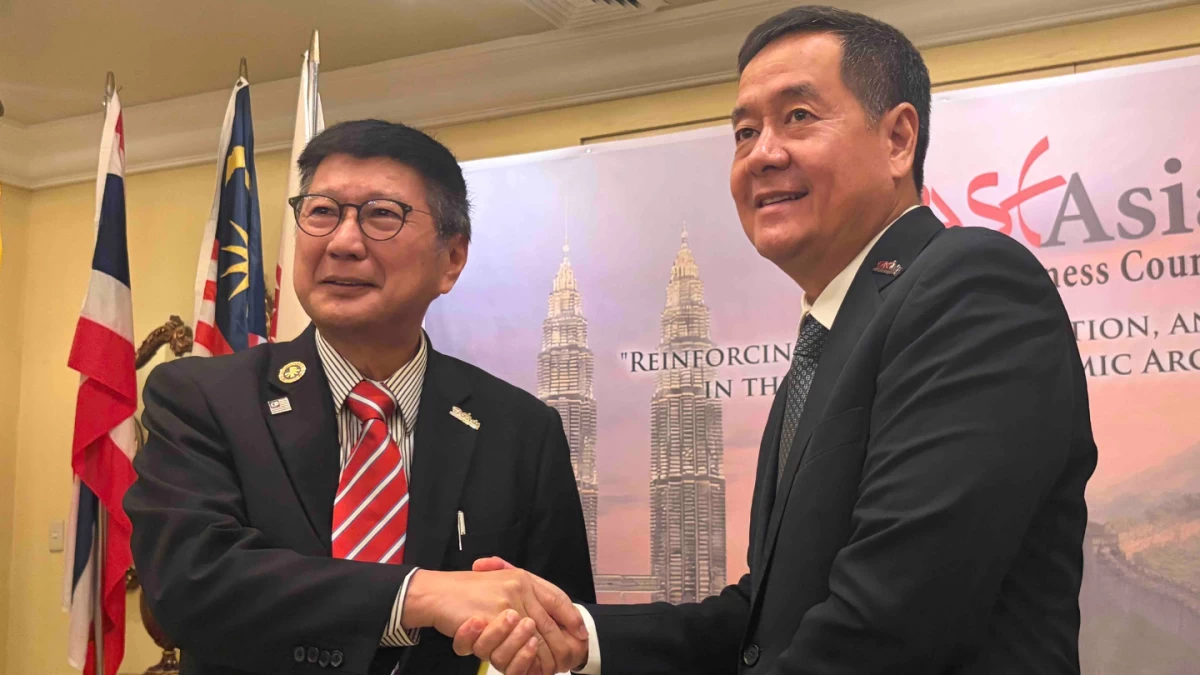
Outgoing EABC Chair (2025) Tan Sri Dato' Soh Thian Lai (left) and incoming EABC Chair (2026) Jay Yuvallos during the chairmanship turnover ceremony on Jan. 28. (Dexter Barro II/MANILA BULLETIN)
The Philippines will focus on building a transparent and predictable business environment for the region to revive investor confidence as it assumes the chairmanship of the East Asia Business Council (EABC).
EABC Chair Jay Yuvallos said the country’s chairmanship of the 39-member business council will focus on reinforcing the confidence of investors as one of its core priorities for the year.
Yuvallos said investment decisions depend on certainty, a critical element that the region struggled to attain last year amid global and regional headwinds.
“EABC will continue to support policy dialogue that promotes good governance, clearer operating rules and a stronger overall environment for long-term business planning and cross-border investment,” he said during the turnover ceremony of the EABC chairmanship on Wednesday, Jan. 28.
This, he said, is particularly vital for the Philippines amid weaker investment sentiment last year following the corruption scandal in the public works sector.
“We are putting that on purpose, because we really need to regain the trust, and we need to reinforce and take care of the trust for the Philippines [which] has been eroded, but we can always do something about it and bounce back from this,” he added.
Complementing these efforts, the country will also focus on deepening the utilization of the Regional Comprehensive Economic Partnership (RCEP) to benefit micro, small, and medium enterprises (MSMEs) this year.
Yuvallos said the RCEP framework offers strong growth potential, but its impact ultimately depends on how effectively companies use it in practice.
“We hope to continue supporting efforts that improve awareness, simplify processes and strengthen confidence among businesses so that RCEP becomes a tool that delivers clear commercial value, particularly for smaller firms,” he said.
RCEP is a free trade agreement (FTA) that the country entered into alongside members of the Association of Southeast Asian Nations (ASEAN), China, Japan, South Korea, Australia, and New Zealand.
The agreement was envisioned to create a more business-friendly environment, encourage closer integration of economies, and provide a more stable and predictable rules-based system of trade between members.
Under the RCEP, countries benefit from lower or zero tariffs, broader sourcing of raw materials, and enhanced trade facilitation, among other benefits.
RCEP was meant to level the playing field, but only developed economies have largely benefited from the deal, according to the EABC.
“The numbers speak for itself, the more advanced economies are benefiting more from it compared to us. So we want to change that,” said Yuvallos.
EABC plans to leverage the “best practices” of the Korea International Trade Association (KITA) and the Japan Chamber of Commerce and Industry (JCCI) not only to raise awareness of the RCEP, but also to help businesses take advantage of the agreement.
Through these efforts, Yuvallos said MSMEs can take a more active role in the regional value chain, further expanding their business and contributions to their respective economies.
The business council is also seeking to harmonize digital payments across the region to further accelerate trade amid delays and costs associated with varying payment infrastructure among RCEP members.
“We're going to harmonize the digital trade platforms within the region. We're going to work on minimizing or, if not eliminating, these barriers of trade, especially on the payment platform,” Yuvallos said.
As EABC chair, another key priority for the country is to advance sustainability efforts and the circular economy “in ways that are realistic and workable for businesses.”
Yuvallos noted that many companies, especially MSMEs, want to participate in the green transition but face constraints in cost, capability and access to practical guidance.
“EABC will support approaches that strengthen competitiveness while making sustainability more achievable across the region,” he said.
ADVERTISEMENT
.most-popular .layout-ratio{ padding-bottom: 79.13%; } @media (min-width: 768px) and (max-width: 1024px) { .widget-title { font-size: 15px !important; } }

{{ articles_filter_1561_widget.title }}

.most-popular .layout-ratio{ padding-bottom: 79.13%; } @media (min-width: 768px) and (max-width: 1024px) { .widget-title { font-size: 15px !important; } }

{{ articles_filter_1562_widget.title }}

.most-popular .layout-ratio{ padding-bottom: 79.13%; } @media (min-width: 768px) and (max-width: 1024px) { .widget-title { font-size: 15px !important; } }

{{ articles_filter_1563_widget.title }}

{{ articles_filter_1564_widget.title }}

.mb-article-details { position: relative; } .mb-article-details .article-body-preview, .mb-article-details .article-body-summary{ font-size: 17px; line-height: 30px; font-family: "Libre Caslon Text", serif; color: #000; } .mb-article-details .article-body-preview iframe , .mb-article-details .article-body-summary iframe{ width: 100%; margin: auto; } .read-more-background { background: linear-gradient(180deg, color(display-p3 1.000 1.000 1.000 / 0) 13.75%, color(display-p3 1.000 1.000 1.000 / 0.8) 30.79%, color(display-p3 1.000 1.000 1.000) 72.5%); position: absolute; height: 200px; width: 100%; bottom: 0; display: flex; justify-content: center; align-items: center; padding: 0; } .read-more-background a{ color: #000; } .read-more-btn { padding: 17px 45px; font-family: Inter; font-weight: 700; font-size: 18px; line-height: 16px; text-align: center; vertical-align: middle; border: 1px solid black; background-color: white; } .hidden { display: none; }
function initializeAllSwipers() { // Get all hidden inputs with cms_article_id document.querySelectorAll('[id^="cms_article_id_"]').forEach(function (input) { const cmsArticleId = input.value; const articleSelector = '#article-' + cmsArticleId + ' .body_images'; const swiperElement = document.querySelector(articleSelector); if (swiperElement && !swiperElement.classList.contains('swiper-initialized')) { new Swiper(articleSelector, { loop: true, pagination: false, navigation: { nextEl: '#article-' + cmsArticleId + ' .swiper-button-next', prevEl: '#article-' + cmsArticleId + ' .swiper-button-prev', }, }); } }); } setTimeout(initializeAllSwipers, 3000); const intersectionObserver = new IntersectionObserver( (entries) => { entries.forEach((entry) => { if (entry.isIntersecting) { const newUrl = entry.target.getAttribute("data-url"); if (newUrl) { history.pushState(null, null, newUrl); let article = entry.target; // Extract metadata const author = article.querySelector('.author-section').textContent.replace('By', '').trim(); const section = article.querySelector('.section-info ').textContent.replace(' ', ' '); const title = article.querySelector('.article-title h1').textContent; // Parse URL for Chartbeat path format const parsedUrl = new URL(newUrl, window.location.origin); const cleanUrl = parsedUrl.host + parsedUrl.pathname; // Update Chartbeat configuration if (typeof window._sf_async_config !== 'undefined') { window._sf_async_config.path = cleanUrl; window._sf_async_config.sections = section; window._sf_async_config.authors = author; } // Track virtual page view with Chartbeat if (typeof pSUPERFLY !== 'undefined' && typeof pSUPERFLY.virtualPage === 'function') { try { pSUPERFLY.virtualPage({ path: cleanUrl, title: title, sections: section, authors: author }); } catch (error) { console.error('ping error', error); } } // Optional: Update document title if (title && title !== document.title) { document.title = title; } } } }); }, { threshold: 0.1 } ); function showArticleBody(button) { const article = button.closest("article"); const summary = article.querySelector(".article-body-summary"); const body = article.querySelector(".article-body-preview"); const readMoreSection = article.querySelector(".read-more-background"); // Hide summary and read-more section summary.style.display = "none"; readMoreSection.style.display = "none"; // Show the full article body body.classList.remove("hidden"); } document.addEventListener("DOMContentLoaded", () => { let loadCount = 0; // Track how many times articles are loaded const offset = [1, 2, 3, 4, 5, 6, 7, 8, 9, 10]; // Offset values const currentUrl = window.location.pathname.substring(1); let isLoading = false; // Prevent multiple calls if (!currentUrl) { console.log("Current URL is invalid."); return; } const sentinel = document.getElementById("load-more-sentinel"); if (!sentinel) { console.log("Sentinel element not found."); return; } function isSentinelVisible() { const rect = sentinel.getBoundingClientRect(); return ( rect.top < window.innerHeight && rect.bottom >= 0 ); } function onScroll() { if (isLoading) return; if (isSentinelVisible()) { if (loadCount >= offset.length) { console.log("Maximum load attempts reached."); window.removeEventListener("scroll", onScroll); return; } isLoading = true; const currentOffset = offset[loadCount]; window.loadMoreItems().then(() => { let article = document.querySelector('#widget_1690 > div:nth-last-of-type(2) article'); intersectionObserver.observe(article) loadCount++; }).catch(error => { console.error("Error loading more items:", error); }).finally(() => { isLoading = false; }); } } window.addEventListener("scroll", onScroll); });

Sign up by email to receive news.