






Manila Bulletin
 Business
Trade & Industry
Philippine EV investments in jeopardy after President vetoes tax incentives
Business
Trade & Industry
Philippine EV investments in jeopardy after President vetoes tax incentives
Business
Trade & Industry
Philippine EV investments in jeopardy after President vetoes tax incentives
Philippine EV investments in jeopardy after President vetoes tax incentives
Published Jan 12, 2026 03:37 pm


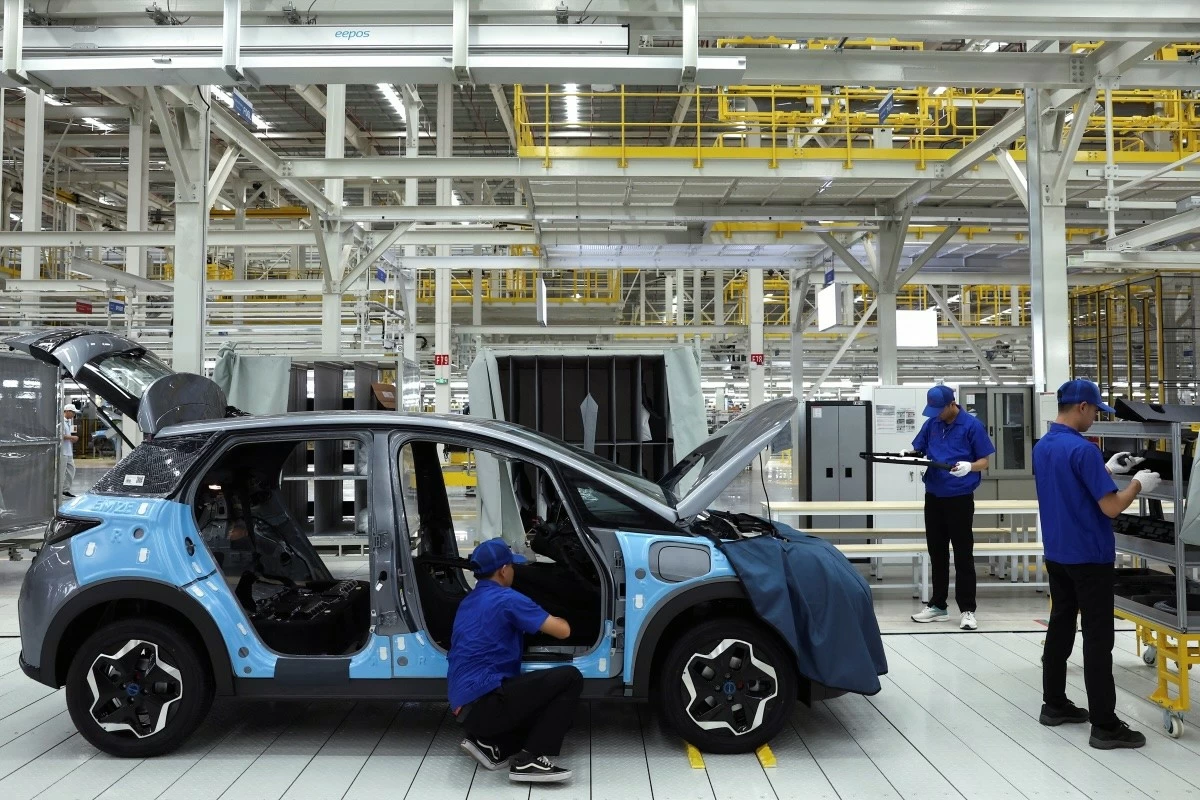
(EVAP photo)
The Electric Vehicle Association of the Philippines (EVAP) is urging the Marcos administration to reinstate funding for two automotive manufacturing incentive programs, warning that inaction could weaken the country’s growing EV sector.
EVAP president Edmund Araga said an industrial policy aimed at strengthening the automotive industry should be in place as the country undergoes a transition towards clean energy and electric mobility.
He said such a policy was already implemented under the Comprehensive Automotive Resurgence Strategy (CARS) program, and its successor Revitalizing the Automotive Industry for Competitiveness Enhancement (RACE).
However, the budget for CARS and RACE was scrapped as part of the unprogrammed appropriations vetoed by President Ferdinand “Bongbong” Marcos Jr. in this year’s national budget.
For EVAP, the transition to electric mobility cannot succeed in isolation, and must instead be anchored on a competitive local automotive manufacturing base.
“Electric vehicles are still vehicles. They rely on the same manufacturing ecosystem, supply chains, skilled workers, and industrial infrastructure that support conventional automotive production. If the local automotive industry weakens, the EV sector will struggle to scale,” said Araga.
“Reinstating support for CARS and RACE is a critical step toward ensuring that the country remains competitive in both automotive manufacturing and electric mobility,” he added.
Both CARS and RACE grant incentives to attract strategic investments in the manufacturing of vehicles and their components in the country.
Under CARS, which was supposed to have a budget of ₱4.32-billion, fiscal support is provided for companies that produce at least 200,000 units of their enrolled model within six years.
Toyota Motor Philippines Corp. (TMPC) and Mitsubishi Motors Philippines Corp. (MMPC) are the two participants of the program, where they enrolled the Vios and Mirage models, respectively.
RACE, which had a proposed ₱250-million funding, intends to focus on the manufacturing of four-wheeled internal combustion engine vehicles although with a lower production requirement.
EVAP said these programs were meant to help develop the country’s automotive manufacturing sector to reach the same level as neighboring countries.
The group noted that countries such as Thailand, Indonesia, and Vietnam are now leaders in the EV industry, largely due to their strong internal combustion engine manufacturing base.
“The global experience is clear. Countries that are winning in EVs today are the same countries that protected and nurtured their automotive industries for decades. EVs are the next chapter of automotive manufacturing, not a replacement for the ecosystem,” said Araga.
Araga emphasized that losing the funding to develop the local sector would have a huge impact on potential investments in the EV industry.
He said investors look at the incentive system and the level of production of domestic vehicle assembly and parts manufacturing when making a decision to invest in a manufacturing plant.
“Without sufficient production volume and government support, these investments become difficult to justify,” he said.
EVAP is the latest industry group to denounce the veto of the funding for CARS and RACE programs. Previously, the Chamber of Automotive Manufacturers of the Philippines Inc. (CAMPI) and the Philippine Parts Makers Association (PPMA) also voiced their opposition.