






Manila Bulletin
 Philippines
National
Shifting threats: How 2025 tested the AFP beyond the battlefield
Philippines
National
Shifting threats: How 2025 tested the AFP beyond the battlefield
Philippines
National
Shifting threats: How 2025 tested the AFP beyond the battlefield
Shifting threats: How 2025 tested the AFP beyond the battlefield
A year-ender story on the current state of Philippine defense and security
Published Dec 30, 2025 09:02 pm


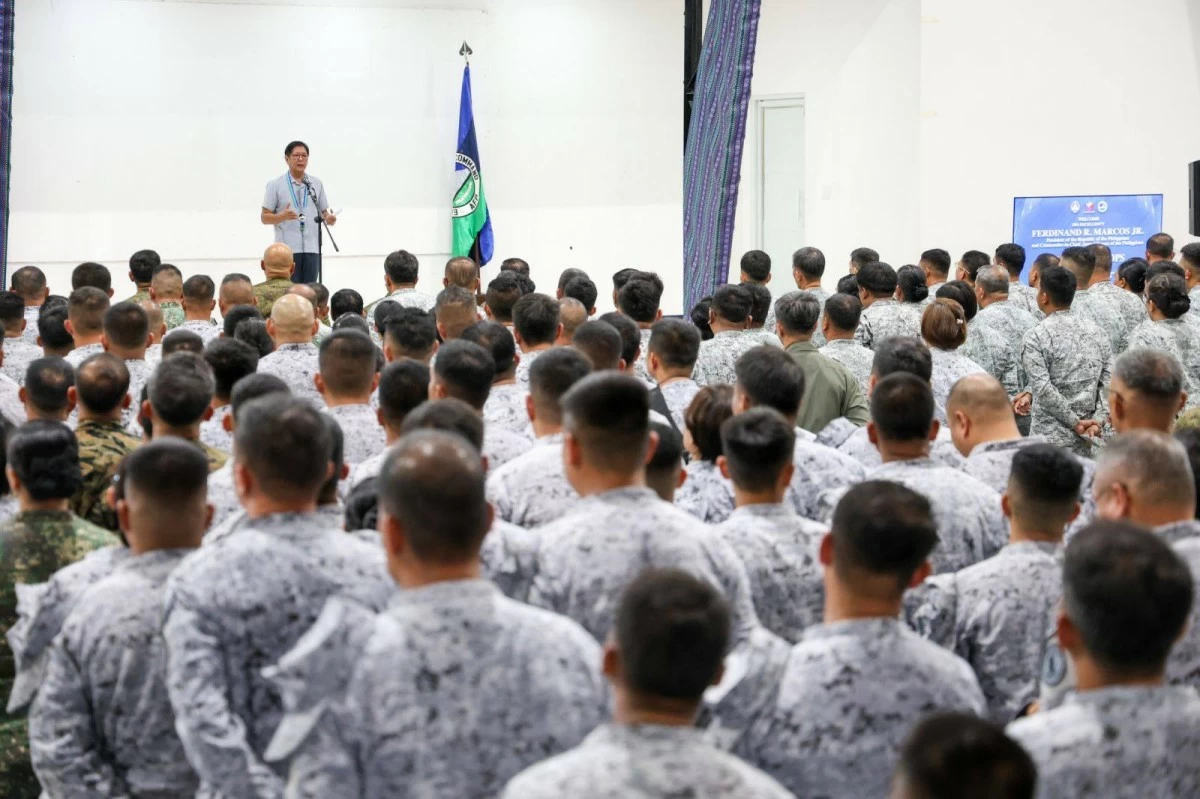
President Ferdinand R. Marcos Jr., Commander-in-Chief of the Armed Forces of the Philippines (AFP), visits the Eastern Mindanao Command (EASTMINCOM) headquarters at Naval Station Felix Apolinario in Panacan, Davao City on December 4, 2025 as part of his regular engagements to review the Command’s operational progress. (Photo: AFP)
The year 2025 placed the Philippine defense and security sector under sustained pressure. The threats came from multiple directions on land, at sea, in the air, in cyberspace, and in the corridors of power.
This prompted the Armed Forces of the Philippines (AFP) to defend territory, guard institutions, and respond to crises without crossing political lines. The military spent more time preparing for war and, at the same time, proving restraint in the face of great challenges.
Let’s take a look at how the passing year shaped the landscape of the country’s security which highlighted the multiple fronts where threats emerged and the ways the AFP adapted.
Troubled waters
In the West Philippine Sea (WPS), Chinese vessels shadowed, harassed, and blocked Filipino fishermen and government patrols throughout the year.
“China’s illegal presence has been in the West Philippine Sea for quite some time now. Every now and then, they carry out coercive and aggressive actions that are especially dangerous when directed against our fisherfolk,” said Rear Adm. Roy Vincent Trinidad, AFP spokesperson for WPS.
In February, the AFP reported 260 Chinese ships in disputed waters near Ayungin (Second Thomas) Shoal, Bajo de Masinloc (Scarborough or Panatag Shoal), and Escoda (Sabina) Shoal, marking one of the most concentrated displays of Chinese maritime presence in years.
Encounters between Philippine forces and Chinese vessels became more frequent and more dangerous. Chinese Coast Guard (CCG) ships, People’s Liberation Army – Navy (PLA-N) warships, and maritime militia vessels used water cannons and risky maneuvers against Filipino fishermen and during resupply missions.
In one high-profile incident on August 11, a Chinese PLA-N destroyer and a CCG cutter maneuvered aggressively near Philippine Coast Guard (PCG) ship BRP Suluan in Bajo de Masinloc. However, the Chinese vessels ended up colliding into each other when the PCG ship masterfully evaded their aggressive maneuvers. Casualties were feared but the Chinese government did not confirm this.
On December 12, the PCG also reported that Chinese vessels targeted Filipino fishing boats near Escoda Shoal with water cannons and blocking tactics. Three fishermen were hurt in the incident.
The Philippine government filed repeated diplomatic protests against these harassments, as well as Beijing’s plan to establish a maritime reserve in Bajo de Masinloc, which experts warned could be a tactic by the Asian superpower to control the entire South China Sea.
The AFP and PCG answered by sustaining patrols and documenting encounters. Manila also widened the circle of partners present in contested waters. Maritime cooperative activities (MCAs) were conducted with the United States, Japan, Australia, France, and other like-minded countries, sending a message of unity rather than provocation.
‘Cyberwar’
The tension felt by the AFP was not limited to the surface. Authorities reported cyber intrusions targeting government and maritime systems. Security agencies linked several attacks to foreign state-aligned actors.
Investigations led to the arrest of five Chinese nationals accused of espionage and intelligence gathering near military facilities and critical infrastructure in January.
The AFP said the suspects conducted aerial reconnaissance with drones and collected imagery on naval facilities and ports. President Ferdinand Marcos Jr. said he was “very disturbed” by the espionage activities and ordered increased oversight of foreign intelligence operations.
Separate operations led to the arrest of six more suspected Chinese spies and one Filipino in Zambales, where surveillance photos and documents were found. In April, another Chinese national was arrested and authorities seized from him an International Mobile Subscriber Identity (IMSI) catcher device capable of intercepting communications near strategic areas.
The succession of espionage arrests over the year signaled a shift in threat perception. The AFP increasingly saw intelligence operations as part of the broader security landscape.
Modernizing the military
Against this backdrop, the AFP pushed forward with long-planned modernization under the Re-Horizon 3, a new procurement plan that overhauled what was supposed to be the third and final horizon of the 15-year defense spending.
“We are modernizing. We are now on Re-horizon 3 of our modernization program. We are heavily investing in maritime assets, aerial assets, and cybersecurity. That is our path toward modernization,” Padilla, the AFP spokesperson, said.
In 2025, the Philippine Navy (PN) received its first pair of HDF‑3200 guided‑missile hybrid frigates, the BRP Miguel Malvar and BRP Diego Silang, built by South Korean shipbuilder Hyundai Heavy Industries.
These frigates, equipped with surface‑to‑air and anti‑ship missiles, were designed to enhance deterrence and credible defense in contested waters.
In addition, the Navy also received BRP Albert Majini, a missile‑capable fast attack interdiction craft (FAIC‑M), in May.
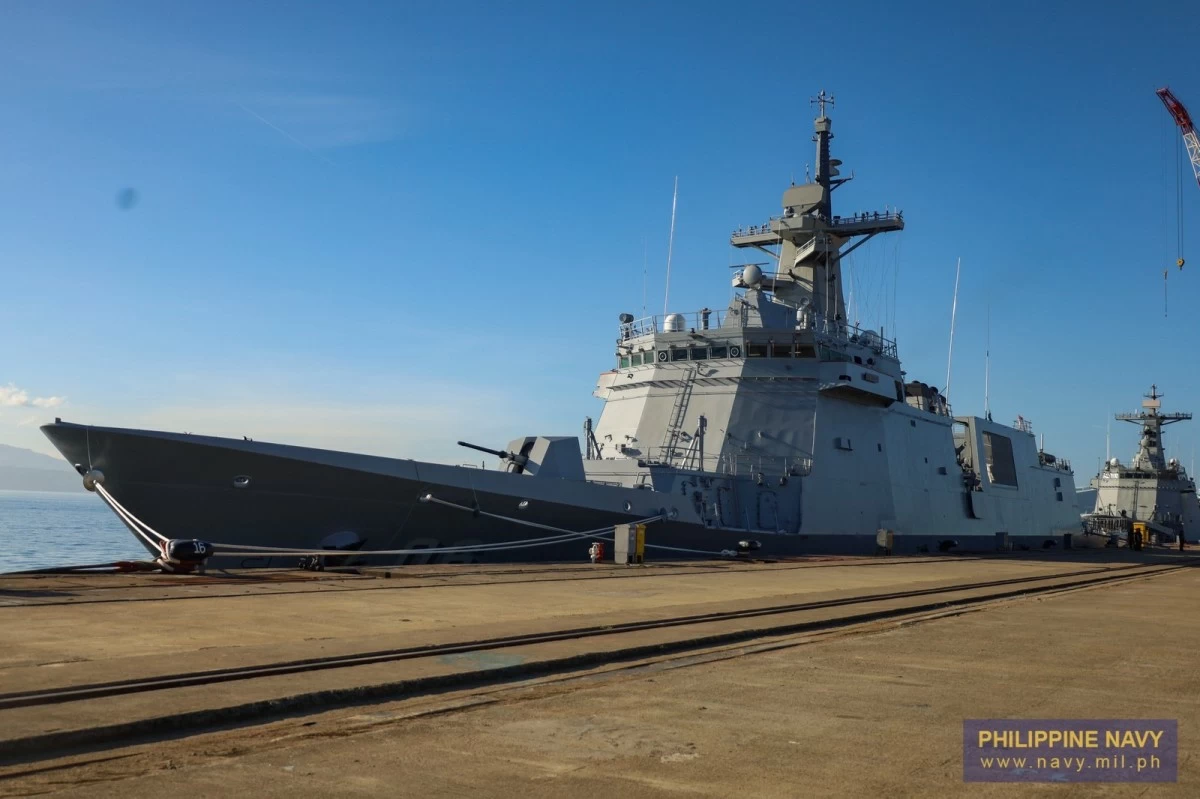
BRP Miguel Malvar (PHoto: Philippine Navy)
For the Philippine Air Force (PAF), at least 10 S-70 Black Hawk combat utility helicopters were delivered this year. The PAF also inked a deal with Korea Aerospace Industries (KAI) to acquire 12 additional FA-50PH light fighter jets for USD 700 million or around P40 billion.
The Philippine Army (PA) began integrating unmanned systems into its operations. At a September event, the Army Reserve Command showcased its growing unmanned aerial vehicle (UAV) capabilities for intelligence, surveillance, and reconnaissance operations.
The PA also formalized partnerships with academic institutions and technology developers to advance robotics and automated defense, one of which was the SAFEGUARD Robot, short for Surveillance and Field Evaluator for Ground-based Unmanned Autonomous Robot, which can survey hostile or unfamiliar terrain, assess sites after disasters or combat, and collect visual and environmental data without putting troops at risk.
Corruption issues
At home, a different challenge tested the institution’s discipline. Allegations of massive corruption in flood control projects at the Department of Public Works and Highways triggered public anger.
Some retired officers and activist groups openly called for military intervention. But Department of National Defense (DND) Secretary Gilberto Teodoro Jr. and AFP Chief of Staff, General Romeo Brawner Jr. rejected any role in political power struggles. They stressed loyalty to the Constitution and civilian supremacy.
“We know what is happening, and we are just people also. We get angry and we are angry at what is happening to our country,” Brawner said during a forum hosted by the Foreign Correspondents Association of the Philippines (FOCAP) at Camp Aguinaldo in Quezon City on October 3.
“In the Armed Forces, we conduct ourselves properly, we try to do things properly. We promote transparency and accountability within our ranks, and yet we continue to see these things (corruption) happening in our country. We understand the sentiments of the people and, in fact, we are one with them in the fight against corruption,” he added.
What came with the troops’ fury were calls for Brawner from former military officers led by retired Air Force major general Romeo Poquiz, a vocal critic of the current administration, to withdraw the AFP’s support for President Marcos Jr.
Brawner said the rumored destabilization in the administration of President Marcos Jr. “is not true,” but he confirmed meeting Poquiz’ group to hear their grievances.
“This is not hidden, this is not new,” Brawner said, although he stressed that he rejected the retired officers’ call.
The coup rumors were tied to the September 21 anti-corruption protest that coincided with the commemoration of the declaration of martial law declared by former president Ferdinand Marcos Sr., the ousted dictator and father of the current President.
However, the AFP did assist in limited ways to investigate the corruption at DPWH as engineering and technical units helped verify alleged ghost projects, but the military’s role stayed within fact-finding support.
Disasters
As the public anger boils due to corruption, disaster risk reduction and management demanded action as lives were lost due to floods from powerful typhoons.
Natural disasters tested the military’s adaptability and the season’s first major test came with Super Typhoon Uwan in November. Unified commands deployed 349 disaster response task units (DRTU) and search, rescue, and retrieval (SRR) teams, backed by more than 2,500 military personnel and essential assets, across the archipelago to rescue stranded families, ferry supplies, and support local governments.
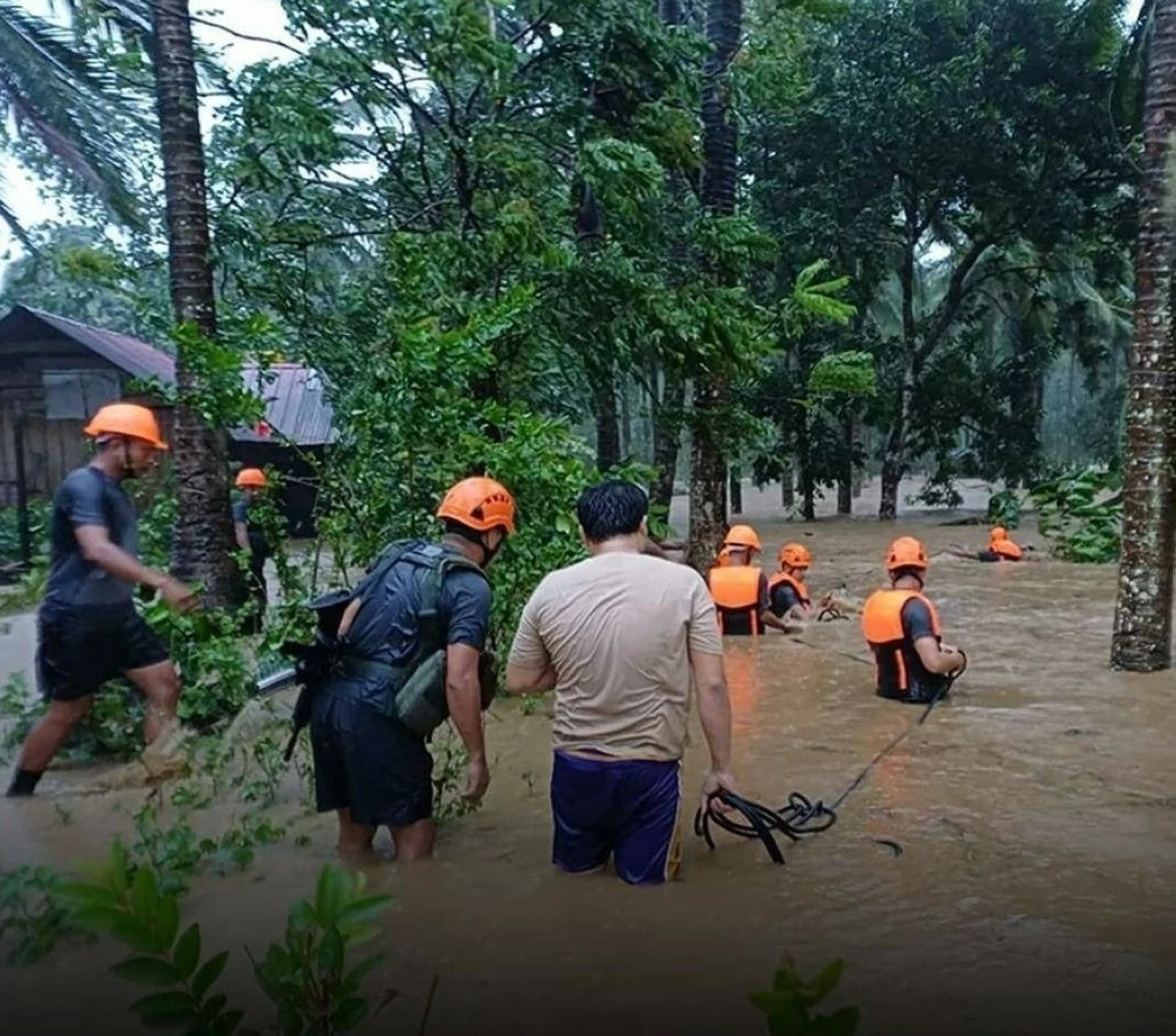
Philippine Army conduct search and rescue operations for victims of Super Typhoon Uwan on Nov. 10, 2025. (Photo: Philippine Army)
The devastation of Uwan followed closely on the heels of Typhoon Tino, which left at least 114 people dead and hundreds missing while dumping torrential rain and causing widespread flooding in the Visayas, particularly Cebu.
While storms ravaged coastal regions, the ground shook in Central and Eastern Visayas. A powerful 6.9‑magnitude earthquake struck northern Cebu province in September, collapsing homes and critical infrastructure. This was followed by doublet earthquakes with magnitudes 7.4 and 6.8 in Davao Oriental on October 10.
Rescue operations intensified as AFP personnel, alongside police, civilian volunteers, and search and rescue teams, worked round the clock to find survivors amid rubble and landslides.
Elsewhere in Negros province, Mount Kanlaon’s volcanic unrest in April and May prompted the AFP to place units on standby and coordinate with the Office of Civil Defense for immediate response. The military assured the public that troops and assets were ready to support evacuations, logistical needs, and community safety should eruption conditions worsen.
Domestic threats
On internal security, the AFP saw the further weakening of local terrorist groups and communist insurgents, led by the Communist Party of the Philippines (CPP) and its armed wing, the New People’s Army (NPA).
However, things took an interesting turn when father and son Sajid Akram, 50, an Indian national, and his son, Naveed Akram, 24, an Indian-Australian national, who were accused of killing 14 people during a mass shooting at the Bondi Beach in Sydney, Australia on December 14, were reported to have visited the Philippines weeks before they carried out the attack.
International news agencies were quick to report that the country remains as a “training hotspot” for terrorists and extremists, a claim denied by the AFP and other security agencies.
Brawner said the country’s current peaceful security situation, particularly in Mindanao, does not align with the claims that the Bondi Beach shooting suspects trained in the Philippines.
Records from the AFP showed that from a high of 1,257 local terrorists in 2016, the manpower of local terrorist groups has dropped to around 50 in 2025.
While not completely eliminated, Brawner noted that the sharp decline followed years of sustained military operations, peace initiatives, and community-based programs that are enough to prevent radicalization.
Between 2016 and 2025, government forces also neutralized 28 high-value individuals through armed encounters, arrests, and surrenders, the data noted.
Ten of these were group leaders including Abu Sayyaf Group (ASG) leader Isnilon Hapilon, who was killed during the Marawi Siege in October 2017; Maute Group leaders Abdullah Maute and Owaida Marohombsar alias Abu Dar, who were slain in August 2017 and March 2019 respectively; Mohammad Jaafar Maguid, leader of the Dawlah Islamiyah-Maguid Group (DI-MG), killed in January 2017; Salahuddin Hassan, leader of the Hassan Group, killed in October 2021;
Esmael Abdulmalik alias Abu Turaifie, leader of the Islamic State (IS)-linked Turaifie Group, who surrendered in August 2023; Fahrudin Hadji Satar alias Abu Bakar and Khadafi Mimbesa alias Engineer, leaders of DI-Maute Group, who were killed in June 2023 and January 2024 respectively; Bangsamoro Islamic Freedom Fighters (BIFF) leader Muhiddin Animbang, killed in April 2024; and most recently, Mohammad Usman Solaiman, leader of the DI–Hassan Group, who was killed in an encounter just last December 7.
The AFP said the neutralization of the terrorist leaders created a leadership vacuum while the remaining groups are fragmented, largely defensive, and no longer capable of planning or sustaining large-scale attacks.
The AFP also noted that there have been no recorded terrorist training activities, recruitment efforts, or major attacks by domestic terror groups since 2016. Given the developments in the security atmosphere in Mindanao, the AFP said terrorism threat levels in several areas of Western and Central Mindanao have shifted from high to low.
“That is why we do not see any basis for the claim that the two Bondi Beach gunmen trained here in the Philippines,” Brawner said.