






Manila Bulletin
 Business
Trade & Industry
Year-ender: Can renewables still hit the 35% power target?
Business
Trade & Industry
Year-ender: Can renewables still hit the 35% power target?
Business
Trade & Industry
Year-ender: Can renewables still hit the 35% power target?
Year-ender: Can renewables still hit the 35% power target?
Published Dec 26, 2025 08:43 am


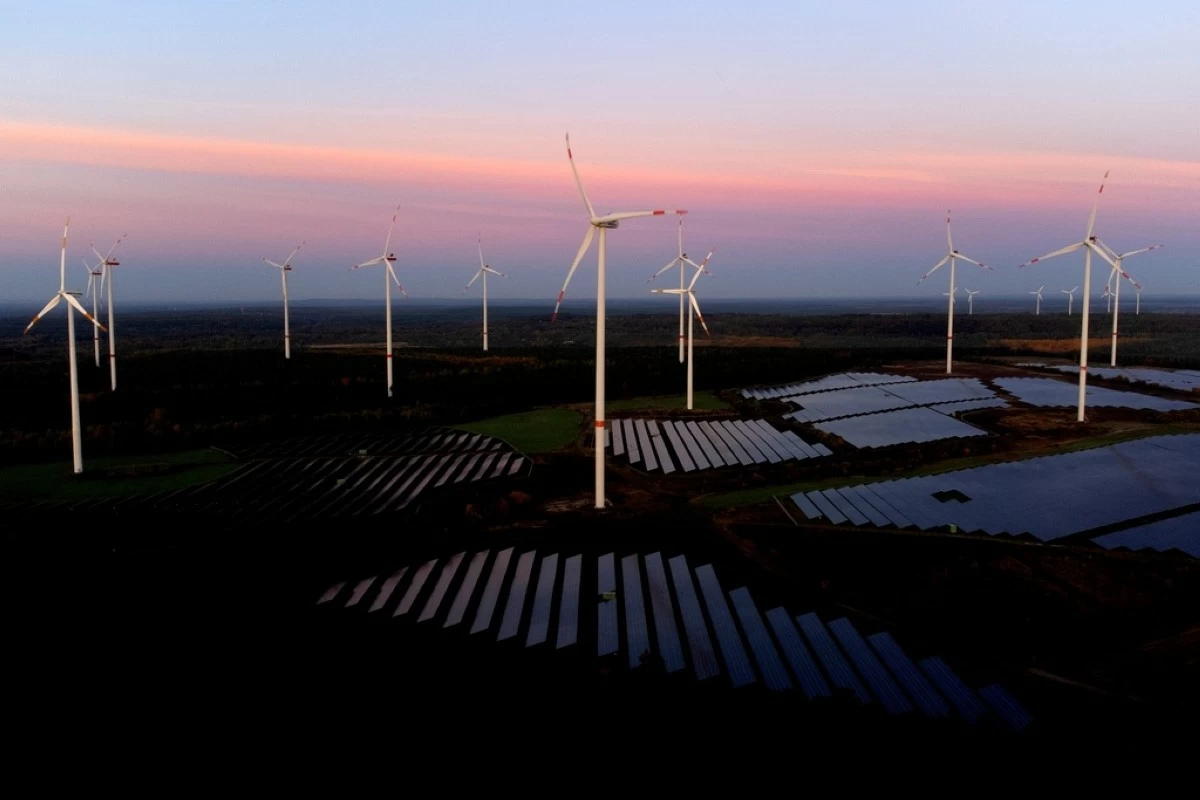
FILE - Wind turbines operate as the sun rises at the Klettwitz Nord solar energy park near Klettwitz, Germany, Oct. 16, 2024. (AP Photo/Matthias Schrader, File)
The renewable energy (RE) landscape is becoming increasingly competitive, as both the public and private sectors pursue technologies that could scale up efforts to reach a 35-percent clean energy share in the generation mix over the next five years. How is it shaping up so far, and is this goal still achievable?
During the first half of 2025, the Department of Energy (DOE) finally kicked off the third round of the Green Energy Auction (GEA-3), a program specifically intended for impounding hydropower, pumped-storage hydropower, and geothermal technologies.
GEA-3, which was initially scheduled to run in 2024, was pushed to the first quarter of 2025. The planned installation capacity eventually stood at 7,530 megawatts (MW) from 14 submitted projects.
Four months later, the DOE awarded multiple projects scheduled to begin generating power between 2025 and 2035—a 10-year leeway to accommodate larger developments, as these technologies typically require years of preparation before starting operations.
Even before the third RE bidding concluded, the agency saw no signs of slowing down its auction programs, as it unveiled GEA-4 to bid out ground-mounted, rooftop, and floating solar projects, as well as onshore wind and integrated RE and storage systems (IRESS).
While the latest round bore similarities to GEA-1 and GEA-2, the DOE awarded more winners by the second half of the year, eventually reaching a total subscribed capacity of around 10 gigawatts (GW). Most of these developers focused on ground-mounted solar projects.
Beyond government auctions, 2025 also saw massive private-sector RE ventures, with Meralco PowerGen Corp. (MGen) pioneering what could be the country’s—and possibly the world’s—largest solar and battery energy storage project, covering 3,500 hectares (ha) of land. The 2,500-megawatt-peak (MWp) solar facility continued development throughout the year and remains on track to begin commercial operations for its first phase by 2026.
This year also marked the unveiling of the world’s first utility-scale solar project within a residential community. Located in Naic, Cavite province, the 6.55-MWp Ning*Ning solar rooftop facility of Joy~Nostalg Group has been granted the right to install solar panels on homeowners’ rooftops for up to 50 years.
Beyond land-based RE, the DOE has further pushed to attract offshore wind (OSW) investments. It earlier awarded 92 service contracts (SCs) to developers, equivalent to about 65 GW of OSW capacity.
While optimism for OSW remains, some international investors reportedly grew hesitant to invest in the Philippines, as several SC holders signaled plans to divest their developments.
Several factors may have contributed to this, as Makati Business Club (MBC) previously noted that the country still needs to address gaps in port infrastructure, grid and transmission integration, and pricing, among others.
Still, the government remains optimistic. It delayed the auction to the fourth quarter to address similar concerns, and by November, it had kicked off the fixed-bottom OSW auction.
The DOE said developers that win the auction will be granted a 20-year supply period and Green Energy Tariff (GET) payments.
With GEA-5 underway, multiple companies have signaled interest in participating, including Ayala-led ACEN Corp. and NexGen Energy Corp., among others.
Even amid wariness toward larger RE technologies, allowing foreign investors full ownership of their assets has fueled rapid growth in clean energy investments, according to Juan Paolo Colet, managing director of Chinabank Capital Corp.
“Allowing full foreign ownership has been very beneficial. It has enabled significant investment in domestic RE development,” he told Manila Bulletin. “Foreign capital is particularly important for large-scale or complex projects, such as OSW farms or massive solar facilities.”
Energy Undersecretary Rowena Guevara said last August that the entry of international investors has attracted 75 ventures amounting to around 20 GW.
With the country experiencing La Niña conditions, hydropower generation also gained renewed attention in 2025. Earlier this year, state-run Power Sector Assets and Liabilities Management Corp. (PSALM) bid out the 797-MW Caliraya-Kalayaan-Botocan (CBK) hydropower complex, with two major consortia competing in an intense bidding duel. Thunder Consortium—comprising Aboitiz Renewables Inc., a unit of Aboitiz Power Corp. (AboitizPower), and Tokyo-based Sumitomo Corp. and Electric Power Development Co.—won the assets for ₱36.26 billion.
Next on the agenda is PSALM’s push to rehabilitate the 1,001-MW Agus-Pulangi hydropower complex, aiming to recover capacity that has fallen to around 300 to 400 MW. PSALM President Dennis Dela Serna earlier said the agency has received a rehabilitation proposal from a “known” consortium, though details remain undisclosed, potentially pushing the process into next year.
While the private sector seeks to take over existing hydropower assets, developers such as Lopez-led First Gen Corp. (FGen) and Repower Energy Development Corp. (REDC) posted strong financial growth from their facilities and are eyeing further expansion of their hydropower portfolios.
To further maximize the country’s natural resources, the DOE, with support from the Manila-based multilateral lender Asian Development Bank (ADB) and state-run Land Bank of the Philippines (Landbank), partnered to develop a geothermal de-risking facility aimed at encouraging developers to pursue costly exploration and drilling. Under the initiative, 50 percent of the drilling fund will be treated as a loan if the survey is successful or converted into a grant if exploration fails.
In addition, 2025 marked the year the energy industry was formally introduced to DOE-led carbon credit trading, following the release of a long-awaited framework designed to incentivize the early retirement of coal plants and their replacement with RE.
These wide-ranging initiatives have boosted clean energy capacity in the country’s generation mix. As of 2025, the DOE recorded 2,441.31 MW of RE targeted for commercial operation—nearly six times more than non-RE sources. The agency expects around 11 GW of RE to begin commercial operations over the next five years, including this year.
The Energy Regulatory Commission (ERC) also supported RE integration by lowering the contestable market threshold, adjusting the feed-in tariff allowance (FIT-All), and launching the Green Energy Auction allowance (GEA-All) to expand renewable participation.
Still, challenges remain. The DOE has allowed additional exemptions to the coal moratorium, while oil-based facilities are still under development.
“To encourage more RE projects, we need reasonable tariffs, adequate grid and other infrastructure, efficient permitting, and strong local community support,” Colet said.
Ser Percival K. Peña-Reyes, director at Ateneo Center for Economic Research and Development (ACERD), said that continued government incentives, long-term contracts, improved infrastructure, blended public-private funding, new financial instruments, risk mitigation tools, and corporate partnerships remain key to staying on track with the DOE’s targets.
“These are meant to help lower the cost of capital, reduce risk, and broaden access to financing so that renewable projects become more competitive and scalable,” he added.
Energy Secretary Sharon Garin, who assumed office this year, said she plans to continue the initiatives of her predecessor, Raphael P.M. Lotilla, now Secretary of the Department of Environment and Natural Resources (DENR).
Garin emphasized the need to pursue cleaner energy while ensuring energy security in 2026, highlighting geothermal and other scalable renewable technologies as alternatives to coal and diesel.