






Manila Bulletin
 Business
Banking & Finance
Year-ender: Flood control corruption, spending gaps cloud Philippines' 2025 growth
Business
Banking & Finance
Year-ender: Flood control corruption, spending gaps cloud Philippines' 2025 growth
Business
Banking & Finance
Year-ender: Flood control corruption, spending gaps cloud Philippines' 2025 growth
Year-ender: Flood control corruption, spending gaps cloud Philippines' 2025 growth
By Derco Rosal
Published Dec 26, 2025 12:00 am
|
Updated Dec 24, 2025 03:06 pm


At A Glance
- It could be said that the Philippines began the year on solid footing after hitting—or coming close to hitting—its goals in 2024. We were afloat. We were ready to swim through the waters throughout the year.
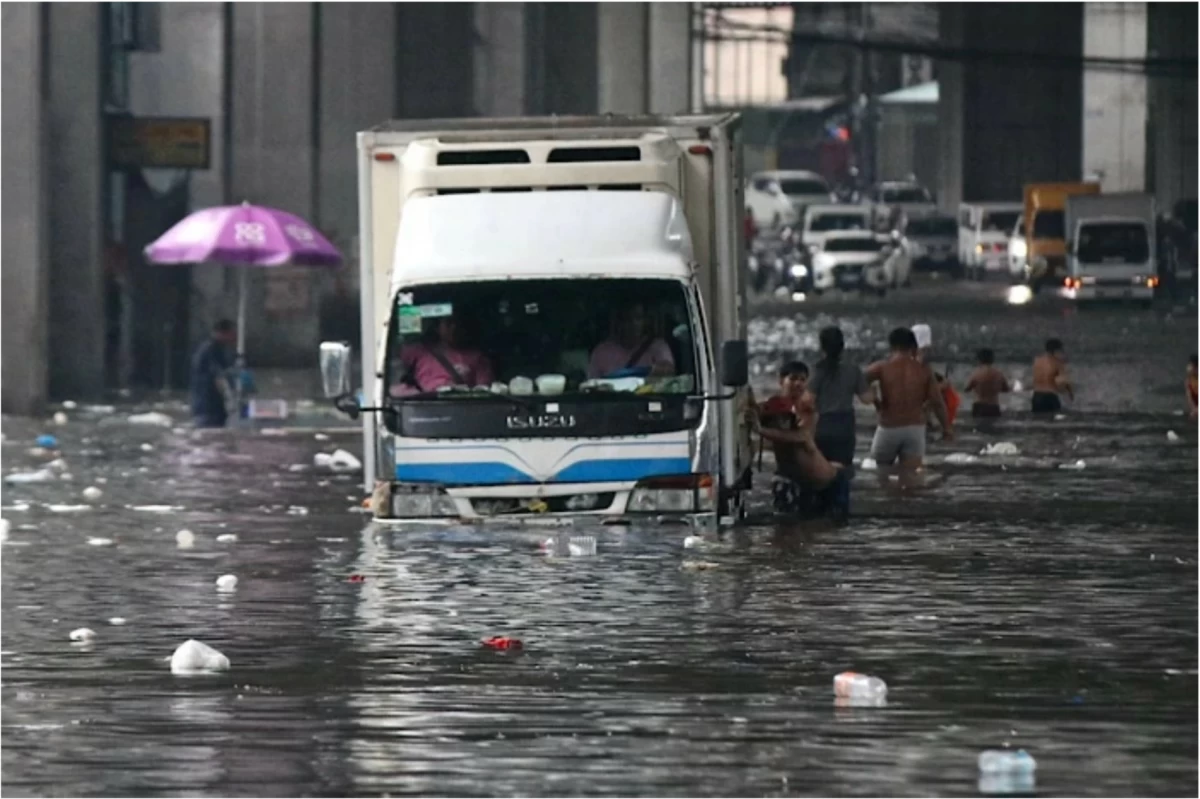
It could be said that the Philippines began the year on solid footing after hitting—or coming close to hitting—its goals in 2024. We were afloat. We were ready to paddle through the waters throughout the year.
However, as the year progressed, the mood gradually shifted to confusion as the waters grew murkier and moved unpredictably. The country almost lost control over the gush of floodwaters that sifted through the national structure.
Economic managers had expected the relatively stronger 5.7-percent growth in the previous year to accelerate in 2025, but figures kept falling short of expectations, with year-to-date growth now standing at five percent—well below the full-year target of at least 5.5 percent.
This was followed by downward adjustments to macroeconomic targets, including fiscal targets, as revenue and deficit goals are tied to output expansion, price hikes, and exchange rate movements.
Fiscal targets across the board were revised midyear as United States (US) tariffs, alongside escalating tensions in the Middle East, posed threats to the local economy.
This year’s revenue goal was lowered to ₱4.52 trillion from ₱4.64 trillion in the previous Development Budget Coordination Committee (DBCC) meeting. Revenue targets were also revised downward for 2026 (to ₱4.98 trillion from ₱5.06 trillion), 2027 (to ₱5.37 trillion from ₱5.63 trillion), and 2028 (to ₱5.91 trillion from ₱6.25 trillion).
In parallel with projected revenues, the fiscal deficit was also adjusted to 5.5 percent of gross domestic product (GDP) this year from the narrower 5.3 percent previously. Revisions were also made for 2026 (to 5.3 percent from 4.7 percent), 2027 (to 4.8 percent from 4.1 percent), and 2028 (to 4.3 percent from 3.7 percent).
What shocked private-sector economists was not the introduction of new tax measures but the erosion of confidence in the government following the unearthing of anomalies in flood control projects.
Philippine Institute for Development Studies (PIDS) senior research fellow John Paolo R. Rivera said the most unexpected development was the sudden loss of confidence in governance, which turned into sand in the wheels of the economy.
Government spending, especially on infrastructure, was tightened as a result of heightened public outrage. Rivera noted that this squeeze on public spending “had an outsized drag on growth, even as revenue agencies pushed harder on compliance.”
Indeed, the four-percent economic growth recorded in the third quarter was the weakest in four and a half years, due in part to slower public spending.
Expenditures on hard infrastructure fell by almost a third in the third quarter amid tighter scrutiny of public spending following the flood control scandal. Spending also fell short of the government’s plan to ramp up infrastructure disbursements for the period.
“Onshore, the key lesson is that underspending can be as damaging as overspending when the economy needs momentum,” Rivera said.
SM Investments Corp. (SMIC) group economist Robert Dan J. Roces said revenue gains from tax measures such as the digital value-added tax (VAT) helped buoy the economy, “but stop-start public spending and infrastructure governance issues had outsized effects on confidence and multipliers.”
For Michael L. Ricafort, chief economist at Rizal Commercial Banking Corp. (RCBC), the country’s performance could still be bolstered if a spending catch-up plan is taken “seriously” to recover foregone gains.
“If the government carries out catch-up spending to make up for any underspending in the latter part of 2025—while prioritizing anti-corruption reforms and consistently strengthening governance standards—this could further improve fiscal performance,” Ricafort said.
This could result in more disciplined government spending through anti-leakage measures, alongside more aggressive tax collection, helping to recover deteriorating investor confidence.
Meanwhile, Union Bank of the Philippines (UnionBank) chief economist Ruben Carlo O. Asuncion said one of the year’s least anticipated developments was the Marcos administration’s shift in rice policy, with a temporary import ban to be followed by import windows next year and a tariff hike to 20 percent.
Bureau of Customs (BOC) Commissioner Ariel F. Nepomuceno had said the government’s forgone revenues from the rice import ban could reach as much as ₱12 billion due to the three-month suspension.
Even before the ban took effect, former Department of Finance (DOF) secretary Ralph G. Recto had already forecast the BOC to fall short of its full-year revenue target, while his expectations remained high for the Bureau of Internal Revenue (BIR).
Who entered the scene
Targets have not been touched again since the adjustments made in late June.
However, the heads of both national tax authorities were replaced. Nepomuceno assumed the post previously held by Bienvenido Y. Rubio until June, while BIR Commissioner Charlito Martin R. Mendoza replaced Romeo D. Lumagui Jr. in November.
Another notable development was the reshuffle within President Marcos’ inner circle, which appeared to be a continuation of the Cabinet shakeup in May. Former Department of Budget and Management (DBM) secretary Amenah F. Pangandaman stepped down swiftly after being implicated in the flood control controversy.
Meanwhile, Recto became executive secretary as Lucas Bersamin resigned alongside Pangandaman. He was succeeded by Frederick D. Go, who had led the Office of the Special Assistant to the President for Investment and Economic Affairs (OSAPIEA) previously.
Despite the reshuffle, macroeconomic and fiscal targets remained unchanged. However, the flood control scandal became a glaring red flag for investors and credit watchers.
For one, S&P Global Ratings could have upgraded the Philippines’ credit rating this year if not for the eruption of alleged corruption cases involving flood control funds. Recto said the rating agency held back on upgrading the sovereign credit rating from BBB+ to A-.
General government (GG) debt, particularly its share of GDP, is among the indicators closely reviewed by credit rating agencies.
Recto had previously taken pride in the Marcos Jr. administration’s “prudent” management of the Philippines’ swollen debt, which had ballooned by ₱6.84 trillion under the Duterte administration during the Covid-19 crisis five years ago.
However, national government debt appeared to contradict this narrative as it hit a fresh high of ₱17.56 trillion in July, already surpassing the DBCC’s projected year-end level of ₱17.36 trillion.
To recall, the debt pile eased in August and September before swelling again to July levels in October.
What will cross into 2026
Securing an “A” credit rating remains on the national to-do list beyond 2025, a goal that will require a strong debt management strategy.
Priority revenue-generating tax measures were proposed by the DOF this year to help plug the persistent fiscal deficit. These include the excise tax on single-use plastics (SUPs), a general tax amnesty (GTA), and an extension of the estate tax amnesty.
The DOF is also pushing to legislate the qualified domestic minimum top-up tax (QDMTT) in the 20th Congress, a move that would recoup forgone revenues from the non-imposition of top-up taxes on large multinational enterprises (MNEs) operating in the Philippines.
Asuncion said 2026 will also inherit the unexpected delay in military and uniformed personnel (MUP) pension reform, which would strain fiscal resources and slow deficit reduction as pension spending is projected to balloon to over a third of next year’s national budget.
Meanwhile, a reenacted national budget has emerged as a possibility following the President’s latest State of the Nation Address (SONA). This risk was compounded by allegations implicating Pangandaman in budget insertions in 2025.
Steering clear of the “most corrupt budget” label in 2026 now falls to DBM Acting Secretary Rolando U. Toledo.
For economists, credibility should drive the gradual fiscal consolidation next year, as it carries as much weight as arithmetic.
Rivera expects fiscal consolidation to advance through “a mix of improved spending efficiency, stronger tax administration, and more disciplined prioritization of high-multiplier projects, while managing the deficit path to avoid crowding out private investment.”
Roces’ views somehow align with Rivera’s, as he looks forward to fiscal discipline that relies more on expanding revenues and tax administration, and on “faster spending rather than sharp cuts, with the aim of lowering the deficit without undermining growth.”
While unmet targets could still be achieved over the medium term, Asuncion flagged execution risks—especially in governance and infrastructure spending—warning that these “could slow the pace of consolidation.”