






 Entertainment
Music and Concerts
The story behind Devo's 'Whip It' and their misunderstood legacy
Entertainment
Music and Concerts
The story behind Devo's 'Whip It' and their misunderstood legacy
The story behind Devo's 'Whip It' and their misunderstood legacy


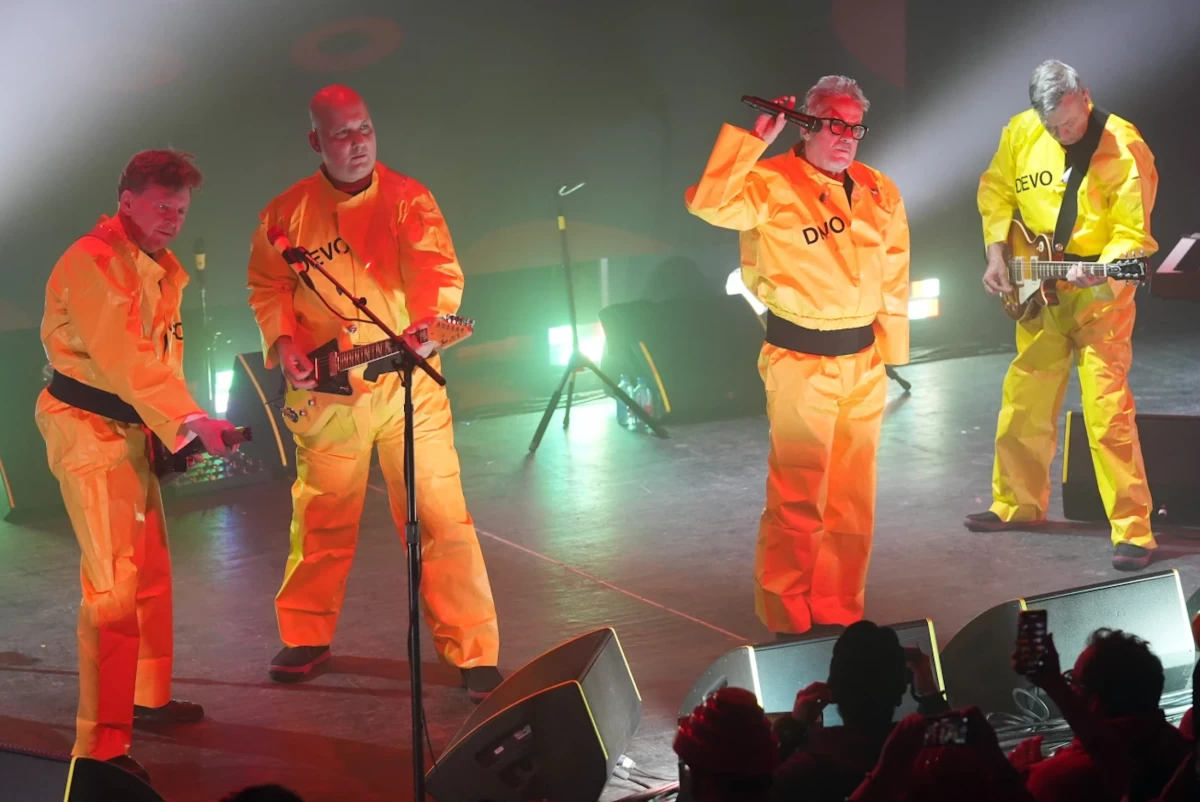
NEW YORK (AP) — You know the band Devo, right? The guys with the funny red plastic hats and jumpsuits? The New Wave musicians behind the silly "Whip It" video?They had that odd, spiky ‘80s vibe? Well, it turns out you may not know as much as you think.
The new Netflix documentary “Devo” is an eye-opening examination of an Ohio-born art-rock band that argues they were perhaps the most misunderstood band on the face of the planet. It debuts on the streaming service Tuesday.
“We were trivialized and pigeonholed,” co-founder Gerald Casale tells The Associated Press. “This documentary allows us to talk about what we were thinking and what we are motivated by to create what we created.”
Directed by Chris Smith, “Devo” uses archival footage and interviews to trace the band’s beginnings, rise, and fall, with cameos from fans like Davie Bowie, Iggy Pop, and Neil Young.
Devo introduced themselves to the world in 1977 by making a frenetic version of the Rolling Stones’ “I Can’t Get No) Satisfaction,” which earned them a crucial slot on “Saturday Night Live.” On stages, they would wriggle like worms or dress like the guys from“Ghostbusters.”
They released their Brian Eno-produced debut, “Q: Are We Not Men? A: We Are Devo!,” in 1978 and reached platinum status with 1980’s “Freedom of Choice,” which featured “Whip It,” a hit just as their label was getting ready to drop them.
But behind the odd neck braces and knee pads were powerful art and literary ideas about where the country was going. They named themselves after the idea that modern society was entering a process of “devolution.”
“We were seeing a world that was the antithesis of the idealized, promised future ginned up in the ’50s and ’60s,” Casale says in the movie. “What we saw was regression.”
The nucleus of the band was formed from tragedy: Casale and Mark Mothersbaugh met at Kent State University, where they lived through the 1970 killing of four unarmed anti-war student protesters by the National Guard.
That tragedy forged in the pair an antiestablishment, anti-capitalist protest, mixing lofty art history with pop culture. They admired Dadaism and Andy Warhol. The factories of Akron inspired their gray overalls and clear plastic face masks — portraying cogs in a machine like in the art movie “Metropolis.”
“We had a meta-approach,” Casale tells the AP. “It was a multimedia, big idea approach. Music was an element, a layer, a dimension, but it was connected to this big worldview.”
‘Whip It’ video
Part of Devo’s strength was its visual component, and their videos were drenched with political commentary. The upbeat Beautiful World featured footage of police violence,the KKK, and bombings, while “Freedom of Choice” warned against the dangers of conformity.
The song “Whip It” was written after reading Thomas Pynchon’s 760-page postmodern sci-fi tome “Gravity’s Rainbow.” The video - featuring cowboys drinking beer, dangerous gunplay assault - was mocking President Ronald Reagan and his macho brand of conservatism.
Members of Devo — which also included Mark’s brother, Bob, Gerald's brother, Bob, and Ala Myers — performed on TV and chatted with talk show hosts like David Letterman but their satire never seemed never to break through.
“Nobody wanted to hear us talking about the duality of human nature and the dangers of groupthink and the atrophication of people being able to think logically and think critically,” Casale says. “It was like, ‘That’s a bummer. Just tell us about drugs and sex.’”
A counterculture legacy
Rock has always needed bands like Devo, a corrective to the corporate machine. You can see an echo of Devo when M.I.A. raised her middle finger during the Super Bowl halftime show in 2012. The members of Devo cite such bands as Rage Against the Machine and System of a Down as keeping the flame alive.
“The only thing you can hope is that it will create an awareness and get rid of complacency, but it doesn’t seem to have done that in the past,” Mothersbaugh tells the AP.
“I always tried to be optimistic that devolution was something that was going to be corrected and that our message would be not necessary at this point, but unfortunately it’s more real than ever.”
After Devo, Casale directed music videos and commercials, while Mothersbaugh scored movies and TV shows such as “Pee-Wee’s Playhouse,” “The Life Aquatic with Steve Zissou,” “Rugrats” and "Hello Tomorrow!"
There are signs of optimism when members of Devo play live these days. Mothersbaugh says he sees a lot of young people, who have used their smartphones to bypass media gatekeepers.
“We see a lot of people that look like us, with gray hair out there in the audience. But there’s also, there’s also a lot kids, which is kind of surprising to me, but I think it’s only because they have this thing in their hand that they sometimes use to their advantage.”
Devo are set to hit the road later this year in a co-headlining tour with the B-52’s. The Cosmic De-Evolution Tour will kick off Sept. 24 in Toronto and wraps Nov. 2 in Houston.
You may think of Devo as New Wave or early electronica or synth-pop. but they see themselves differently: “We were true punk, meaning we questioned illegitimate authority and we stayed in our own lane and did our thing, remaining true to our vision,” says Casale. “That’s punk.”