ADVERTISEMENT

Lawmakers, lawbreakers

Published Sep 1, 2026 05:48 am
Congress’ power over the budget is supposed to discipline executive spending, not license legislative excess. Yet recent appropriations show how the constitutional ban on increasing the President’s proposed budget has been repeatedly blurred, especially through unprogrammed funds and lawmakers’ own institutional budgets.
In a democracy, the power of the purse is meant to be a restraint, not a loophole. Congress authorizes spending so that presidents cannot build roads, erect monuments, or wage wars without public consent. But that power carries a matching duty: to protect taxpayers from waste and to ensure that public money is spent only as the Constitution allows.
The Philippine legislature has wide authority over the budget, taxes, and tariffs. It may decide how large government should be and how much citizens should pay for it, subject to constitutional limits. Its task is not merely to spend, but to make the state deliver value for money.
That discipline begins with the National Expenditure Program (NEP), prepared by the President. The General Appropriations Bill must be based on that proposal. This is not a ceremonial sequence. There can be no budget bill without the President’s submission, and Congress is not free to turn authorization into augmentation.
The rule Congress keeps testing
The constitutional rule is blunt. Article VI, Section 25(1) provides that Congress “may not increase the appropriations recommended by the President for the operation of the Government as specified in the budget.” Yet recent budgets suggest that this rule has been treated less as a command than as an inconvenience.

Sources: Department of Budget and Management, various budget documents.
A quiet expansion of the budget
In the programmed and automatic portions of the 2023, 2024, and 2025 budgets, Congress broadly kept to the President’s proposal. In 2025 it even approved slightly less than requested: ₱4.222 trillion against ₱4.247 trillion. On its face, that looked compliant.
The real expansion took place in unprogrammed appropriations. Congress added ₱219.0 billion in 2023 (or 37.2 percent), ₱449.5 billion in 2024 (or 159.5 percent), and ₱204.7 billion in 2025 (or 129.0 percent). Over three years, the additions reached ₱873.3 billion—close to ₱1 trillion. The form may have been legislative adjustment; the substance was budget enlargement.
When lawmakers budget for themselves
The Constitution is equally clear on another point: appropriations for Congress must follow the same procedure applied to other departments and agencies. Senators and representatives are not a budgetary class apart. The rules they impose on the Executive should apply, with equal force, to themselves.
Two principles therefore matter: Congress should not increase what the President proposes, and when it budgets for its own institutions, it should undergo the same pre-plenary scrutiny faced by executive departments. Fiscal restraint loses force when its authors exempt themselves from it.
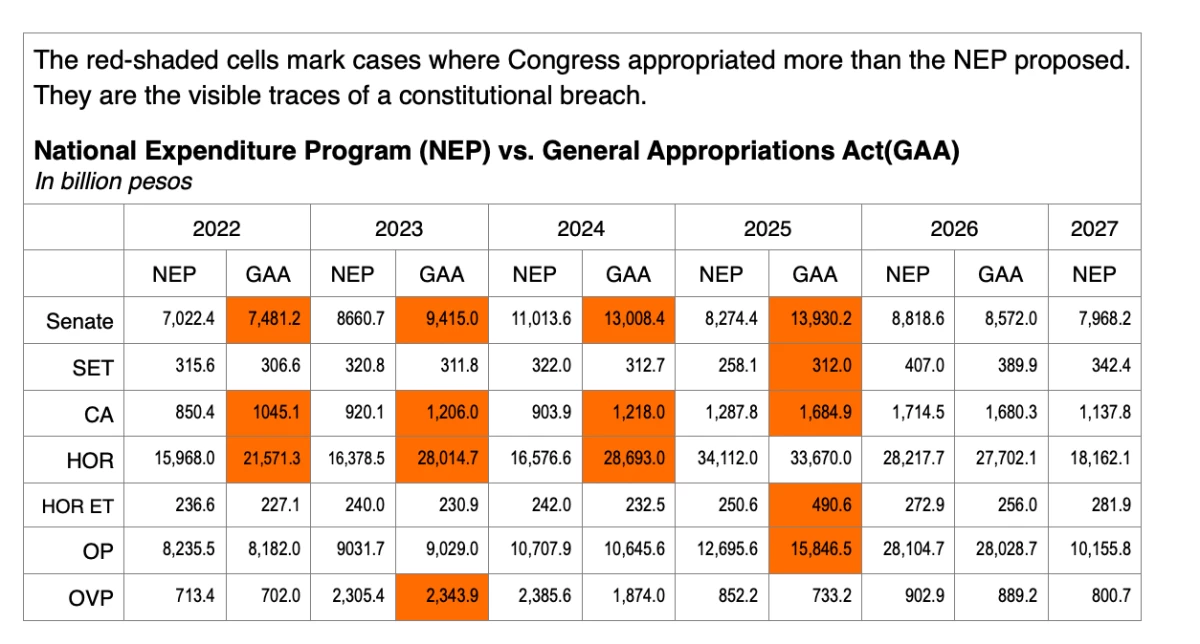
Legend: SET: Senate Electoral Tribunal; CA: Commission on Appointments; HOR: House of Representatives; HOR ET: House Electoral Tribunal; OP: Office of the President; OVP: Office of the Vice President.
The pattern is clearest in the appropriations for the highest offices of government: the President, the Vice President, the Senate, the House, and their related bodies. These figures reveal not merely accounting choices, but the political economy of budgeting.
In the first four national budgets submitted by President Marcos Jr., lawmakers—particularly the Senate, the House, and the Commission on Appointments—approved appropriations above the President’s proposal. The constitutional ceiling became, in practice, a floor.
The fifth budget tells a different story. Lawmakers appear to have observed the “no increase” rule, perhaps chastened by public outrage over the misuse of public funds. That is progress, but not virtue. Obeying the Constitution is the minimum expected of those who write the laws.
The real test is still ahead. Will Congress now allow its own budget to be examined in public before plenary debate, as one legislator has proposed? The Senate and the House have long resisted such scrutiny. If lawmakers want the public to believe they have rediscovered fiscal discipline, they should begin by applying it to themselves.

Related Tags

2027 National Budget National Expenditure Program (NEP) Department of Budget and Management (DBM) House of Representatives Senate of the Philippines
ADVERTISEMENT
.most-popular .layout-ratio{ padding-bottom: 79.13%; } @media (min-width: 768px) and (max-width: 1024px) { .widget-title { font-size: 15px !important; } }

{{ articles_filter_1561_widget.title }}

.most-popular .layout-ratio{ padding-bottom: 79.13%; } @media (min-width: 768px) and (max-width: 1024px) { .widget-title { font-size: 15px !important; } }

{{ static_articles_1562_widget.title }}

.most-popular .layout-ratio{ padding-bottom: 79.13%; } @media (min-width: 768px) and (max-width: 1024px) { .widget-title { font-size: 15px !important; } }

{{ articles_filter_1563_widget.title }}

{{ articles_filter_1564_widget.title }}

.mb-article-details { position: relative; } .mb-article-details .article-body-preview, .mb-article-details .article-body-summary{ font-size: 17px; line-height: 30px; font-family: "Libre Caslon Text", serif; color: #000; } .mb-article-details .article-body-preview iframe , .mb-article-details .article-body-summary iframe{ width: 100%; margin: auto; } .read-more-background { background: linear-gradient(180deg, color(display-p3 1.000 1.000 1.000 / 0) 13.75%, color(display-p3 1.000 1.000 1.000 / 0.8) 30.79%, color(display-p3 1.000 1.000 1.000) 72.5%); position: absolute; height: 200px; width: 100%; bottom: 0; display: flex; justify-content: center; align-items: center; padding: 0; } .read-more-background a{ color: #000; } .read-more-btn { padding: 17px 45px; font-family: Inter; font-weight: 700; font-size: 18px; line-height: 16px; text-align: center; vertical-align: middle; border: 1px solid black; background-color: white; } .hidden { display: none; }
function initializeAllSwipers() { // Get all hidden inputs with cms_article_id document.querySelectorAll('[id^="cms_article_id_"]').forEach(function (input) { const cmsArticleId = input.value; const articleSelector = '#article-' + cmsArticleId + ' .body_images'; const swiperElement = document.querySelector(articleSelector); if (swiperElement && !swiperElement.classList.contains('swiper-initialized')) { new Swiper(articleSelector, { loop: true, pagination: false, navigation: { nextEl: '#article-' + cmsArticleId + ' .swiper-button-next', prevEl: '#article-' + cmsArticleId + ' .swiper-button-prev', }, }); } }); } setTimeout(initializeAllSwipers, 3000); const intersectionObserver = new IntersectionObserver( (entries) => { entries.forEach((entry) => { if (entry.isIntersecting) { const newUrl = entry.target.getAttribute("data-url"); if (newUrl) { history.pushState(null, null, newUrl); let article = entry.target; // Extract metadata const author = article.querySelector('.author-section').textContent.replace('By', '').trim(); const section = article.querySelector('.section-info ').textContent.replace(' ', ' '); const title = article.querySelector('.article-title h1').textContent; // Parse URL for Chartbeat path format const parsedUrl = new URL(newUrl, window.location.origin); const cleanUrl = parsedUrl.host + parsedUrl.pathname; // Update Chartbeat configuration if (typeof window._sf_async_config !== 'undefined') { window._sf_async_config.path = cleanUrl; window._sf_async_config.sections = section; window._sf_async_config.authors = author; } // Track virtual page view with Chartbeat if (typeof pSUPERFLY !== 'undefined' && typeof pSUPERFLY.virtualPage === 'function') { try { pSUPERFLY.virtualPage({ path: cleanUrl, title: title, sections: section, authors: author }); } catch (error) { console.error('ping error', error); } } // Optional: Update document title if (title && title !== document.title) { document.title = title; } } } }); }, { threshold: 0.1 } ); function showArticleBody(button) { const article = button.closest("article"); const summary = article.querySelector(".article-body-summary"); const body = article.querySelector(".article-body-preview"); const readMoreSection = article.querySelector(".read-more-background"); // Hide summary and read-more section summary.style.display = "none"; readMoreSection.style.display = "none"; // Show the full article body body.classList.remove("hidden"); } document.addEventListener("DOMContentLoaded", () => { let loadCount = 0; // Track how many times articles are loaded const offset = [1, 2, 3, 4, 5, 6, 7, 8, 9, 10]; // Offset values const currentUrl = window.location.pathname.substring(1); let isLoading = false; // Prevent multiple calls if (!currentUrl) { console.log("Current URL is invalid."); return; } const sentinel = document.getElementById("load-more-sentinel"); if (!sentinel) { console.log("Sentinel element not found."); return; } function isSentinelVisible() { const rect = sentinel.getBoundingClientRect(); return ( rect.top < window.innerHeight && rect.bottom >= 0 ); } function onScroll() { if (isLoading) return; if (isSentinelVisible()) { if (loadCount >= offset.length) { console.log("Maximum load attempts reached."); window.removeEventListener("scroll", onScroll); return; } isLoading = true; const currentOffset = offset[loadCount]; window.loadMoreItems().then(() => { let article = document.querySelector('#widget_1690 > div:nth-last-of-type(2) article'); intersectionObserver.observe(article) loadCount++; }).catch(error => { console.error("Error loading more items:", error); }).finally(() => { isLoading = false; }); } } window.addEventListener("scroll", onScroll); });

Sign up by email to receive news.