

ADVERTISEMENT

Color photos of occupied Japan face fading future

Published Aug 31, 2026 01:04 pm
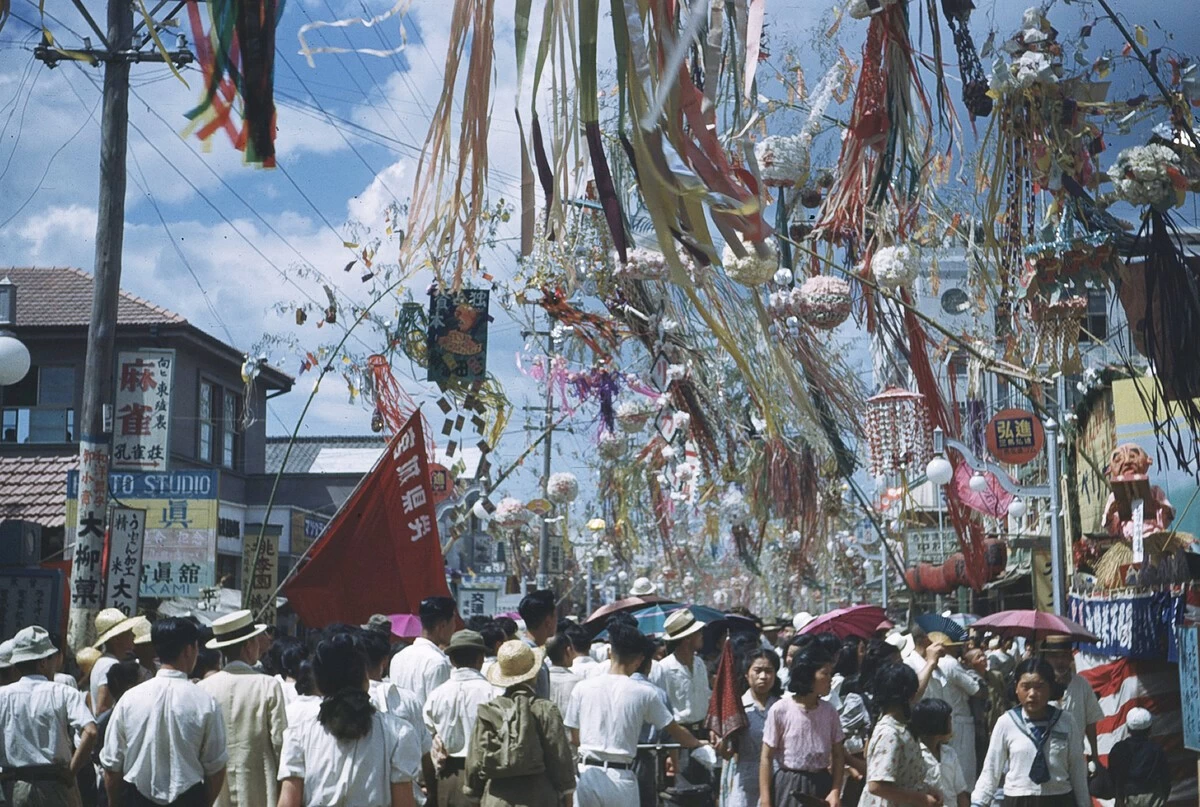
The Tanabata festival in Sendai, Miyagi Prefecture, photographed on Aug. 6, 1949, by then-U.S. serviceman Norbert S. Lang (Courtesy of Fujio Chiba)
SENDAI, Miyagi Pref., Aug. 30 (Jiji Press) -- Color photographs of Japan under Allied occupation are vanishing more than 70 years after U.S. service members captured vivid scenes that may reveal forgotten fragments of history.
From 1945 to 1952, when Allied forces governed Japan after World War II, U.S. service members stationed in the country photographed postwar Japan on color film, which was still rare in the country.
Many of the photos are gradually being dispersed or lost over time, while some may contain historically significant scenes.
An exhibition featuring color photos taken by U.S. service members was held in Sendai, Miyagi Prefecture, northeastern Japan, in August.
The photos capture everyday scenes, including the area around a railway station, shopping streets and department stores decorated for the Tanabata festival, one of the three largest festivals in the Tohoku region of northeastern Japan, and Christmas. Their vivid colors are so striking that they look as though they were taken only recently with a digital camera.
The photos are believed to have been taken by a U.S. Army officer stationed in Sendai with a camera made by Germany's Leica Camera AG and Eastman Kodak Co.'s Kodachrome reversal film.
Fujio Chiba, 67, a senior official of a local history research association in Sendai, collected the photos on display. He searches for and acquires Japan-related photos and film through websites run by former U.S. military personnel and their relatives, photo-sharing sites and auctions.
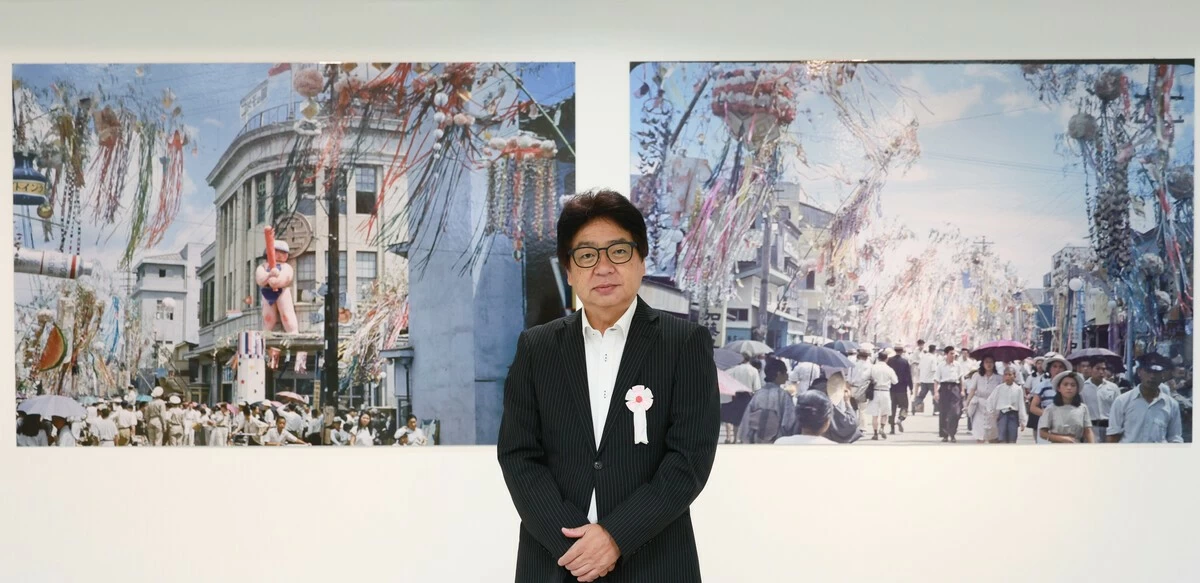
Fujio Chiba stands in front of panels of collected color photographs in Sendai, Miyagi Prefecture, on Aug. 5.
Chiba owns about 1,000 such photos, which show mainly cities where U.S. forces were stationed. Some vividly preserve places and objects that no longer exist.
One photo whose photographer and date are unknown shows a monument marking the hypocenter of the Aug. 9, 1945, atomic bombing of the southwestern city of Nagasaki, capturing a white wooden pillar bearing the black inscription "marker of the atomic bomb hypocenter" atop a rounded mound. It precedes the current triangular black-granite pillar.
Urakami Cathedral in the same city, which was heavily damaged by the atomic bombing, was rebuilt in 1959. A photo believed to have been taken in 1955 preserves a view of the cathedral's ruined state before reconstruction.
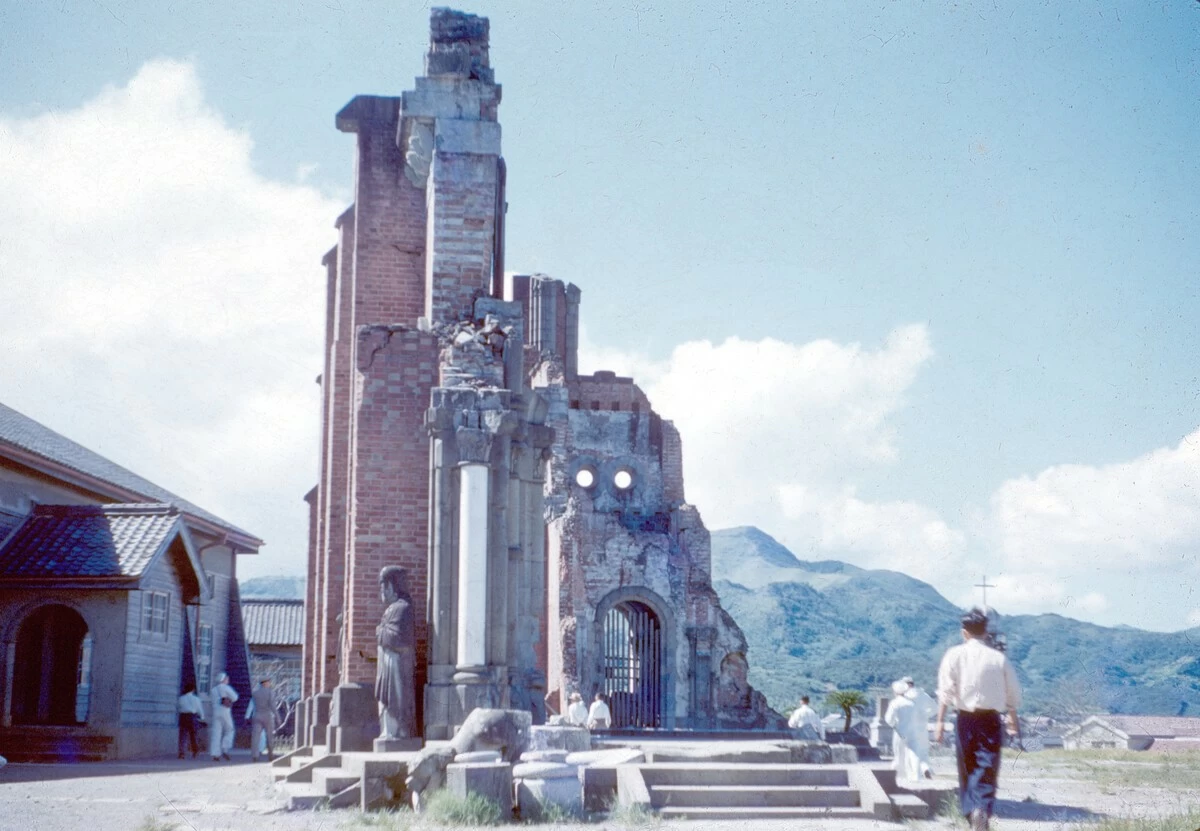
Ruins of Urakami Cathedral, heavily damaged in the 1945 atomic bombing of Nagasaki, are seen in a photograph believed to have been taken in 1955. (Exact date and photographer unknown. Courtesy of Fujio Chiba)
Color film did not become widely available in Japan until after the 1964 Tokyo Olympic Games.
Long before then, however, U.S. service members had been recording through color film the unfamiliar landscapes they saw through their viewfinders.
Many of those service members have since died. Their children and grandchildren, who may have no particular attachment to the photos' subjects, sometimes leave the photos in cardboard boxes with other belongings or take them to antique shops as unwanted clutter.
Some of those photos may preserve historical records that Japanese people themselves never documented, prompting Chiba to continue collecting them.
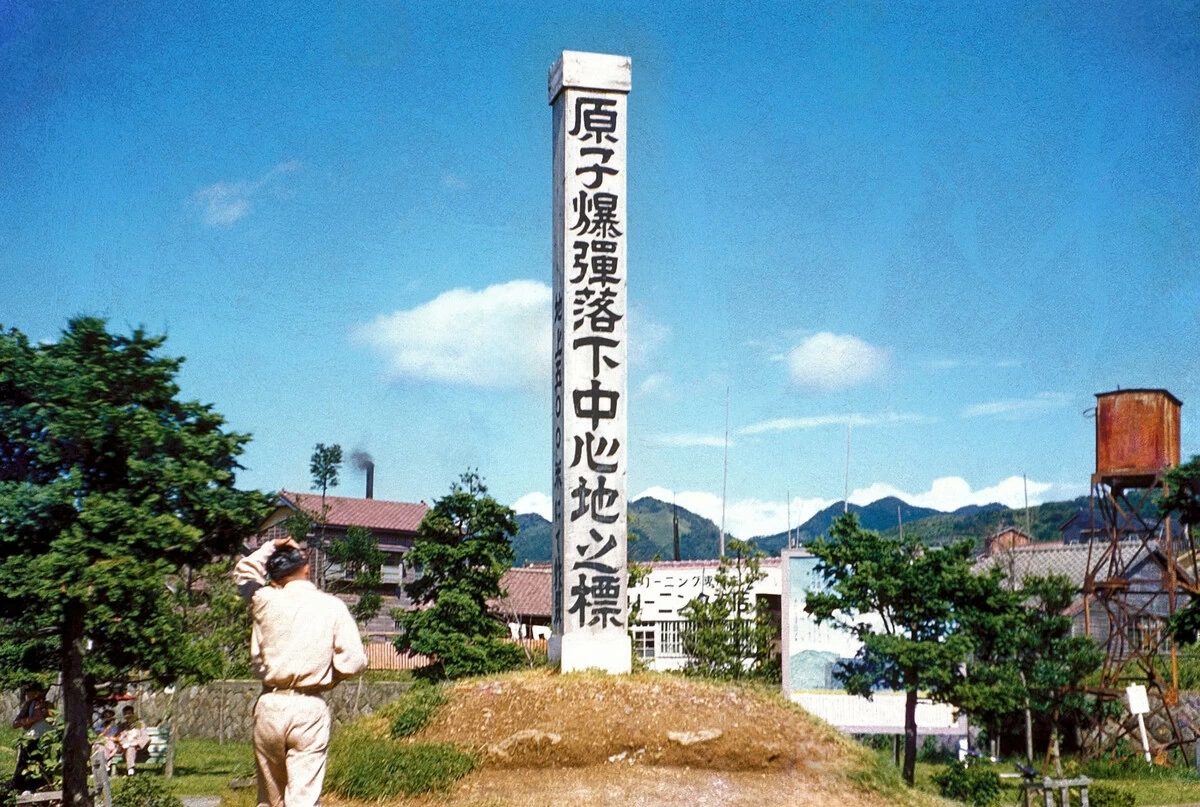
A marker identifying the hypocenter of the Nagasaki atomic bombing is seen in a photograph taken shortly after World War II. (Exact date and photographer unknown. Courtesy of Fujio Chiba)
"Photos tucked away among someone's belongings may have no value to their current owners but could be immensely valuable to Japanese people," he said. "I don't want them to end up as mere garbage."


Related Tags

world news Japan
ADVERTISEMENT
.most-popular .layout-ratio{ padding-bottom: 79.13%; } @media (min-width: 768px) and (max-width: 1024px) { .widget-title { font-size: 15px !important; } }

{{ articles_filter_1561_widget.title }}

.most-popular .layout-ratio{ padding-bottom: 79.13%; } @media (min-width: 768px) and (max-width: 1024px) { .widget-title { font-size: 15px !important; } }

{{ static_articles_1562_widget.title }}

.most-popular .layout-ratio{ padding-bottom: 79.13%; } @media (min-width: 768px) and (max-width: 1024px) { .widget-title { font-size: 15px !important; } }

{{ articles_filter_1563_widget.title }}

{{ articles_filter_1564_widget.title }}

.mb-article-details { position: relative; } .mb-article-details .article-body-preview, .mb-article-details .article-body-summary{ font-size: 17px; line-height: 30px; font-family: "Libre Caslon Text", serif; color: #000; } .mb-article-details .article-body-preview iframe , .mb-article-details .article-body-summary iframe{ width: 100%; margin: auto; } .read-more-background { background: linear-gradient(180deg, color(display-p3 1.000 1.000 1.000 / 0) 13.75%, color(display-p3 1.000 1.000 1.000 / 0.8) 30.79%, color(display-p3 1.000 1.000 1.000) 72.5%); position: absolute; height: 200px; width: 100%; bottom: 0; display: flex; justify-content: center; align-items: center; padding: 0; } .read-more-background a{ color: #000; } .read-more-btn { padding: 17px 45px; font-family: Inter; font-weight: 700; font-size: 18px; line-height: 16px; text-align: center; vertical-align: middle; border: 1px solid black; background-color: white; } .hidden { display: none; }
function initializeAllSwipers() { // Get all hidden inputs with cms_article_id document.querySelectorAll('[id^="cms_article_id_"]').forEach(function (input) { const cmsArticleId = input.value; const articleSelector = '#article-' + cmsArticleId + ' .body_images'; const swiperElement = document.querySelector(articleSelector); if (swiperElement && !swiperElement.classList.contains('swiper-initialized')) { new Swiper(articleSelector, { loop: true, pagination: false, navigation: { nextEl: '#article-' + cmsArticleId + ' .swiper-button-next', prevEl: '#article-' + cmsArticleId + ' .swiper-button-prev', }, }); } }); } setTimeout(initializeAllSwipers, 3000); const intersectionObserver = new IntersectionObserver( (entries) => { entries.forEach((entry) => { if (entry.isIntersecting) { const newUrl = entry.target.getAttribute("data-url"); if (newUrl) { history.pushState(null, null, newUrl); let article = entry.target; // Extract metadata const author = article.querySelector('.author-section').textContent.replace('By', '').trim(); const section = article.querySelector('.section-info ').textContent.replace(' ', ' '); const title = article.querySelector('.article-title h1').textContent; // Parse URL for Chartbeat path format const parsedUrl = new URL(newUrl, window.location.origin); const cleanUrl = parsedUrl.host + parsedUrl.pathname; // Update Chartbeat configuration if (typeof window._sf_async_config !== 'undefined') { window._sf_async_config.path = cleanUrl; window._sf_async_config.sections = section; window._sf_async_config.authors = author; } // Track virtual page view with Chartbeat if (typeof pSUPERFLY !== 'undefined' && typeof pSUPERFLY.virtualPage === 'function') { try { pSUPERFLY.virtualPage({ path: cleanUrl, title: title, sections: section, authors: author }); } catch (error) { console.error('ping error', error); } } // Optional: Update document title if (title && title !== document.title) { document.title = title; } } } }); }, { threshold: 0.1 } ); function showArticleBody(button) { const article = button.closest("article"); const summary = article.querySelector(".article-body-summary"); const body = article.querySelector(".article-body-preview"); const readMoreSection = article.querySelector(".read-more-background"); // Hide summary and read-more section summary.style.display = "none"; readMoreSection.style.display = "none"; // Show the full article body body.classList.remove("hidden"); } document.addEventListener("DOMContentLoaded", () => { let loadCount = 0; // Track how many times articles are loaded const offset = [1, 2, 3, 4, 5, 6, 7, 8, 9, 10]; // Offset values const currentUrl = window.location.pathname.substring(1); let isLoading = false; // Prevent multiple calls if (!currentUrl) { console.log("Current URL is invalid."); return; } const sentinel = document.getElementById("load-more-sentinel"); if (!sentinel) { console.log("Sentinel element not found."); return; } function isSentinelVisible() { const rect = sentinel.getBoundingClientRect(); return ( rect.top < window.innerHeight && rect.bottom >= 0 ); } function onScroll() { if (isLoading) return; if (isSentinelVisible()) { if (loadCount >= offset.length) { console.log("Maximum load attempts reached."); window.removeEventListener("scroll", onScroll); return; } isLoading = true; const currentOffset = offset[loadCount]; window.loadMoreItems().then(() => { let article = document.querySelector('#widget_1690 > div:nth-last-of-type(2) article'); intersectionObserver.observe(article) loadCount++; }).catch(error => { console.error("Error loading more items:", error); }).finally(() => { isLoading = false; }); } } window.addEventListener("scroll", onScroll); });

Sign up by email to receive news.