







The true currency of good governance
Published Aug 29, 2026 12:01 am
|
Updated Aug 28, 2026 07:18 am


What is the most valuable asset of any government? Some would immediately answer natural resources, infrastructure, technology, military capability, economic strength, or political stability. Well, those are all important. But history teaches us something remarkably different. There are nations blessed with abundant natural resources that remain poor. There are also countries with limited land and almost no natural wealth, yet they have become among the most prosperous in the world.
The difference was never simply resources. The difference was trust—trust in institutions, trust in government, trust that laws are applied fairly, trust that taxes are used wisely, trust that public officials are accountable, and trust that public servants place the people's welfare above personal interest.
That is the most valuable asset of any government.
Once public trust begins to erode, every policy becomes questionable, every procurement becomes suspicious, every infrastructure project is viewed with doubt, every financial report is met with skepticism, and every accomplishment is overshadowed by suspicion. And rebuilding trust is infinitely more difficult than losing it.
That is why I firmly believe that public trust is the true currency of good governance. Without it, our laws lose their effectiveness, institutions lose their legitimacy, and leadership loses its moral authority.
This principle is not merely philosophical; it is embedded in our Constitution. The Constitution does not describe public office as a privilege, nor does it call it an entitlement. It declares that “Public office is a public trust.” I have always found those words remarkably profound because they remind us that government authority never belongs to those who occupy positions, whether in the past or in the present. Authority is merely entrusted to them—temporarily—by the Filipino people. And every trust carries accountability.
As Certified Public Accountants, we often work with numbers. We analyze financial statements, reconcile accounts, examine variances, evaluate controls, issue reports, and audit transactions. But the work of a CPA is not ultimately about numbers. It is about confidence—confidence that public funds are properly managed, confidence that financial reports faithfully represent reality, confidence that internal controls are functioning, confidence that decisions are supported by reliable information, and confidence that institutions deserve the trust placed upon them. In many ways, our profession does not merely account for money. Our profession accounts for trust. And that is a far greater responsibility.
So, how do we preserve public trust in an age of unprecedented change?
Governance today is no longer judged merely by compliance. Citizens are no longer satisfied asking, “Was the money spent?” Today, they ask: “Was it spent wisely?” “Did it improve people's lives?” “Was the process transparent?” “Who was held accountable?” “Could the outcome have been better?” Those questions have fundamentally changed what society expects from all of us.
For many years, the Commission on Audit has continuously evolved to respond to these changing expectations. Not because its constitutional mandate has changed—it has not—but because the environment in which accountability is exercised has changed dramatically. Government has become more digital. Risks have become more complex. Fraud has become more sophisticated. Citizens have become more informed.
Therefore, public auditing itself has also evolved: not merely to detect deficiencies, but to strengthen institutions; not merely to ensure compliance, but to improve governance; not merely to protect public funds, but ultimately, to protect public trust. That evolution is reflected in reforms that have strengthened performance auditing, citizen participation, digital governance, electronic audit evidence, fraud prevention, and the modernization of audit processes—all while remaining anchored on the Commission's constitutional mandate and international standards. These reforms demonstrate that accountability is most effective when it evolves alongside the changing needs of government and society.
As CPAs, let us look beyond accounting standards, beyond audit reports, beyond internal controls, and beyond compliance requirements. Instead, let us examine a more fundamental question: What kind of institutions must we build so that future generations of Filipinos will continue to trust them?
At the end of the day, our greatest contribution as accountants, auditors, financial managers, and public servants will not be measured by the number of reports we prepare, the number of audit findings we issue, or the number of regulations we comply with. Our legacy will ultimately be measured by something much simpler: whether the Filipino people have greater confidence in their public institutions because we chose to serve with competence, integrity, and accountability. That is the higher purpose of our profession, and that is what I hope we shall reflect upon in our work on a daily basis.
Whenever governance is discussed, we almost instinctively think about rules, policies, internal controls, compliance checklists, audit observations, and risk management. These are certainly part of governance, but they are not governance itself. Compliance is the minimum expected of us; governance is the standard we aspire to. Compliance tells us what we are required to do. Governance asks whether we are doing what is right, what is wise, and what best serves the public interest. That distinction is critically important—because an institution may comply with every procedural requirement yet still fail in its responsibility to the public.
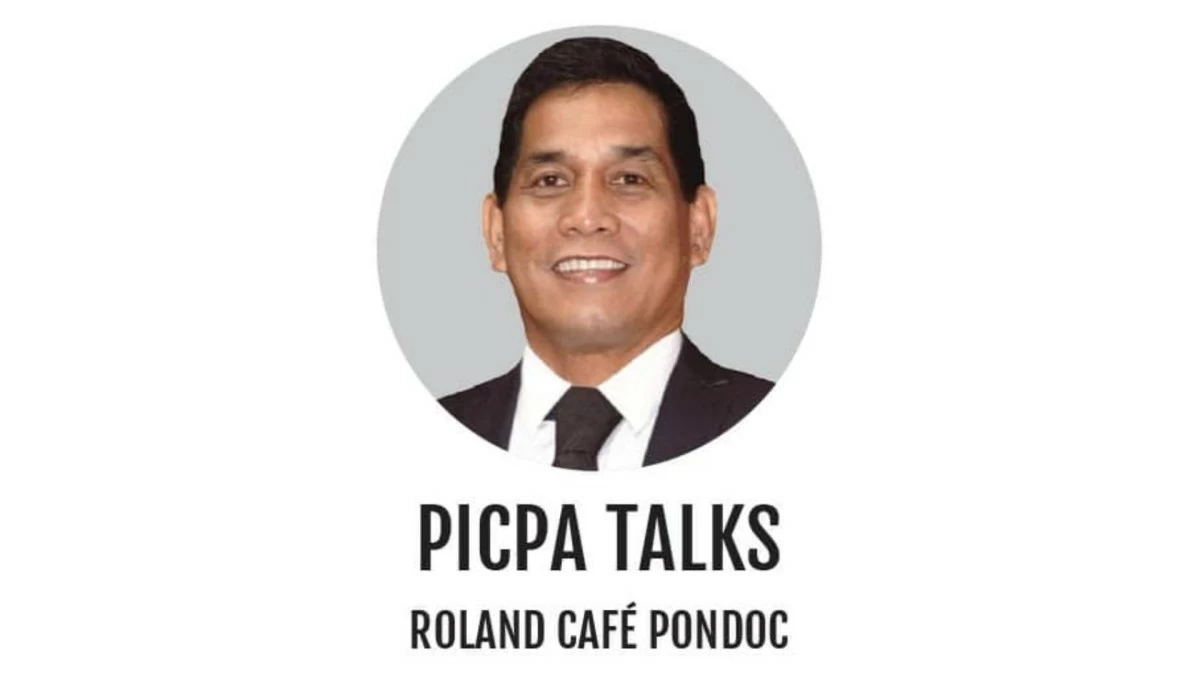
(Atty. Pondoc is a Member of the Board of Trustees of the University of Mindanao; Chairperson of PICPA Davao Foundation, Inc.; PICPA Past National President; and former COA Commissioner and former Asst. Executive Secretary for Finance in the Office of the President.)
(Disclaimer: The views expressed herein belong solely to the author and do not necessarily reflect the official policy or position of any office, agency, employer, or organization.)