






Manila Bulletin
 Philippines
National
'Para sa susunod na henerasyon!' Teodoro urges youth to view West Philippine Sea as fight for future resources
Philippines
National
'Para sa susunod na henerasyon!' Teodoro urges youth to view West Philippine Sea as fight for future resources
Philippines
National
'Para sa susunod na henerasyon!' Teodoro urges youth to view West Philippine Sea as fight for future resources
'Para sa susunod na henerasyon!' Teodoro urges youth to view West Philippine Sea as fight for future resources
Published Aug 29, 2026 03:57 pm


At A Glance
- Department of National Defense Secretary Gilberto Teodoro Jr. urged young Filipinos to view the West Philippine Sea as a source of future food and energy, saying growing populations and dwindling resources could heighten competition for maritime resources.
- He stressed the Philippines' strategic position as an archipelagic nation, with 2.4 million square kilometers of maritime domain and borders facing both the South China Sea and the Pacific Ocean.
- Teodoro highlighted stronger defense partnerships to counter maritime threats, citing the Philippines' SOVFAs with Canada and New Zealand and ongoing agreements with France and the United Kingdom.
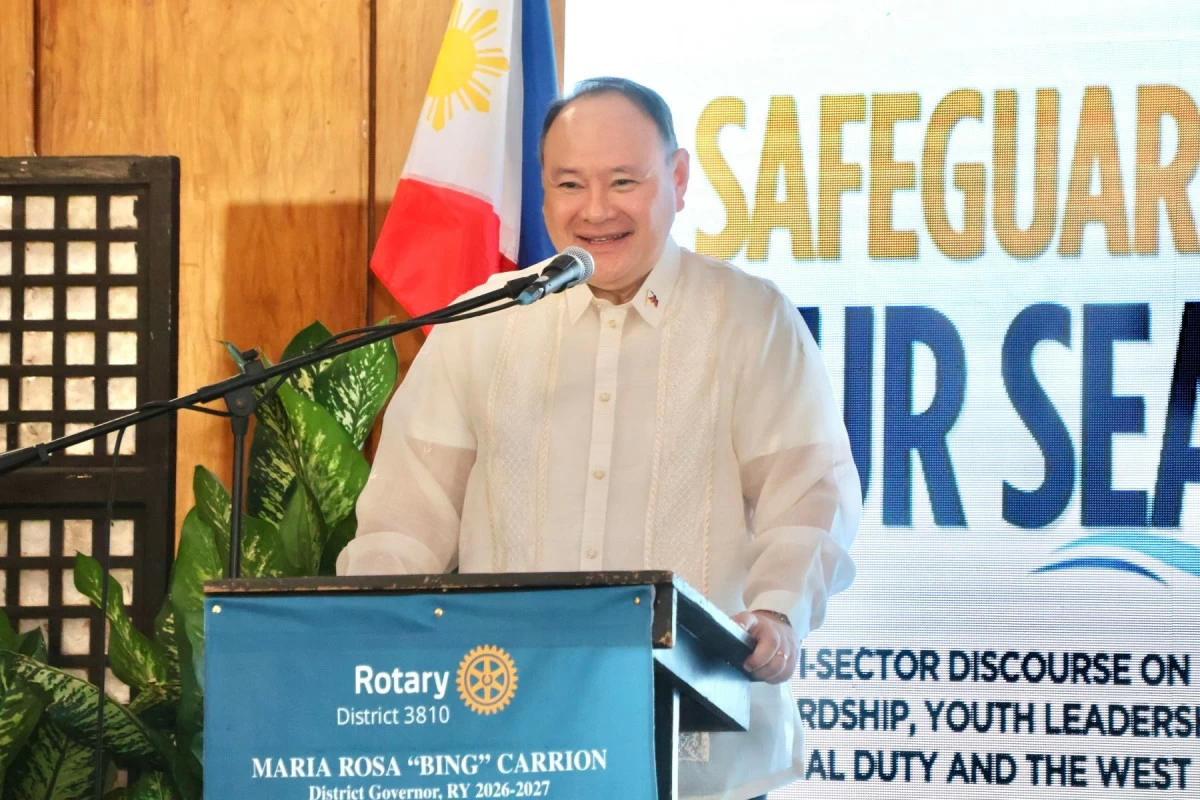
Department of National Defense (DND) Secretary Gilberto C. Teodoro Jr. delivers a speech during the launch of the Bantay Dagat Youth Ambassadors – West Philippine Sea Edition Caravan in San Juan City on Aug. 28, 2026. (Photo: DND)
Department of National Defense (DND) Secretary Gilberto C. Teodoro Jr. called on young Filipinos to recognize the West Philippine Sea (WPS) dispute as a struggle for future sustenance, stressing that maritime resources will be vital for generations to come.
Speaking at the launch of the Bantay Dagat Youth Ambassadors – West Philippine Sea Edition Caravan in San Juan City on Friday, Aug. 28, Teodoro warned that ballooning populations and diminishing global commodities make maritime security an urgent struggle for tomorrow's sustenance.
"Where will you get the fuel to feed yourselves in the future, to run your gadgets in the future, if you do not have the resources under the sea?" Teodoro asked the audience of student advocates and community leaders.
He stressed that the Philippines, as an archipelagic nation, spans 2.4 million square kilometers of maritime domain, contrasted against a land area of only 20 percent.
Therefore, he explained that defending WPS secures vital energy supplies and food sources for upcoming generations, noting that rapid demographic shifts dictate an inevitable competition for raw materials.
"As populations expand in the world, as resources grow more scarce, as needs grow more scarce, there is a temptation to expand and that we cannot allow for your safety in the future," Teodoro noted.
Global expansionist pressures compound these resource demands, and the defense chief pointed to unilateral maritime claims by China that supposedly disregard the 1982 United Nations Convention on the Law of the Sea (UNCLOS) and the 2016 Arbitral Award, which invalidated the latter’s claims in the South China Sea.
He emphasized that the Philippines holds a distinct geographical position as the sole ASEAN member possessing both a South China Sea border and a Pacific Ocean maritime frontier.
“You cannot stop the growth of human needs, the growth of society. You can't stop evolution,” Teodoro stated. “What you can stop is somebody else taking what should be yours to support yourself and give it to somebody else, and to me that's how best you should frame the problem set in front of you.”
The forum, organized by the Rotary Club of Chinatown Circle in collaboration with the Philippine Navy, drew key security officials including National Security Adviser Eduardo Oban Jr. and Presidential Anti-Organized Crime Commission Executive Director Benjamin Acorda Jr.
The discussions centered on multidimensional threats ranging from foreign malign influence online to illegal offshore gaming operations.
And to counter foreign maritime encroachment, Teodoro said the national defense apparatus combines internal security operations with broader international deterrence networks.
He detailed the formalization of the country’s Status of Visiting Forces Agreements (SOVFAs) with Canada and New Zealand, while similar pacts await Senate concurrence with France or remain under active negotiation with the United Kingdom.
“You can see that these alliances are for shared interests,” Teodoro said. “And what are these interests? That is to secure the maritime domain for supply chains of like-minded countries who feel threatened by expansionism in their own borders.”