






Manila Bulletin
 Business
Trade & Industry
Solar developer combines green power with farming to solve Philippines land debate
Business
Trade & Industry
Solar developer combines green power with farming to solve Philippines land debate
Business
Trade & Industry
Solar developer combines green power with farming to solve Philippines land debate
Solar developer combines green power with farming to solve Philippines land debate
Published Aug 27, 2026 06:03 pm


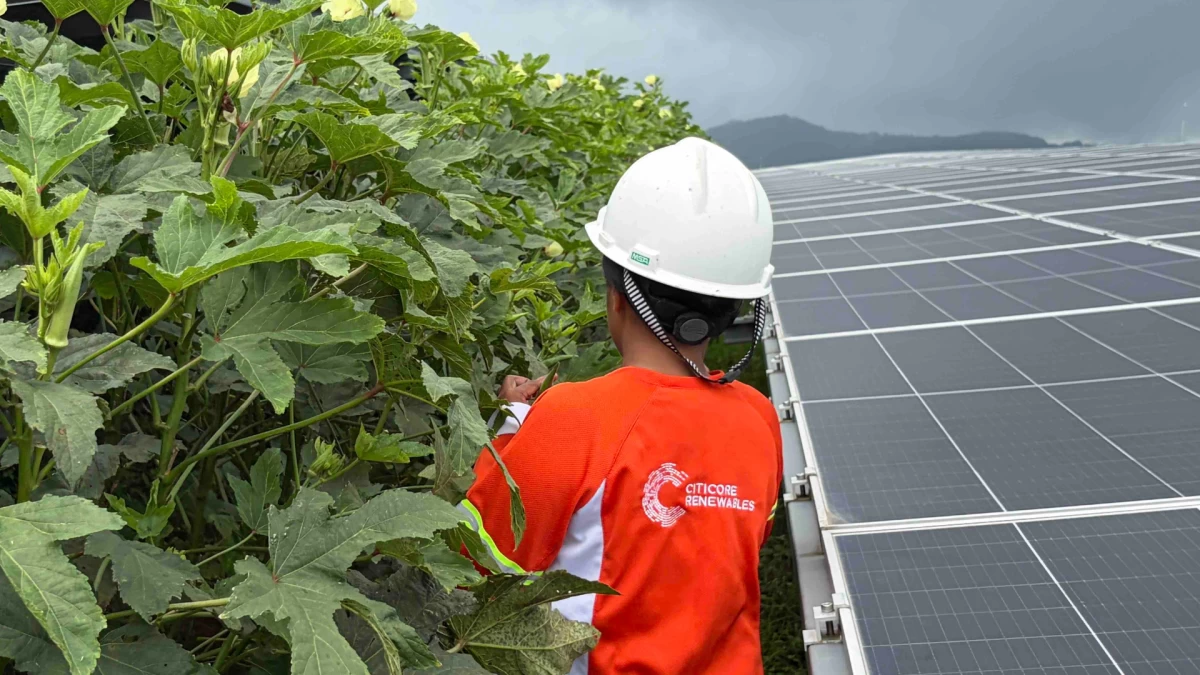
(Dexter Barro II/MANILA BULLETIN)
TUY, Batangas—Citicore Renewable Energy Corp. (CREC) is planning to expand its AgroSolar initiative to three more solar farms this year, as the company looks to deepen its presence in agriculture and unlock another revenue stream.
CREC, one of the country’s largest solar energy developers, intends to end the year with a total of six AgroSolar sites across its wide network of solar farms.
Launched in 2021, the AgroSolar project combines agriculture and power generation by allowing solar power plants and vegetable farming to coexist.
CREC said it is the first company in the country to apply agrovoltaics, or the practice of using the same land to generate both solar energy and agricultural products.
The AgroSolar project is managed by Citicore Agri-Aqua Ventures Inc. (CAAVI), which operates under Citicore Foundation, the social sustainability arm of CREC’s parent firm Citicore Power Inc.
Based on a financial disclosure, CAAVI was formed to drive “profitable growth in agriculture and aquaculture by delivering high-quality, sustainable food products.”
Citicore Foundation Head Czarina Brodit-Valeros said the AgroSolar program is currently active in three CREC solar farms located in Batangas and Pampanga, backed by an investment of over ₱4 million.
The three sites span a combined planting area of more than 25 hectares, with agricultural output consisting of high-value crops such as chili, okra, and eggplants.
The project provides livelihoods to 17 farmers, including those who were displaced by the construction of the solar farms.
Valeros said integrating agriculture into its solar farms responds to concerns that these facilities are displacing valuable agricultural land, ultimately reducing the country’s food production.
“That's why we are scaling up this initiative. And, working closely with relevant partners like the Department of Agriculture (DA) and local government units (LGUs), so that we do not sacrifice the agricultural purpose of the land,” she explained.
Valeros said the company is looking to build three additional AgroSolar sites in its solar farms in Tarlac, Pangasinan, and Negros Occidental.
She noted that the sites in Pangasinan and Negros Occidental would be developed alongside their respective LGUs, while the Tarlac site is expected to be developed in partnership with the DA.
By next year, CREC plans to expand the current planting areas before adding more sites to its other solar farms.
Through the dual use of CREC’s solar farms, Valeros noted that crops are protected from severe weather conditions with the help of the solar panels, resulting in higher yields.
According to CREC, the total agricultural output of its AgroSolar sites reached an accumulated 16,000 kilos from 2022 to 2025, primarily marketing to nearby communities.
With its expanding productivity, Valeros said the goal is to transform CAAVI into a full-fledged enterprise that would be able to meet the demands of commercial partners, including grocery stores and manufacturers.