

ADVERTISEMENT

Could a disaster like the one in Nepal happen in the Philippines?

Published Aug 27, 2026 04:32 pm

At A Glance

  • According to UPRI-NOAH Center Executive Director Mahar Lagmay, the Philippines has its own history of destructive debris flows.
  • More than 1,000 areas in the country have now been identified as potential sites for debris flows, up from just a little over 100 previously.
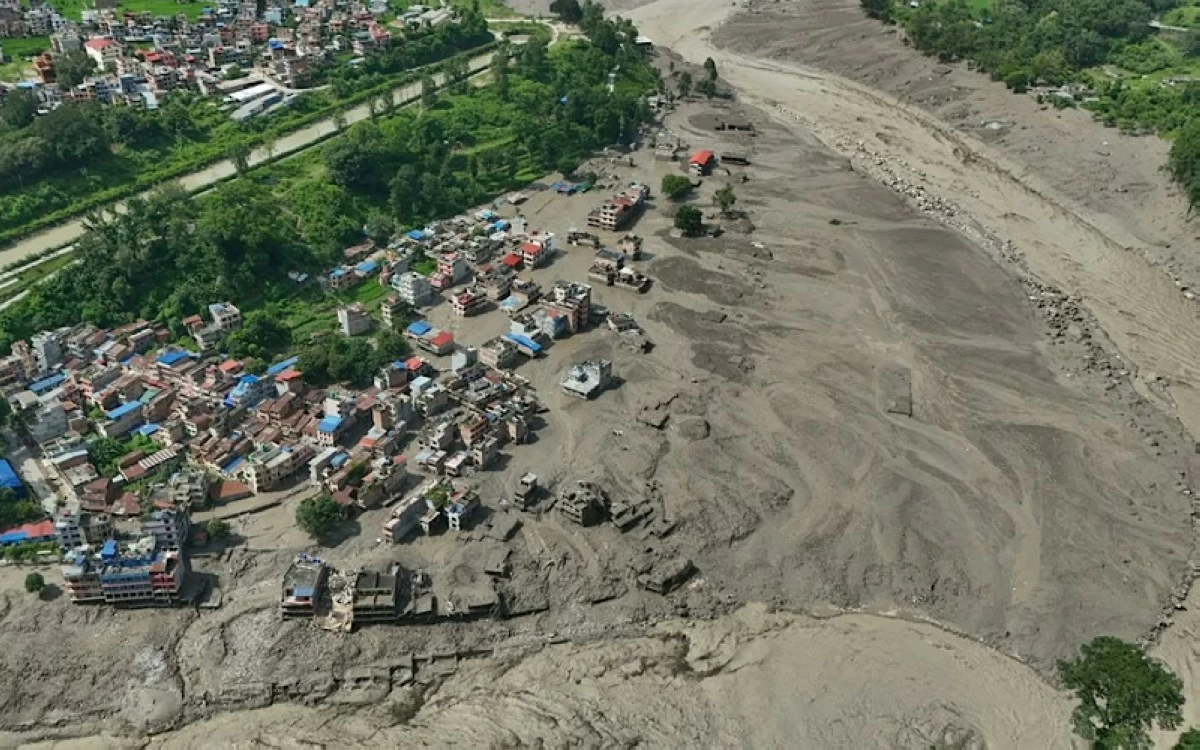
Damaged houses stand precariously near the swollen, debris-choked banks of the Trishuli River after flash floods in Nepal's Nuwakot district on Wednesday, Aug. 26, 2026. (AP Photo/Niranjan Shrestha)
The catastrophic flash flood in Nepal has shown how quickly debris flows can overwhelm communities, a danger that also exists in the Philippines.
University of the Philippines Resilience Institute-National Operational Assessment of Hazards Center (UPRI-NOAH) Executive Director Mahar Lagmay said the Philippines also faces the threat of debris flows, although the trigger can be different from what happened in Nepal.
The Nepal incident was most likely triggered by a glacier collapse, while extreme rainfall is the more likely trigger for debris flows in the Philippines.
Lagmay said more than 1,000 areas  in the country have now been identified as potential sites for debris flows, up from just a little over 100 previously, through the use of science and technology and the best available tools.
Many communities are located on alluvial plains because these areas have fertile land and access to rivers and other water resources that support agriculture and livelihoods.
Flooding also replenishes the soil with sediments and nutrients.
“Gusto ng mga tao yon. There's a natural tendency for them to live in hazardous areas (People want to stay in those areas. There's a natural tendency for them to live in hazardous areas),” Lagmay said during a press conference on Thursday, Aug. 27.
According to Lagmay, the Philippines has its own history of destructive debris flows.
In December 2012, debris flows overwhelmed Barangay Andap in New Bataan, Compostela Valley during Super Typhoon Pablo, killing 566 people and burying parts of the community under several meters of debris.
He also cited Gabaldon, Nueva Ecija, where Typhoon Lando triggered debris flows in 2015 that damaged homes and other structures, although warnings and evacuation helped prevent deaths.
Baco, Oriental Mindoro, was another example, where debris flows struck during Typhoon Nona in 2015.
“There are more than 1,000 places where there are communities, and we need to put them out of harm’s way. And if we cannot get them to be in that place, at least we need to get them prepared,” Lagmay said.
The challenge is that debris flows do not happen often, making it harder for communities to recognize the danger before one occurs.
“Di naman kasi araw-araw nangyayari yung debris flow, but we can get them to understand that there's a problem so that they know. Kasi if they don't know, chances are they will get surprised. And if there are many people who get surprised, it turns into what we call as a disaster (Debris flows do not happen every day, but we can get them to understand that there's a problem so that they know. Because if they don't know, chances are they will get surprised, and if there are many people who get surprised, it turns into what we call as a disaster),” he said.
Lagmay pointed out that the goal is to address the risks while finding safer ways for communities to live alongside natural hazards.
“We want to solve that problem. We want to do better and be smarter in living with nature,” he said.

Related Tags

PHILIPPINES NEPAL FLASH FLOOD PROJECT NOAH MAHAR LAGMAY UP RESILIENCE INSTITUTE
ADVERTISEMENT
.most-popular .layout-ratio{ padding-bottom: 79.13%; } @media (min-width: 768px) and (max-width: 1024px) { .widget-title { font-size: 15px !important; } }

{{ articles_filter_1561_widget.title }}

.most-popular .layout-ratio{ padding-bottom: 79.13%; } @media (min-width: 768px) and (max-width: 1024px) { .widget-title { font-size: 15px !important; } }

{{ static_articles_1562_widget.title }}

.most-popular .layout-ratio{ padding-bottom: 79.13%; } @media (min-width: 768px) and (max-width: 1024px) { .widget-title { font-size: 15px !important; } }

{{ articles_filter_1563_widget.title }}

{{ articles_filter_1564_widget.title }}

.mb-article-details { position: relative; } .mb-article-details .article-body-preview, .mb-article-details .article-body-summary{ font-size: 17px; line-height: 30px; font-family: "Libre Caslon Text", serif; color: #000; } .mb-article-details .article-body-preview iframe , .mb-article-details .article-body-summary iframe{ width: 100%; margin: auto; } .read-more-background { background: linear-gradient(180deg, color(display-p3 1.000 1.000 1.000 / 0) 13.75%, color(display-p3 1.000 1.000 1.000 / 0.8) 30.79%, color(display-p3 1.000 1.000 1.000) 72.5%); position: absolute; height: 200px; width: 100%; bottom: 0; display: flex; justify-content: center; align-items: center; padding: 0; } .read-more-background a{ color: #000; } .read-more-btn { padding: 17px 45px; font-family: Inter; font-weight: 700; font-size: 18px; line-height: 16px; text-align: center; vertical-align: middle; border: 1px solid black; background-color: white; } .hidden { display: none; }
function initializeAllSwipers() { // Get all hidden inputs with cms_article_id document.querySelectorAll('[id^="cms_article_id_"]').forEach(function (input) { const cmsArticleId = input.value; const articleSelector = '#article-' + cmsArticleId + ' .body_images'; const swiperElement = document.querySelector(articleSelector); if (swiperElement && !swiperElement.classList.contains('swiper-initialized')) { new Swiper(articleSelector, { loop: true, pagination: false, navigation: { nextEl: '#article-' + cmsArticleId + ' .swiper-button-next', prevEl: '#article-' + cmsArticleId + ' .swiper-button-prev', }, }); } }); } setTimeout(initializeAllSwipers, 3000); const intersectionObserver = new IntersectionObserver( (entries) => { entries.forEach((entry) => { if (entry.isIntersecting) { const newUrl = entry.target.getAttribute("data-url"); if (newUrl) { history.pushState(null, null, newUrl); let article = entry.target; // Extract metadata const author = article.querySelector('.author-section').textContent.replace('By', '').trim(); const section = article.querySelector('.section-info ').textContent.replace(' ', ' '); const title = article.querySelector('.article-title h1').textContent; // Parse URL for Chartbeat path format const parsedUrl = new URL(newUrl, window.location.origin); const cleanUrl = parsedUrl.host + parsedUrl.pathname; // Update Chartbeat configuration if (typeof window._sf_async_config !== 'undefined') { window._sf_async_config.path = cleanUrl; window._sf_async_config.sections = section; window._sf_async_config.authors = author; } // Track virtual page view with Chartbeat if (typeof pSUPERFLY !== 'undefined' && typeof pSUPERFLY.virtualPage === 'function') { try { pSUPERFLY.virtualPage({ path: cleanUrl, title: title, sections: section, authors: author }); } catch (error) { console.error('ping error', error); } } // Optional: Update document title if (title && title !== document.title) { document.title = title; } } } }); }, { threshold: 0.1 } ); function showArticleBody(button) { const article = button.closest("article"); const summary = article.querySelector(".article-body-summary"); const body = article.querySelector(".article-body-preview"); const readMoreSection = article.querySelector(".read-more-background"); // Hide summary and read-more section summary.style.display = "none"; readMoreSection.style.display = "none"; // Show the full article body body.classList.remove("hidden"); } document.addEventListener("DOMContentLoaded", () => { let loadCount = 0; // Track how many times articles are loaded const offset = [1, 2, 3, 4, 5, 6, 7, 8, 9, 10]; // Offset values const currentUrl = window.location.pathname.substring(1); let isLoading = false; // Prevent multiple calls if (!currentUrl) { console.log("Current URL is invalid."); return; } const sentinel = document.getElementById("load-more-sentinel"); if (!sentinel) { console.log("Sentinel element not found."); return; } function isSentinelVisible() { const rect = sentinel.getBoundingClientRect(); return ( rect.top < window.innerHeight && rect.bottom >= 0 ); } function onScroll() { if (isLoading) return; if (isSentinelVisible()) { if (loadCount >= offset.length) { console.log("Maximum load attempts reached."); window.removeEventListener("scroll", onScroll); return; } isLoading = true; const currentOffset = offset[loadCount]; window.loadMoreItems().then(() => { let article = document.querySelector('#widget_1690 > div:nth-last-of-type(2) article'); intersectionObserver.observe(article) loadCount++; }).catch(error => { console.error("Error loading more items:", error); }).finally(() => { isLoading = false; }); } } window.addEventListener("scroll", onScroll); });

Sign up by email to receive news.