






Manila Bulletin
 Philippines
National
AFP warns public vs foreign malign influence amid Chinese Embassy's 'word war' with PH officials
Philippines
National
AFP warns public vs foreign malign influence amid Chinese Embassy's 'word war' with PH officials
Philippines
National
AFP warns public vs foreign malign influence amid Chinese Embassy's 'word war' with PH officials
AFP warns public vs foreign malign influence amid Chinese Embassy's 'word war' with PH officials
Published Aug 25, 2026 04:22 pm


At A Glance
- The Armed Forces of the Philippines (AFP) urged Filipinos to be wary of foreign malign influence, saying false narratives could be used to divide the public and shape perceptions of the West Philippine Sea and government operations.
- AFP WPS spokesperson retired admiral Roy Vincent Trinidad cited the continuing exchanges between the Chinese Embassy and Philippine officials over the Tagoloan law enforcement operation, Ayungin Shoal, and other WPS issues.
- Meanwhile, the AFP recorded 16 Chinese vessels in Philippine-held features from Aug. 18 to 24, all China Coast Guard ships. Eleven were monitored at Ayungin Shoal, four at Bajo de Masinloc and one near Pag-asa Island, with no PLA Navy warships detected.
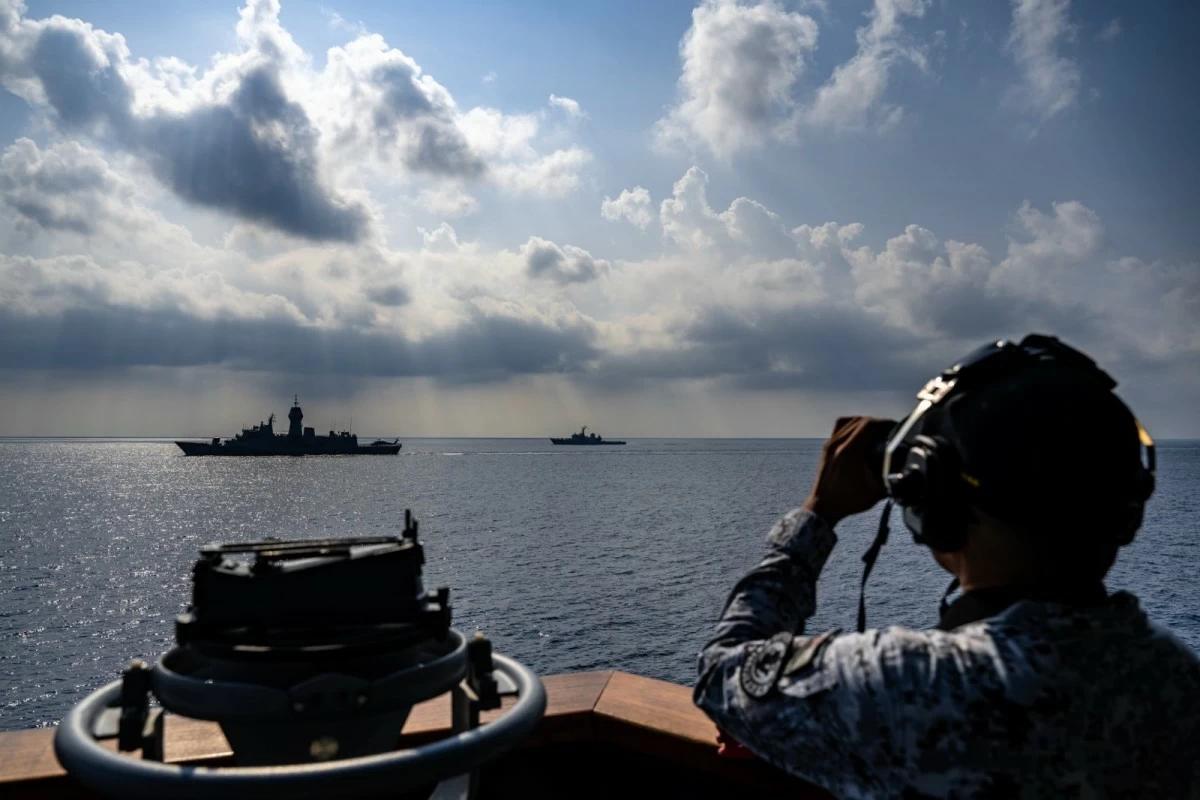
A Philippine Navy personnel aboard BRP Rajah Sulayman (PS20) carries out an Officer of the Watch (OOW) Manning Exercise during the division tactics and maneuvering drills alongside partner vessels as part of the Multilateral Maritime Cooperative Activity (MMCA) held by the Armed Forces of the Philippines (AFP) with the United States Indo-Pacific Command (Indopacom) and Australian Defence Force (ADF) in the West Philippine Sea from April 9 to 12, 2026. (Photo: AFP)
The Armed Forces of the Philippines (AFP) on Tuesday, Aug. 25, urged Filipinos to be cautious about narratives being circulated by foreign actors as the Chinese Embassy in Manila continues a public exchange of accusations with Philippine officials over the West Philippine Sea (WPS) and recent law enforcement operations.
AFP spokesperson for WPS retired admiral Roy Vincent Trinidad said the public should be alert to foreign malign influence activities aimed at changing public perception and shaping the information environment.
“Be very careful in listening to foreign malign influence. These are false narratives being spread by our adversary to shape the information space,” Trinidad said.
Hesaid the AFP has observed an increase in foreign-aligned influence activities during the past four months.
“There has been a noted spike or increase in foreign-aligned influence activities for the past four months,” he said. “This centered on the conduct of law enforcement operations. These targeted government officials, to include our very own SND [Secretary of National Defense].”
He said the objective was to create division among Filipinos and alter public understanding of the country's maritime disputes.
“Be careful because the objective of foreign malign influence is to divide us as a people. To make Filipinos fight among themselves, to shape the narrative, to change public perception, and ultimately to advance their own interest,” Trinidad said.
His warning came amid a series of increasingly pointed statements from the Chinese Embassy and Philippine officials, including Department of National Defense (DND) Secretary Gilberto Teodoro Jr. and Philippine Coast Guard (PCG) WPS spokesperson Rear Adm. Jay Tarriela.
Trinidad said the military welcomes foreign partners who follow Philippine laws but warned against narratives that question legitimate government operations.
“We welcome our partners and allies to abide by the laws of the land, to do site surveys, inspections, or exercises with the AFP. We do not welcome adversaries who turn out to spout false narratives about legal law enforcement operations,” he said.
Continuing word war
Trinidad pointed to the dispute over a law enforcement operation at a steel facility in Tagoloan, Misamis Oriental in May where authorities arrested several Chinese nationals.
The Chinese Embassy questioned why the AFP participated in the operation, why Chinese workers were arrested while Filipino workers were released, and why the Chinese nationals were transported to Manila aboard a military aircraft. It also said the embassy had a responsibility to provide consular protection to Chinese nationals.
The dispute also involved Presidential Anti-Organized Crime Commission (PAOCC) Executive Director Benjamin Acorda Jr., who told a Senate hearing that Chinese Embassy representatives had warned that Filipinos in China could be arrested if the Chinese workers apprehended in the steel plant raid were not released.
Trinidad said the Tagoloan operation was a legitimate law enforcement action supported by the AFP.
“If we look at the situation in Tagoloan, it is close to a future projected site for development for a naval base. It is close to Lumbia Airport and an EDCA [Enhanced Defense Cooperation Agreement] site. It is close to other critical government infrastructure,” he said.
“That activity was a law enforcement operation fully supported by the AFP,” he added.
The embassy has also been involved in a dispute with officials of the Kalayaan municipal government after the town declared Chinese Ambassador Jing Quan persona non grata. China later imposed entry restrictions on 16 Kalayaan officials, including Mayor Balthazar Alindogan.
Trinidad also cited continuing narratives surrounding Ayungin Shoal and the BRP Sierra Madre, where the Chinese Embassy claimed the Philippine government had promised to remove the grounded naval ship although the military denied there was such a discussion.
“Allow me to say this to all, Filipinos and foreigners alike: BRP Sierra Madre is there to stay on Ayungin Shoal. We will not remove that ship,” he said.
No PLA Navy ships monitored
Meanwhile, the AFP's latest weekly monitoring of Chinese vessels in Philippine-held features in the WPS showed that from Aug. 18 to 24, there were 16 Chinese vessels across four areas. These consisted entirely of China Coast Guard (CCG) vessels, with no People's Liberation Army-Navy (PLA-N) warships detected.
The AFP monitored 11 CCG vessels at Ayungin Shoal, four CCG vessels at Bajo de Masinloc, and one CCG ship at Pag-asa Island.
Asked why there were no PLA Navy warships during the period, Trinidad said the AFP still had to assess the situation.
“It is too early to put any correlation to all the developments in the country and in the region,” Trinidad said. “Suffice it to say, the AFP remains forward-looking in protecting our maritime domain and developments on land.”
Trinidad also acknowledged that weather conditions could be among the factors behind the figures, as the southwest monsoon, or habagat, continued to affect the country.