ADVERTISEMENT

Leechiu Insights: Tourism's two-speed year: strongest start in five years, but the momentum is cooling

Published Aug 24, 2026 03:03 pm
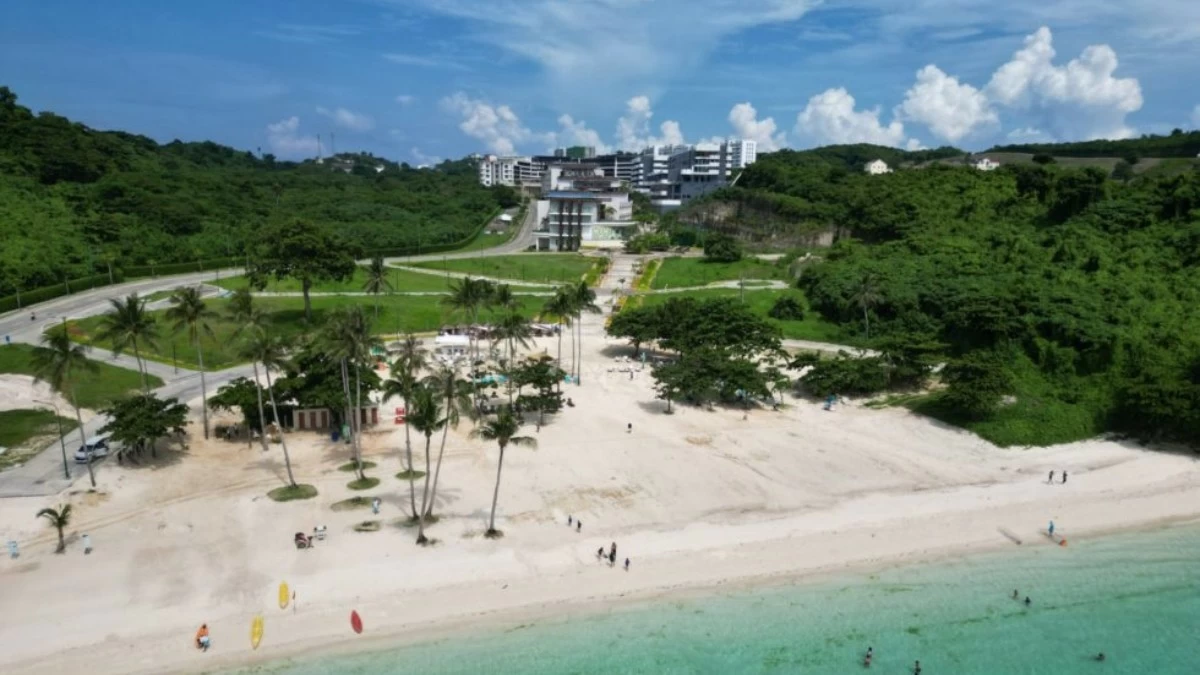
Boracay Newcoast, developed by Megaworld subsidiary Global-Estate Resorts, Inc. (GERI) (Photo: Megaworld Corporation)
By Alfred Lay, Director for Hotels, Tourism, and Leisure at Leechiu Property Consultants
Philippine tourism has just posted its best opening stretch since before the pandemic. Whether it can hold that pace through the rest of 2026 is a very different question.
Foreign arrivals reached 2.74 million from January to May, an 8 percent increase over the 2.54 million recorded in the same period last year. It is the strongest first-five-month showing in five years, ahead of 2024's 2.56 million and a world away from the 559,832 visitors of the same months in 2022, when travel restrictions were still in force. We read that as a genuine sign of resilience, and of a source base that is broadening rather than leaning on one or two markets.
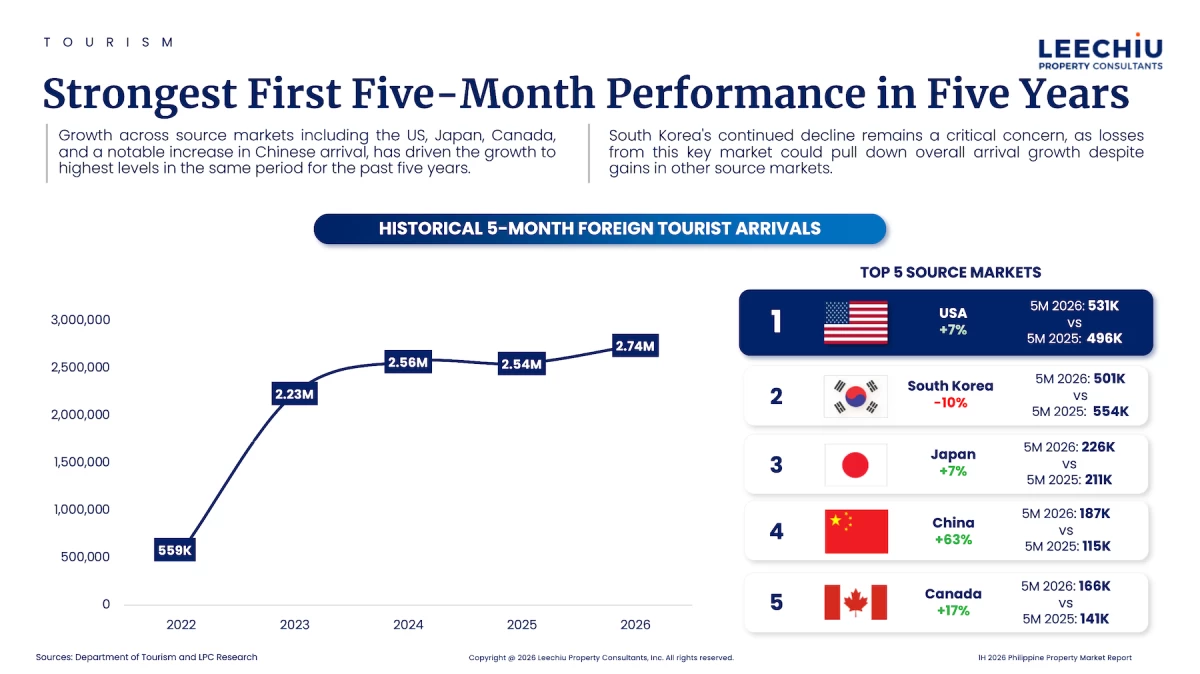
Look at the monthly numbers, though, and a second story emerges. Growth peaked at 17 percent in February, then stepped down to 13 percent in March, 4 percent in April, and just 1 percent by May — averaging 7 percent for the period, but on a clearly descending track. We attribute the slowdown to the lingering effects of the Iran crisis, including traveler hesitation and the ripple effects of flight cancellations at the height of the conflict, and we expect those effects to weigh on arrival growth into the second half. The first half gives the industry a comfortable lead over last year's full-year performance. But the full effects of the global crisis have yet to be felt, and that argues for preparation rather than celebration.
China returns, Korea keeps slipping
The source-market mix is being quietly reshuffled. The United States remained the largest contributor at 531,859 arrivals, up 7 percent. China posted the sharpest gain of the top five, surging 63 percent to 187,478 from 115,163. Canada rose 17 percent to 166,247, and Japan added 7 percent to reach 226,494. The outlier is South Korea. Still the country's second-largest market at 501,789 arrivals, it declined 10 percent from 554,855 — and we flag the sustained losses as a genuine risk. Continued erosion from a market of that size could drag down overall growth even as other markets expand.
Alfred Lay, director for Hotels, Tourism, and Leisure at Leechiu Property Consultants
Two markets, two outcomes
For hotel owners, the more immediate divide is between who their guests are. Metro Manila accommodation held firm through the first five months. Average daily rates rose to ₱6,000 from ₱5,800 a year earlier, peaking at ₱6,200 in April, while average occupancy edged up to 66 percent from 65 percent. Occupancy improved to 67 percent in May from 64 percent in January. Corporate and MICE-driven demand carried that performance, and it stayed largely insulated from both household inflation and the travel disruptions of the Iran crisis.
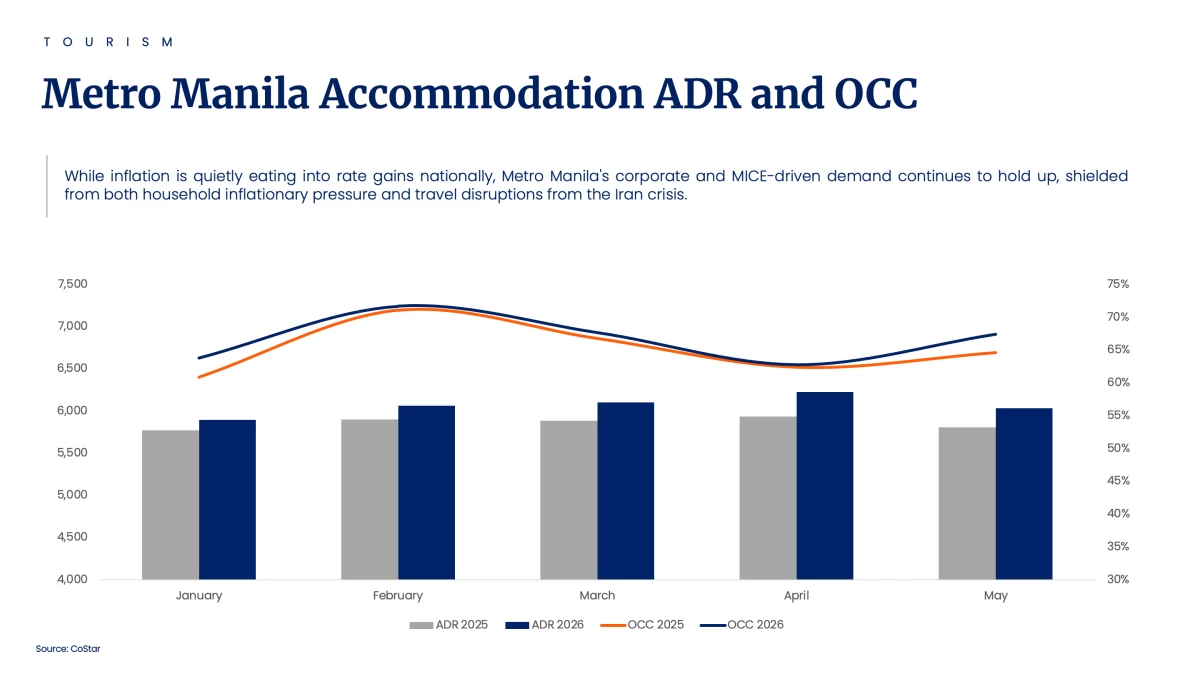
Outside that bubble, the picture is tighter. With inflation projected at 6.4 percent, Filipino travelers have less discretionary income for leisure trips, and elevated fuel costs are keeping airfares high. Budget-to-mid-tier hotels dependent on domestic travelers are the most exposed — and, with operating costs rising, they have little room to discount their way out of it.
Four things to watch
We see four factors shaping the balance of the year. Inflation and fuel costs point to a domestic pullback. A weaker peso works the other way, making the Philippines more affordable for foreign visitors, though operators still absorb higher costs on imported goods. The return of face-to-face ASEAN meetings should lift arrivals modestly, with the benefit concentrated in properties with real MICE capability rather than spread across the market. The wildcard is fuel prices. Stabilization in the second half would ease airfare pressure and support an inbound recovery; further escalation could cancel out whatever the weaker peso delivers.
The read for owners is fairly clear. Properties with foreign-visitor exposure and MICE capacity are best positioned. Those built around domestic budget travel face the harder half. We expect occupancy growth to stay modest, carried by MICE activity and domestic tourism, while room rates keep climbing on sustained demand and higher post-crisis operating costs.

Related Tags

Leechiu Property Consultants Leechiu Insights Alfred Lay
ADVERTISEMENT
.most-popular .layout-ratio{ padding-bottom: 79.13%; } @media (min-width: 768px) and (max-width: 1024px) { .widget-title { font-size: 15px !important; } }

{{ articles_filter_1561_widget.title }}

.most-popular .layout-ratio{ padding-bottom: 79.13%; } @media (min-width: 768px) and (max-width: 1024px) { .widget-title { font-size: 15px !important; } }

{{ static_articles_1562_widget.title }}

.most-popular .layout-ratio{ padding-bottom: 79.13%; } @media (min-width: 768px) and (max-width: 1024px) { .widget-title { font-size: 15px !important; } }

{{ articles_filter_1563_widget.title }}

{{ articles_filter_1564_widget.title }}

.mb-article-details { position: relative; } .mb-article-details .article-body-preview, .mb-article-details .article-body-summary{ font-size: 17px; line-height: 30px; font-family: "Libre Caslon Text", serif; color: #000; } .mb-article-details .article-body-preview iframe , .mb-article-details .article-body-summary iframe{ width: 100%; margin: auto; } .read-more-background { background: linear-gradient(180deg, color(display-p3 1.000 1.000 1.000 / 0) 13.75%, color(display-p3 1.000 1.000 1.000 / 0.8) 30.79%, color(display-p3 1.000 1.000 1.000) 72.5%); position: absolute; height: 200px; width: 100%; bottom: 0; display: flex; justify-content: center; align-items: center; padding: 0; } .read-more-background a{ color: #000; } .read-more-btn { padding: 17px 45px; font-family: Inter; font-weight: 700; font-size: 18px; line-height: 16px; text-align: center; vertical-align: middle; border: 1px solid black; background-color: white; } .hidden { display: none; }
function initializeAllSwipers() { // Get all hidden inputs with cms_article_id document.querySelectorAll('[id^="cms_article_id_"]').forEach(function (input) { const cmsArticleId = input.value; const articleSelector = '#article-' + cmsArticleId + ' .body_images'; const swiperElement = document.querySelector(articleSelector); if (swiperElement && !swiperElement.classList.contains('swiper-initialized')) { new Swiper(articleSelector, { loop: true, pagination: false, navigation: { nextEl: '#article-' + cmsArticleId + ' .swiper-button-next', prevEl: '#article-' + cmsArticleId + ' .swiper-button-prev', }, }); } }); } setTimeout(initializeAllSwipers, 3000); const intersectionObserver = new IntersectionObserver( (entries) => { entries.forEach((entry) => { if (entry.isIntersecting) { const newUrl = entry.target.getAttribute("data-url"); if (newUrl) { history.pushState(null, null, newUrl); let article = entry.target; // Extract metadata const author = article.querySelector('.author-section').textContent.replace('By', '').trim(); const section = article.querySelector('.section-info ').textContent.replace(' ', ' '); const title = article.querySelector('.article-title h1').textContent; // Parse URL for Chartbeat path format const parsedUrl = new URL(newUrl, window.location.origin); const cleanUrl = parsedUrl.host + parsedUrl.pathname; // Update Chartbeat configuration if (typeof window._sf_async_config !== 'undefined') { window._sf_async_config.path = cleanUrl; window._sf_async_config.sections = section; window._sf_async_config.authors = author; } // Track virtual page view with Chartbeat if (typeof pSUPERFLY !== 'undefined' && typeof pSUPERFLY.virtualPage === 'function') { try { pSUPERFLY.virtualPage({ path: cleanUrl, title: title, sections: section, authors: author }); } catch (error) { console.error('ping error', error); } } // Optional: Update document title if (title && title !== document.title) { document.title = title; } } } }); }, { threshold: 0.1 } ); function showArticleBody(button) { const article = button.closest("article"); const summary = article.querySelector(".article-body-summary"); const body = article.querySelector(".article-body-preview"); const readMoreSection = article.querySelector(".read-more-background"); // Hide summary and read-more section summary.style.display = "none"; readMoreSection.style.display = "none"; // Show the full article body body.classList.remove("hidden"); } document.addEventListener("DOMContentLoaded", () => { let loadCount = 0; // Track how many times articles are loaded const offset = [1, 2, 3, 4, 5, 6, 7, 8, 9, 10]; // Offset values const currentUrl = window.location.pathname.substring(1); let isLoading = false; // Prevent multiple calls if (!currentUrl) { console.log("Current URL is invalid."); return; } const sentinel = document.getElementById("load-more-sentinel"); if (!sentinel) { console.log("Sentinel element not found."); return; } function isSentinelVisible() { const rect = sentinel.getBoundingClientRect(); return ( rect.top < window.innerHeight && rect.bottom >= 0 ); } function onScroll() { if (isLoading) return; if (isSentinelVisible()) { if (loadCount >= offset.length) { console.log("Maximum load attempts reached."); window.removeEventListener("scroll", onScroll); return; } isLoading = true; const currentOffset = offset[loadCount]; window.loadMoreItems().then(() => { let article = document.querySelector('#widget_1690 > div:nth-last-of-type(2) article'); intersectionObserver.observe(article) loadCount++; }).catch(error => { console.error("Error loading more items:", error); }).finally(() => { isLoading = false; }); } } window.addEventListener("scroll", onScroll); });

Sign up by email to receive news.