

ADVERTISEMENT

DHSUD: 1,400 Naga residents closer to land ownership through 'people-centric' program

Published Aug 22, 2026 02:29 pm

At A Glance

  • * More than 1,400 Naga City residents are a step closer to owning the land they occupy through the Enhanced Community Mortgage Program (ECMP).
  • * Around 420 families from three homeowners' associations received loan assistance from the Social Housing Finance Corporation (SHFC).
  • * As of August, 47 ECMP projects covering more than 8,000 families have been approved nationwide.
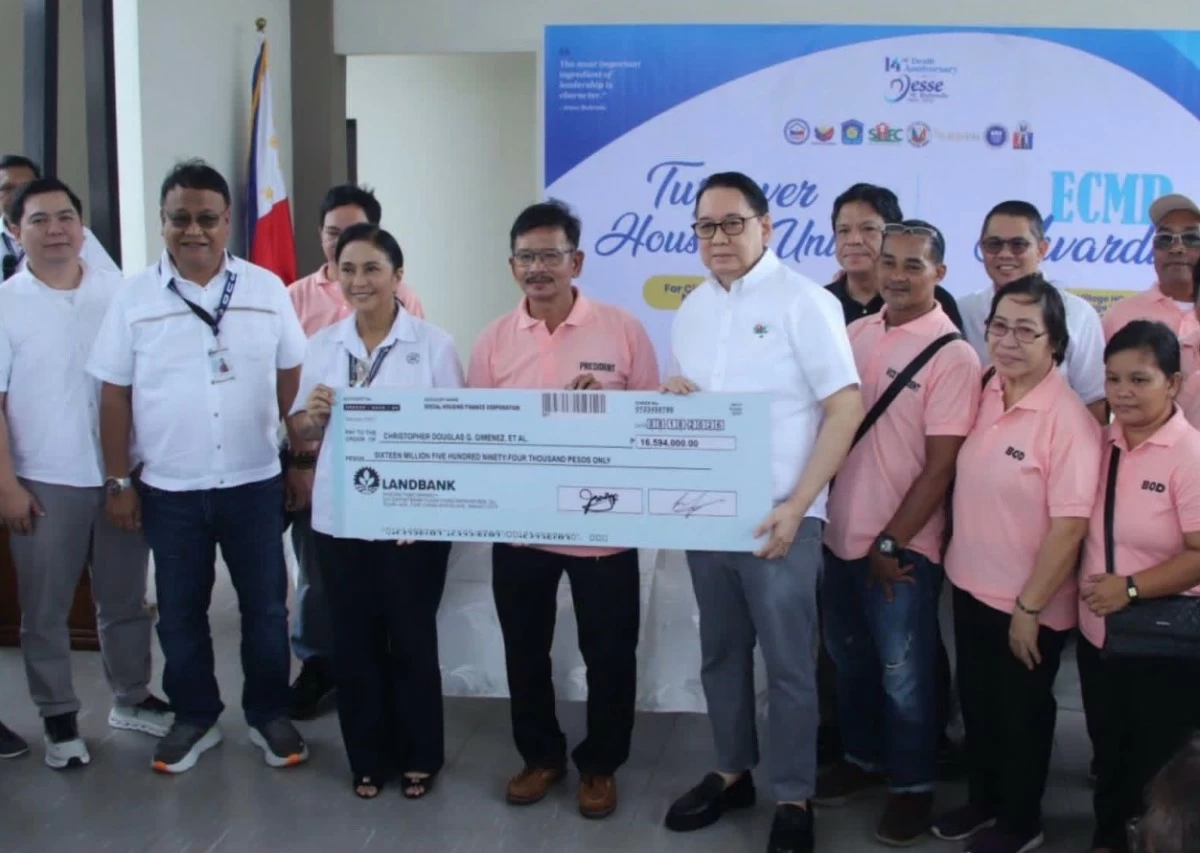
(PHOTO: DHSUD)
(PHOTO: DHSUD)
More than 1,400 Naga City residents will soon secure ownership of the land they occupy through the “people-centric” Enhanced Community Mortgage Program (ECMP), the Department of Human Settlements and Urban Development (DHSUD) said.
The ECMP is among the housing modalities under the administration’s Expanded Pambansang Pabahay para sa Pilipino (4PH) Program.
This came after the Social Housing Finance Corporation (SHFC), a key shelter agency under the DHSUD, awarded loan assistance to around 420 families belonging to the Mabolo Village Homeowners’ Association Phases 1 and 2 and the Saint Joseph Homeowners Association.
The awarding ceremony was held last Wednesday, Aug. 19, in Barangay Pacol, Naga City, as part of the commemoration of Jesse Robredo Day.
DHSUD Assistant Secretary Johnson Domingo represented Secretary Jose Ramon Aliling at the ceremony, joining Naga City Mayor Leni Robredo and SHFC President and CEO Federico Laxa in recognizing the three communities, whose members are now a step closer to owning the land they call home.
“With the latest beneficiaries of around 420 families, more than 800 families in Naga City have now benefited from ECMP projects,” the DHSUD said.
To recall, the SHFC also extended assistance to two other ECMP communities in the city in June, further advancing the government’s efforts to provide organized low-income communities with secure land tenure.
According to the DHSUD, the developments in Naga City highlight how the Expanded 4PH Program helps meet the housing needs of families that wish to remain in the communities where they have put down roots and built their livelihoods.
Aliling said the continuing rollout of the ECMP reflects the administration’s commitment to making government housing assistance more accessible and responsive, especially for families that have long sought security of tenure.
“Sa ilalim ng Expanded 4PH, hindi lamang bahay ang ating ipinagkakaloob. Alinsunod sa direktiba ni Pangulong Ferdinand R. Marcos Jr., tinutulungan din nating makamit ng mga pamilya ang seguridad sa paninirahan sa lupang matagal na nilang tinitirhan (Under the Expanded 4PH Program, we provide not only housing. In line with the directive of President Ferdinand R. Marcos Jr., we also help families secure tenure over the land they have long occupied),” he said in a statement.
“Sa pamamagitan ng ECMP, nabibigyan natin sila ng pagkakataong manatili sa kanilang komunidad habang tinatahak ang landas tungo sa legal at pangmatagalang seguridad sa kanilang tahanan (Through the ECMP, we give families the opportunity to remain in their communities while pursuing legal and long-term security in their homes),” he added.
For her part, Robredo expressed gratitude to the DHSUD and the SHFC for their continued assistance to Naga City, describing the Community Mortgage Program (CMP) as a “life-changing” initiative because it allows families to secure their homes without leaving their existing communities.
“Ang best ang CMP kasi onsite. Hindi na sila mamomroblemang ilipat sila (The CMP is the best option because it is implemented on-site. They will no longer have to worry about being relocated),” she said.
After years of uncertainty, the assistance gave the three beneficiary communities a concrete opportunity to secure tenure over the land they call home.
Mabolo Village Homeowners’ Association Phase 1 President Rowena Bañas and Mabolo Village Homeowners’ Association Phase 2 President Marissa Ramirez described the assistance as an “answered prayer.”
Saint Joseph Homeowners Association Inc. President Nilo Villaflor said the support was timely, noting that their community had previously faced possible eviction.
Revived in 2025 under the Expanded Pambansang Pabahay para sa Pilipino (4PH) Program, the Enhanced Community Mortgage Program is a strengthened and streamlined version of the 38-year-old Community Mortgage Program.
The ECMP seeks to provide organized low-income communities with easier access to government assistance for the purchase of the land they occupy.
As of August, 47 ECMP projects have been approved, covering more than 8,000 families across the country.

Related Tags

DHSUD LENI ROBREDO NAGA CITY SHFC PEOPLE-CENTRIC Enhanced Community Mortgage Program ECMP RESIDENTS LAND OWNERSHIP
ADVERTISEMENT
.most-popular .layout-ratio{ padding-bottom: 79.13%; } @media (min-width: 768px) and (max-width: 1024px) { .widget-title { font-size: 15px !important; } }

{{ articles_filter_1561_widget.title }}

.most-popular .layout-ratio{ padding-bottom: 79.13%; } @media (min-width: 768px) and (max-width: 1024px) { .widget-title { font-size: 15px !important; } }

{{ static_articles_1562_widget.title }}

.most-popular .layout-ratio{ padding-bottom: 79.13%; } @media (min-width: 768px) and (max-width: 1024px) { .widget-title { font-size: 15px !important; } }

{{ articles_filter_1563_widget.title }}

{{ articles_filter_1564_widget.title }}

.mb-article-details { position: relative; } .mb-article-details .article-body-preview, .mb-article-details .article-body-summary{ font-size: 17px; line-height: 30px; font-family: "Libre Caslon Text", serif; color: #000; } .mb-article-details .article-body-preview iframe , .mb-article-details .article-body-summary iframe{ width: 100%; margin: auto; } .read-more-background { background: linear-gradient(180deg, color(display-p3 1.000 1.000 1.000 / 0) 13.75%, color(display-p3 1.000 1.000 1.000 / 0.8) 30.79%, color(display-p3 1.000 1.000 1.000) 72.5%); position: absolute; height: 200px; width: 100%; bottom: 0; display: flex; justify-content: center; align-items: center; padding: 0; } .read-more-background a{ color: #000; } .read-more-btn { padding: 17px 45px; font-family: Inter; font-weight: 700; font-size: 18px; line-height: 16px; text-align: center; vertical-align: middle; border: 1px solid black; background-color: white; } .hidden { display: none; }
function initializeAllSwipers() { // Get all hidden inputs with cms_article_id document.querySelectorAll('[id^="cms_article_id_"]').forEach(function (input) { const cmsArticleId = input.value; const articleSelector = '#article-' + cmsArticleId + ' .body_images'; const swiperElement = document.querySelector(articleSelector); if (swiperElement && !swiperElement.classList.contains('swiper-initialized')) { new Swiper(articleSelector, { loop: true, pagination: false, navigation: { nextEl: '#article-' + cmsArticleId + ' .swiper-button-next', prevEl: '#article-' + cmsArticleId + ' .swiper-button-prev', }, }); } }); } setTimeout(initializeAllSwipers, 3000); const intersectionObserver = new IntersectionObserver( (entries) => { entries.forEach((entry) => { if (entry.isIntersecting) { const newUrl = entry.target.getAttribute("data-url"); if (newUrl) { history.pushState(null, null, newUrl); let article = entry.target; // Extract metadata const author = article.querySelector('.author-section').textContent.replace('By', '').trim(); const section = article.querySelector('.section-info ').textContent.replace(' ', ' '); const title = article.querySelector('.article-title h1').textContent; // Parse URL for Chartbeat path format const parsedUrl = new URL(newUrl, window.location.origin); const cleanUrl = parsedUrl.host + parsedUrl.pathname; // Update Chartbeat configuration if (typeof window._sf_async_config !== 'undefined') { window._sf_async_config.path = cleanUrl; window._sf_async_config.sections = section; window._sf_async_config.authors = author; } // Track virtual page view with Chartbeat if (typeof pSUPERFLY !== 'undefined' && typeof pSUPERFLY.virtualPage === 'function') { try { pSUPERFLY.virtualPage({ path: cleanUrl, title: title, sections: section, authors: author }); } catch (error) { console.error('ping error', error); } } // Optional: Update document title if (title && title !== document.title) { document.title = title; } } } }); }, { threshold: 0.1 } ); function showArticleBody(button) { const article = button.closest("article"); const summary = article.querySelector(".article-body-summary"); const body = article.querySelector(".article-body-preview"); const readMoreSection = article.querySelector(".read-more-background"); // Hide summary and read-more section summary.style.display = "none"; readMoreSection.style.display = "none"; // Show the full article body body.classList.remove("hidden"); } document.addEventListener("DOMContentLoaded", () => { let loadCount = 0; // Track how many times articles are loaded const offset = [1, 2, 3, 4, 5, 6, 7, 8, 9, 10]; // Offset values const currentUrl = window.location.pathname.substring(1); let isLoading = false; // Prevent multiple calls if (!currentUrl) { console.log("Current URL is invalid."); return; } const sentinel = document.getElementById("load-more-sentinel"); if (!sentinel) { console.log("Sentinel element not found."); return; } function isSentinelVisible() { const rect = sentinel.getBoundingClientRect(); return ( rect.top < window.innerHeight && rect.bottom >= 0 ); } function onScroll() { if (isLoading) return; if (isSentinelVisible()) { if (loadCount >= offset.length) { console.log("Maximum load attempts reached."); window.removeEventListener("scroll", onScroll); return; } isLoading = true; const currentOffset = offset[loadCount]; window.loadMoreItems().then(() => { let article = document.querySelector('#widget_1690 > div:nth-last-of-type(2) article'); intersectionObserver.observe(article) loadCount++; }).catch(error => { console.error("Error loading more items:", error); }).finally(() => { isLoading = false; }); } } window.addEventListener("scroll", onScroll); });

Sign up by email to receive news.