







When governance becomes an economic problem
Published Aug 20, 2026 12:01 am
|
Updated Aug 17, 2026 05:44 pm


There was a time early in the Marcos administration when the Philippine economy appeared to have recovered its stride. Coming out of the pandemic, growth was vigorous. But the trajectory since then tells a much less reassuring story. By the second quarter of 2026, gross domestic product (GDP) growth had fallen to just 2.3 percent—the weakest quarterly year-on-year expansion since 2021.
One bad quarter does not define an economy. But this is no longer just one bad quarter. Construction contracted by 14.8 percent, investment fell by 9.2 percent, and household consumption—traditionally the great stabilizer of the Philippine economy—grew by only 2.8 percent as inflation eroded purchasing power.
The comparison with our ASEAN neighbors is sobering. Vietnam grew by about 8.4 percent in the second quarter, Singapore by 5.9 percent, Malaysia by an estimated 5.8 percent, and Indonesia by 5.29 percent. The Philippines has become one of the region's laggards.
What happened?
There are external explanations: higher energy costs, geopolitical uncertainty, and persistent inflation. But these cannot fully explain why neighboring economies, confronting many of the same global conditions, are doing considerably better.
We must confront another possibility: governance itself has become an economic problem.
The flood-control scandal provides the most dramatic example. Economic Planning Secretary Arsenio Balisacan has acknowledged that the controversy curtailed public spending and damaged investor confidence, particularly in infrastructure. Construction collapsed precisely when public investment should have been supporting the economy.
There is an unfortunate paradox here. A government cannot continue questionable projects merely to keep GDP growing. Yet when corruption becomes so pervasive that cleaning it up causes the public-investment machinery itself to seize, we begin to appreciate the enormous economic cost of bad governance.
Corruption does not merely steal taxpayers' money; it distorts decisions. Resources flow toward projects producing political rather than economic returns. Contractors cultivate connections instead of competence. Honest officials become excessively cautious, investors postpone decisions, and citizens grow cynical.
Economists call this declining confidence and increased uncertainty. Ordinary Filipinos have a simpler expression: walang tiwala.
We have been here before, albeit under different circumstances.
One lesson comes from the administration of President Benigno Aquino III. Its Daang Matuwid philosophy was based on a simple proposition: good governance is good economics.
Aquino's record was certainly not flawless; his overcautious stance was frequently criticized. But his administration demonstrated that credibility carries real economic value. Greater fiscal transparency, anti-corruption initiatives, and improved public financial management coincided with credit-rating upgrades, improved investor sentiment, and generally strong economic growth.
When businesses believe rules will be applied fairly, they invest. When taxpayers believe money will be spent properly, the government acquires greater legitimacy. Governance therefore becomes not merely a moral aspiration, but an economic asset.
That lesson is especially relevant today because the answer to our slowdown cannot simply be to spend more. The critical question regarding our enormous national budget is not how much the government spends, but how efficiently every peso is utilized.
Projects should survive rigorous economic and social cost-benefit tests. Programs that repeatedly fail to produce measurable outcomes should be reduced or eliminated. Zero-based budgeting—scrutinizing programs strictly according to results—is a principle worth revisiting.
We must likewise confront the perennial problem of pork barrel politics.
The Supreme Court declared the PDAF system unconstitutional in 2013. Yet pork possesses an extraordinary ability to reinvent itself—disappearing under one name only to reappear through budget insertions, vaguely defined allocations, or other discretionary mechanisms.
The constitutional principle must remain clear: Congress appropriates, the Executive implements, and public money must remain transparent and accountable.
The same discipline should apply to confidential and intelligence funds. Legitimate national security operations sometimes require secrecy. But secrecy should be the exception, not an escape from accountability. Agencies whose mandates have little connection with intelligence gathering should face an exceptionally high burden in justifying such funds.
Every unnecessary peso placed beyond ordinary scrutiny is a peso unavailable for classrooms, hospitals, transportation, agriculture, flood control, and other investments that improve productivity and people's lives.
This is ultimately about fiscal efficiency. A larger budget does not necessarily produce faster growth. What matters is whether spending creates tangible economic and social value.
And that brings us to leadership.
Economic turnarounds require leaders capable of establishing clear priorities and persuading citizens and investors that today's decisions will produce tomorrow's prosperity.
What kind of economy do we intend to become? Will we be able to compete with Vietnam, Malaysia, and Singapore? Can our BPO industry shift toward AI, analytics, and higher-value professional services? Can agriculture finally become productive enough to raise farmers' incomes while lowering food prices?
These questions cannot be answered by distributing projects congressional district by congressional district. They require a cohesive national economic vision.
Yet as 2028 approaches, political discussion seems far more concerned with personalities, alliances, and succession than with productivity, investment, education, and institutional reform. What the Philippines needs is both visionary leadership and stronger institutions—a professional bureaucracy, transparent procurement, disciplined budgeting, predictable regulation, and genuine accountability.
The Philippines has not suddenly lost its educated workforce, entrepreneurial spirit, strategic location, or demographic advantages. Our ASEAN neighbors demonstrate that rapid growth in Asia remains entirely possible.
What appears to have weakened is our ability to convert those advantages into investment, productivity, and confidence.
The Aquino years offered an enduring insight: good governance can be good economics. Our present predicament suggests that the converse is equally true.
Bad governance eventually becomes bad economics.
Our turnaround therefore begins by restoring trust—trust that taxes will be spent wisely, contracts awarded fairly, and national priorities placed above political accommodation.
The question is no longer simply when GDP will return to 6 percent. It is whether we can rebuild the leadership and institutions necessary to sustain it.
Quo vadis, Philippines?
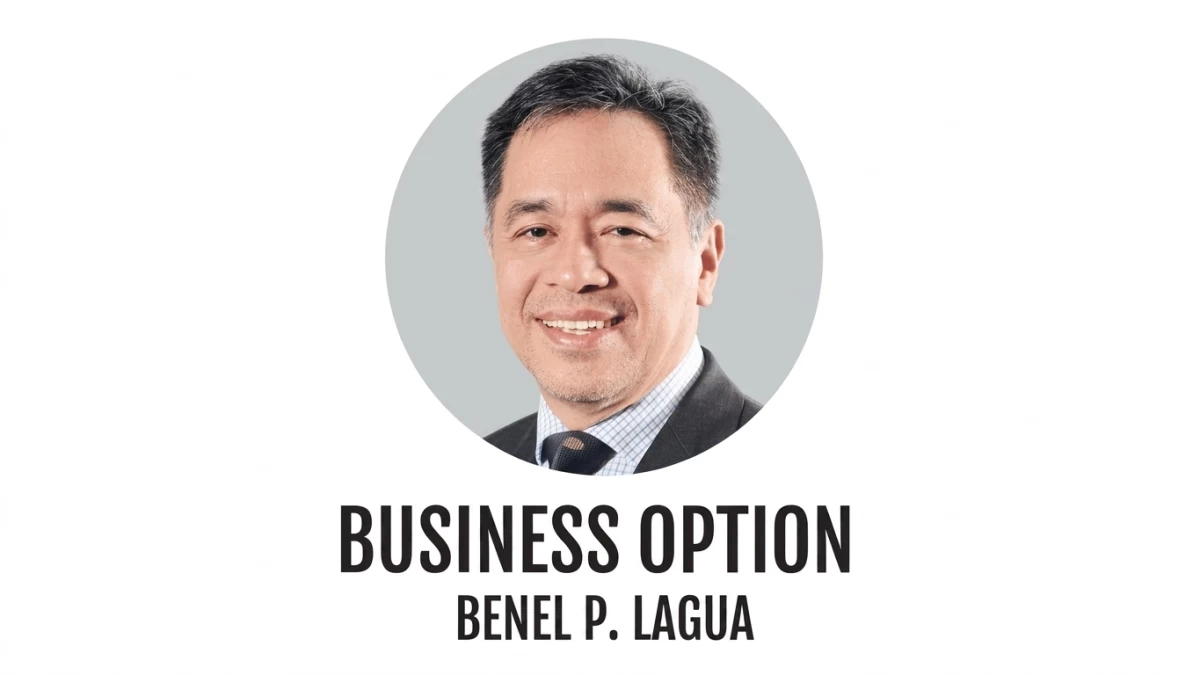
(Benel Dela Paz Lagua was previously EVP and Chief Development Officer at the Development Bank of the Philippines. He is an active FINEX member and an advocate of risk-based lending for SMEs. Today, he serves as an independent director for progressive banks and several NGOs. The views expressed herein are his own and do not necessarily reflect the opinion of his office or FINEX.)