

ADVERTISEMENT

DOH urges floodwater-exposed people to get checked for leptospirosis within 24 to 48 hours

Published Aug 19, 2026 10:30 am

At A Glance

  • DOH said early consultation allows health workers to assess a person's risk of infection and determine whether preventive medication or other appropriate treatment is needed.
  • People can contract leptospirosis by wading through dirty floodwaters, particularly when they have open wounds.
  • Infection may also occur through eating or drinking contaminated food and water, or when contaminated urine or water gets into the eyes, nose, or mouth.
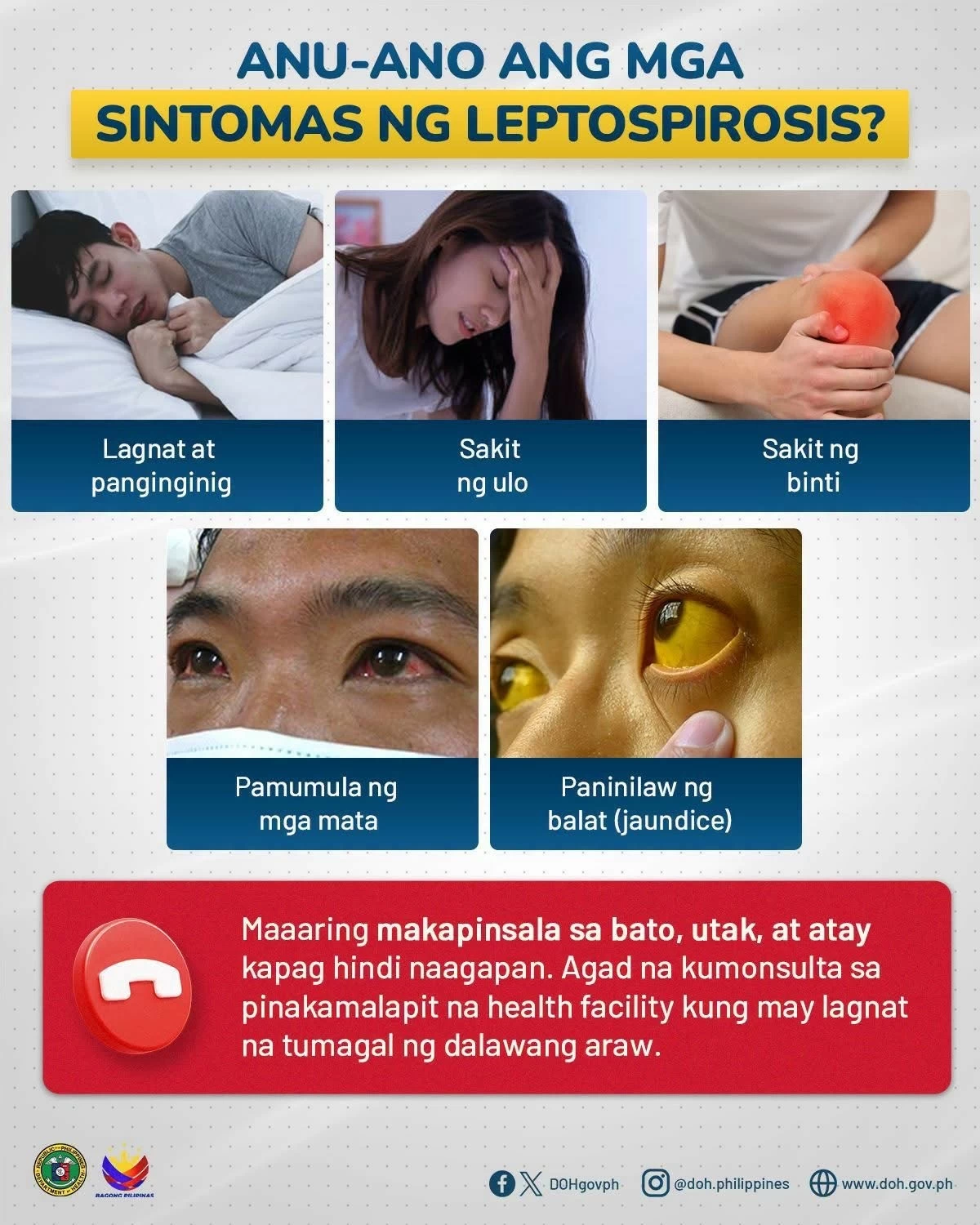
Leptospirosis symptoms (Department of Health)
The Department of Health (DOH) on Wednesday, Aug. 19, urged people who have waded through floodwaters or been exposed to mud to get checked for leptospirosis within 24 to 48 hours, even if they have no symptoms.
DOH said early consultation allows health workers to assess a person's risk of infection and determine whether preventive medication or other appropriate treatment is needed.
The reminder comes as widespread flooding and continued rains brought by the enhanced southwest monsoon or “habagat” increase the risk of exposure to water and mud contaminated with the urine of infected rats and other animals.
“Kahit na walang sintomas, kung lumusong sa baha o na-expose sa putik ay agarang magpakonsulta sa pinakamalapit na health center o doktor sa loob ng 24 hanggang 48 na oras upang masuri ang risk level at mabigyan ng karampatang gamutan o prophylaxis (Even without symptoms, those who have waded through floodwaters or been exposed to mud should immediately consult the nearest health center or doctor within 24 to 48 hours so their risk level can be assessed and they can be given appropriate treatment or prophylaxis),” DOH said.
Leptospirosis is a bacterial disease caused by Leptospira.
People can contract it by wading through dirty floodwaters, particularly when they have open wounds.
Infection may also occur through eating or drinking contaminated food and water, or when contaminated urine or water gets into the eyes, nose, or mouth.
DOH urged the public to avoid wading through floodwaters whenever possible.
“Kung hindi maiiwasan, magsuot ng bota at agad na maghugas ng kamay at katawan gamit ang sabon at malinis na tubig (If exposure to floodwater cannot be avoided, wear boots and immediately wash your hands and body with soap and clean water),” the agency said.
DOH said leptospirosis symptoms can appear two to 30 days after exposure to contaminated floodwater or mud, although they commonly develop within five to 14 days.
People should watch for symptoms such as fever and chills, headache, and leg pain, as well as reddening of the eyes and yellowing of the skin, or jaundice.
“Kung nakararanas naman ng lagnat, sakit ng ulo, panginginig, pananakit ng likod o binti, o di kaya’y pamumula ng mga mata, agad na magpakonsulta sa Leptospirosis Fast Lanes ng DOH hospitals o sa pinakamalapit na health facility (Those experiencing fever, headache, chills, back or leg pain, or reddening of the eyes should immediately seek medical attention at the Leptospirosis Fast Lanes in DOH hospitals or the nearest health facility),” DOH said.
Cases up in latest two-week period
As of Aug. 8, the DOH had recorded 3,440 leptospirosis cases nationwide, 35 percent lower than the 5,318 cases reported during the same period last year.
However, cases increased in the latest two-week monitoring period.
From July 12 to 25, 348 cases were recorded, 27 percent higher than the 275 cases reported from June 28 to July 11.
To prepare for a possible increase in cases, DOH said it has placed concerned Centers for Health Development under Code White Alert and continues to coordinate with the National Disaster Risk Reduction and Management Council.
The department has also prepositioned 3.1 million doxycycline capsules at the DOH Central Office and 17 CHDs to meet the needs of hospitals and local government units.
Doxycycline may also be prescribed by YAKAP providers and obtained from around 3,000 PhilHealth-accredited GAMOT providers nationwide.
DOH said its Zero Balance Billing Program is available to leptospirosis patients in DOH hospitals, while an expanded PhilHealth benefit package covers severe cases in other PhilHealth-accredited hospitals.
Effective July 15, PhilHealth increased its leptospirosis benefit from ₱21,450 to ₱63,000 for regular hospitalization.
The benefit may reach ₱170,000 to ₱411,000 for cases requiring more intensive and critical treatment.

Related Tags

DEPARTMENT OF HEALTH (DOH) LEPTOSPIROSIS HABAGAT DOXYCYCLINE
ADVERTISEMENT
.most-popular .layout-ratio{ padding-bottom: 79.13%; } @media (min-width: 768px) and (max-width: 1024px) { .widget-title { font-size: 15px !important; } }

{{ articles_filter_1561_widget.title }}

.most-popular .layout-ratio{ padding-bottom: 79.13%; } @media (min-width: 768px) and (max-width: 1024px) { .widget-title { font-size: 15px !important; } }

{{ static_articles_1562_widget.title }}

.most-popular .layout-ratio{ padding-bottom: 79.13%; } @media (min-width: 768px) and (max-width: 1024px) { .widget-title { font-size: 15px !important; } }

{{ articles_filter_1563_widget.title }}

{{ articles_filter_1564_widget.title }}

.mb-article-details { position: relative; } .mb-article-details .article-body-preview, .mb-article-details .article-body-summary{ font-size: 17px; line-height: 30px; font-family: "Libre Caslon Text", serif; color: #000; } .mb-article-details .article-body-preview iframe , .mb-article-details .article-body-summary iframe{ width: 100%; margin: auto; } .read-more-background { background: linear-gradient(180deg, color(display-p3 1.000 1.000 1.000 / 0) 13.75%, color(display-p3 1.000 1.000 1.000 / 0.8) 30.79%, color(display-p3 1.000 1.000 1.000) 72.5%); position: absolute; height: 200px; width: 100%; bottom: 0; display: flex; justify-content: center; align-items: center; padding: 0; } .read-more-background a{ color: #000; } .read-more-btn { padding: 17px 45px; font-family: Inter; font-weight: 700; font-size: 18px; line-height: 16px; text-align: center; vertical-align: middle; border: 1px solid black; background-color: white; } .hidden { display: none; }
function initializeAllSwipers() { // Get all hidden inputs with cms_article_id document.querySelectorAll('[id^="cms_article_id_"]').forEach(function (input) { const cmsArticleId = input.value; const articleSelector = '#article-' + cmsArticleId + ' .body_images'; const swiperElement = document.querySelector(articleSelector); if (swiperElement && !swiperElement.classList.contains('swiper-initialized')) { new Swiper(articleSelector, { loop: true, pagination: false, navigation: { nextEl: '#article-' + cmsArticleId + ' .swiper-button-next', prevEl: '#article-' + cmsArticleId + ' .swiper-button-prev', }, }); } }); } setTimeout(initializeAllSwipers, 3000); const intersectionObserver = new IntersectionObserver( (entries) => { entries.forEach((entry) => { if (entry.isIntersecting) { const newUrl = entry.target.getAttribute("data-url"); if (newUrl) { history.pushState(null, null, newUrl); let article = entry.target; // Extract metadata const author = article.querySelector('.author-section').textContent.replace('By', '').trim(); const section = article.querySelector('.section-info ').textContent.replace(' ', ' '); const title = article.querySelector('.article-title h1').textContent; // Parse URL for Chartbeat path format const parsedUrl = new URL(newUrl, window.location.origin); const cleanUrl = parsedUrl.host + parsedUrl.pathname; // Update Chartbeat configuration if (typeof window._sf_async_config !== 'undefined') { window._sf_async_config.path = cleanUrl; window._sf_async_config.sections = section; window._sf_async_config.authors = author; } // Track virtual page view with Chartbeat if (typeof pSUPERFLY !== 'undefined' && typeof pSUPERFLY.virtualPage === 'function') { try { pSUPERFLY.virtualPage({ path: cleanUrl, title: title, sections: section, authors: author }); } catch (error) { console.error('ping error', error); } } // Optional: Update document title if (title && title !== document.title) { document.title = title; } } } }); }, { threshold: 0.1 } ); function showArticleBody(button) { const article = button.closest("article"); const summary = article.querySelector(".article-body-summary"); const body = article.querySelector(".article-body-preview"); const readMoreSection = article.querySelector(".read-more-background"); // Hide summary and read-more section summary.style.display = "none"; readMoreSection.style.display = "none"; // Show the full article body body.classList.remove("hidden"); } document.addEventListener("DOMContentLoaded", () => { let loadCount = 0; // Track how many times articles are loaded const offset = [1, 2, 3, 4, 5, 6, 7, 8, 9, 10]; // Offset values const currentUrl = window.location.pathname.substring(1); let isLoading = false; // Prevent multiple calls if (!currentUrl) { console.log("Current URL is invalid."); return; } const sentinel = document.getElementById("load-more-sentinel"); if (!sentinel) { console.log("Sentinel element not found."); return; } function isSentinelVisible() { const rect = sentinel.getBoundingClientRect(); return ( rect.top < window.innerHeight && rect.bottom >= 0 ); } function onScroll() { if (isLoading) return; if (isSentinelVisible()) { if (loadCount >= offset.length) { console.log("Maximum load attempts reached."); window.removeEventListener("scroll", onScroll); return; } isLoading = true; const currentOffset = offset[loadCount]; window.loadMoreItems().then(() => { let article = document.querySelector('#widget_1690 > div:nth-last-of-type(2) article'); intersectionObserver.observe(article) loadCount++; }).catch(error => { console.error("Error loading more items:", error); }).finally(() => { isLoading = false; }); } } window.addEventListener("scroll", onScroll); });

Sign up by email to receive news.