







DA officials: Support, strengthen vegetable industry
Published Aug 18, 2026 02:45 pm


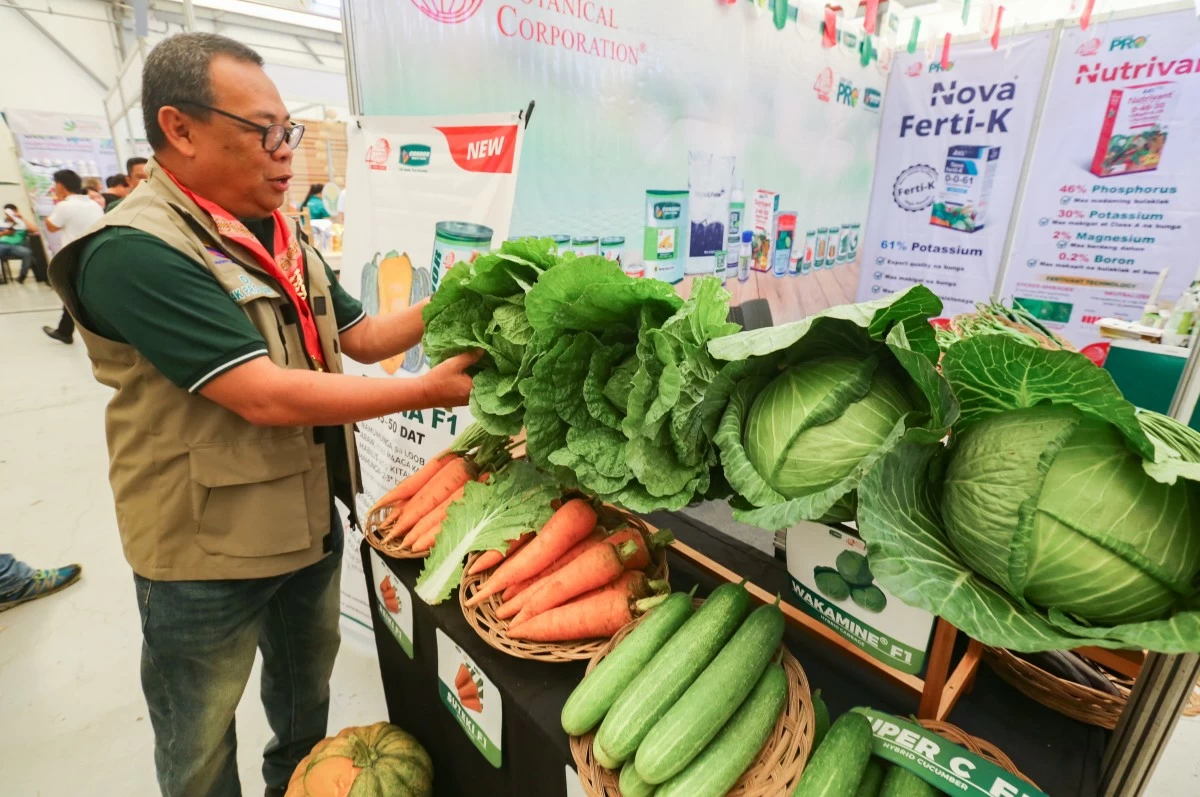
Department of Agriculture Davao Region chief Macario Gonzaga checks a Chinese cabbage from Baguio District, Davao City on display at the National Vegetable Congress at Azuela Cove,Davao City on Tuesday, August 18. (Keith Bacongco)
DAVAO CITY – Officials of the Department of Agriculture (DA) have called on different stakeholders to support and strengthen the country’s vegetable industry amid growing impacts of climate change, rising cost production, and market challenges.
DA Assistant Secretary for Operations U-Nichols Manalo urged vegetable farmers to learn from fellow farmers and from industry leaders in the three-day National Vegetable Congress at the Tent in Azuela Cove here, emphasizing that they should strive for a better quality of their produce to compete in the market.
“Hindi naman kailangan ng mga farmers natin ng ayuda basta’s maganda ang presyo ng kanilang produkto,“ he told the participants.
Moreover, he urged the consumers to patronize the locally-grown vegetables to support the local farmers.
While imported products are cheaper, Manalo appealed, it’s still better to consume locally-grown produce.
Organized by the Vegetable Industry Council of Southern Mindanao (VICSMIN), the National Vegetable Congress, gather vegetable farmers, industry leaders, agripreneurs, students, researchers, government agencies, and other agricultural stakeholders from all over the Philippines to share success stories, latest innovations and market opportunities.
The event is in partnership with the DA Davao Region.
Macario Gonzaga, DA Davao Region chief, pointed out the value of vegetables as among the most important commodities not just for the country’s food security but also for the country’s economy.
While the vegetable industry has an enormous potential, Gonzaga also acknowledged that it is also facing significant challenges, citing oversupply in some areas, climate change, market volatility, limited market access and high input costs.
“That is why the Department of Agriculture is moving toward a more integrated and market-oriented approach, from production and consolidation to logistics, post-harvest handling, processing, marketing, and consumption,” he said before the participants.
Moreover, Gonzaga said the agency, through the High Value Crops Development Program (HVCDP), is strengthening the country's vegetable industry through various interventions.
Under the program, DA is providing with quality planting materials, farm inputs, agricultural machinery, greenhouses and nurseries, technical training, post- harvest equipment and irrigation support.
VICSMIN chair Genovivo Cajes acknowledged the growing challenges that the farmers are facing, such as climate change, rising production cost and market uncertainties.
“These realities remind us that resilience is no longer a choice, it is a necessity. More than ever, we must embrace innovation, adopt climate-smart technologies, strengthen our value chains and continue learning from one another,” said Cajes, who owns a diversified farm in the hinterlands of Baguio District here.
He also urged his fellow farmers to remain united as no farmer or farmer organization can overcome the challenges alone.
Through the gathering, Cajes urged his fellow farmers to seize the opportunity to exchange new ideas, discover new technologies, forge partnerships and inspire one another.