ADVERTISEMENT

Can legislators reform themselves?

The political economy of the 2027 budget

Published Aug 18, 2026 06:09 am
The 2027 national budget comes at an awkward moment: growth is slowing, borrowing costs are rising, and the next election is close enough to concentrate political minds. For lawmakers seeking office in 2028, the 2027 budget matters most. The question is simple but consequential: can Congress resist the temptation to turn fiscal strain into political opportunity and pass a budget free of pork and compliant with the 1987 Constitution?
Three tests of restraint
There are three tests. First, Congress should pass a General Appropriations Bill that stays close to the President’s Budget and respects the constitutional rule barring it from increasing the chief executive's proposed budget. The record is not encouraging. In 2024, 2025, and 2026, Congress rewrote the President’s Budget so extensively that it severely weakened the discipline that rule was designed to impose.

Sources: Budget of Expenditures and Sources of Financing and General Appropriations Act, various years.
The bicameral back door
The second test concerns the bicameral conference committee. Its job is to reconcile differences between the House and Senate versions of the General Appropriations Bill, not to introduce new items that neither chamber properly considered during the formal budget process.
In the 2023, 2024, and 2025 budgets, the bicameral committee did not merely reconcile conflicting provisions. It inserted new items and converted cuts in one department into spending room elsewhere. The clearest example was the repeated reduction of proposed foreign-assisted projects under the Department of Transportation (DOTr) to expand funding for the Department of Public Works and Highways (DPWH). Lawmakers describe this as creating “fiscal space.” In practice, it became a pool for congressional initiatives that, as programmed appropriations, could be drawn from on day one of the fiscal year.
This maneuver proved especially costly because many of the displaced DOTr projects are foreign-assisted initiatives with long lead times and large economic payoffs.
In the 2024 budget, the President proposed ₱161.3 billion for 15 foreign-assisted DOTr projects, including Phase 1 of the Metro Manila Subway Project, at ₱68.4 billion, and the North-South Commuter Railway, at ₱76.3 billion.
Yet in the final General Appropriations Act (GAA), only the MRT-3 Rehabilitation Project survived from the National Expenditure Program. The other transport projects, including the subway and the commuter railway, were stripped out. These cuts helped fund a DPWH budget increase from ₱822.2 billion in the President’s proposal to ₱997.9 billion in the GAA.
The pattern repeated in 2025. Appropriations for DOTr foreign-assisted projects plummeted from ₱122.6 billion in the National Expenditure Program to ₱20.7 billion in the GAA—an 83.1 percent collapse of ₱101.9 billion. The affected projects again included the subway, the commuter rail, and the Cebu Bus Rapid Transit. Over the same cycle, DPWH appropriations rose from ₱900.0 billion to ₱1.088 trillion.
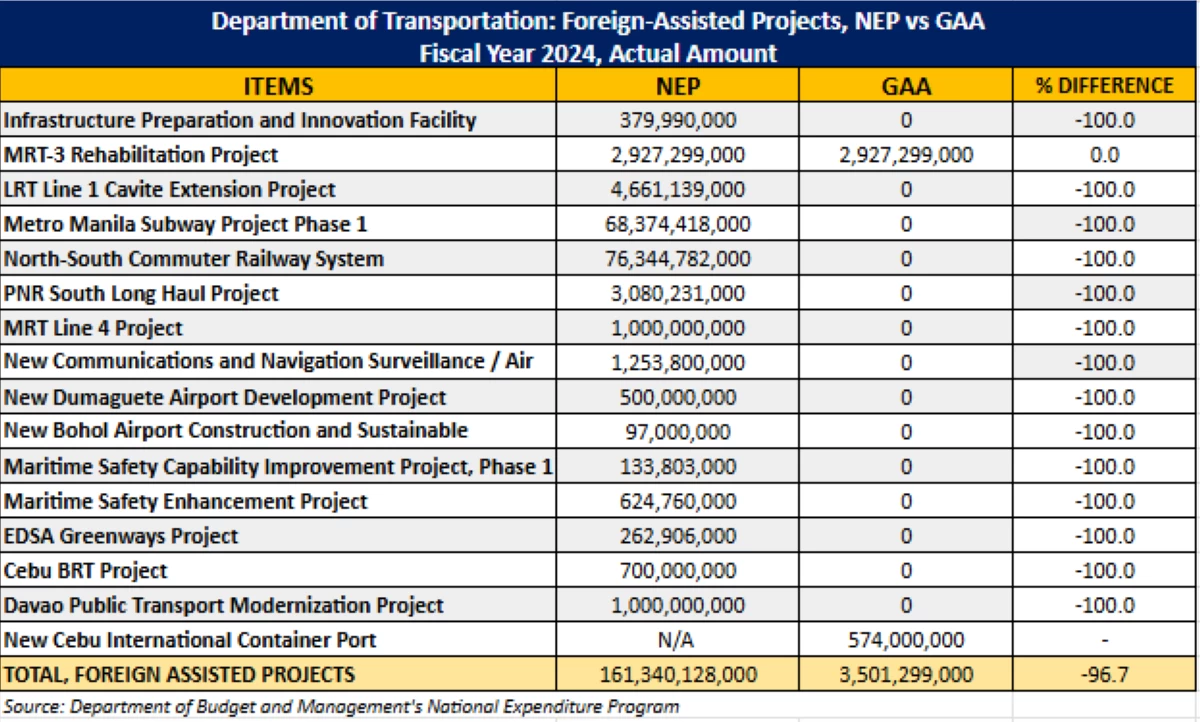
Source: National Expenditure Program 2024
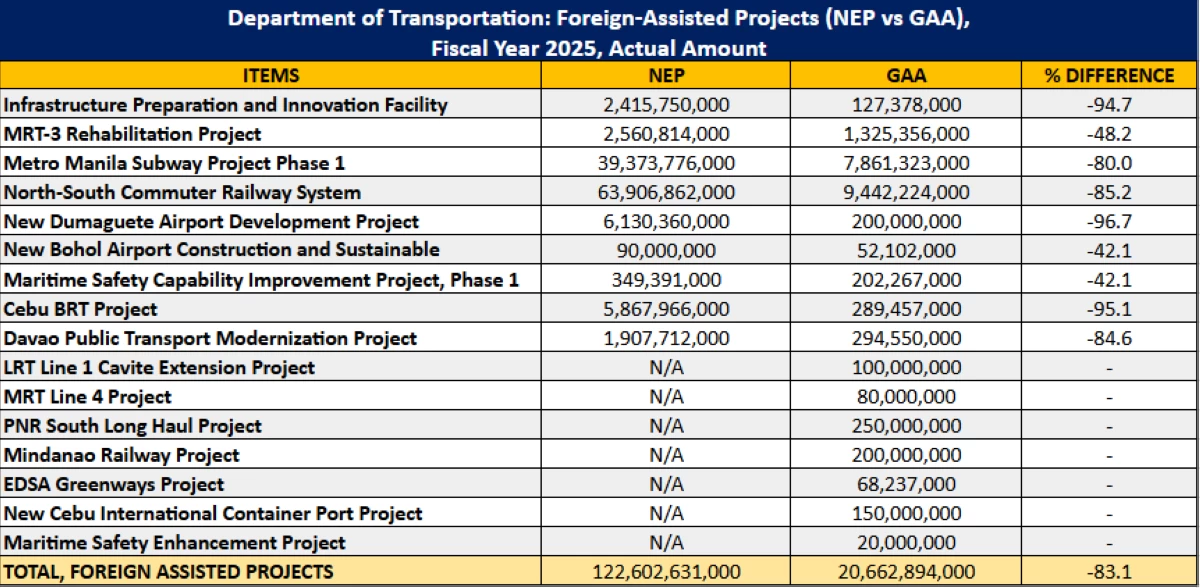
Source: National Expenditure Program 2025
The cost is not merely an accounting exercise. Delays in major infrastructure push up implementation costs and postpone the public benefits citizens were promised.
Seen across three years, the pattern is undeniable. DOTr appropriations, largely for foreign-assisted projects, were slashed; DPWH appropriations were boosted; and the difference was dressed up as “fiscal space.” In 2023, the DOTr budget was cut by ₱61.2 billion while DPWH rose by 24.5 percent. In 2024, DOTr was cut by ₱140.4 billion while DPWH rose by 21.4 percent. In 2025, DOTr was cut by ₱92.9 billion while DPWH rose by 21 percent. The term “fiscal space” makes the practice sound prudent. In reality, it simply financed legislators’ local pet projects.
Pork by another name
The third test is whether the so-called “Leadership Fund”—mentioned by former Public Works Secretary Manuel Bonoan in testimony before the Ombudsman—is abolished rather than merely rebadged. Its alleged existence in the Senate is troubling not only because of its scale, at ₱24 billion or at least ₱500 million per senator, but because of what it reveals about how congressional leaders allocate public funds. Logic dictates that any compromise between the two chambers would require a companion arrangement for the House. With 317 representatives, a House equivalent would presumably be several times larger.
The Senate President, the chair of the Senate finance committee, the Speaker of the House, and the chair of the House appropriations committee are the principal actors in this reconciliation process. If leadership funds exist in both chambers, they strengthen the suspicion that congressional pork—both hard and soft—survives despite the Supreme Court ruling such arrangements unconstitutional.
The final question is whether legislators facing elections in May 2028 can behave differently when the 2027 budget offers their last real opportunity to direct public spending before the campaign season kicks off. Public anger may make reform look attractive, but the incentives of election-year budgeting pull aggressively in the opposite direction. Expecting Congress to voluntarily forgo pork is not impossible—it is merely the hardest test of all.

Related Tags

2027 National Budget General Appropriations Act (GAA) Senate of the Philippines House of Representatives National Expenditure Program (NEP) Department of Public Works and Highways (DPWH) Department of Transportation (DOTr)
ADVERTISEMENT
.most-popular .layout-ratio{ padding-bottom: 79.13%; } @media (min-width: 768px) and (max-width: 1024px) { .widget-title { font-size: 15px !important; } }

{{ articles_filter_1561_widget.title }}

.most-popular .layout-ratio{ padding-bottom: 79.13%; } @media (min-width: 768px) and (max-width: 1024px) { .widget-title { font-size: 15px !important; } }

{{ static_articles_1562_widget.title }}

.most-popular .layout-ratio{ padding-bottom: 79.13%; } @media (min-width: 768px) and (max-width: 1024px) { .widget-title { font-size: 15px !important; } }

{{ articles_filter_1563_widget.title }}

{{ articles_filter_1564_widget.title }}

.mb-article-details { position: relative; } .mb-article-details .article-body-preview, .mb-article-details .article-body-summary{ font-size: 17px; line-height: 30px; font-family: "Libre Caslon Text", serif; color: #000; } .mb-article-details .article-body-preview iframe , .mb-article-details .article-body-summary iframe{ width: 100%; margin: auto; } .read-more-background { background: linear-gradient(180deg, color(display-p3 1.000 1.000 1.000 / 0) 13.75%, color(display-p3 1.000 1.000 1.000 / 0.8) 30.79%, color(display-p3 1.000 1.000 1.000) 72.5%); position: absolute; height: 200px; width: 100%; bottom: 0; display: flex; justify-content: center; align-items: center; padding: 0; } .read-more-background a{ color: #000; } .read-more-btn { padding: 17px 45px; font-family: Inter; font-weight: 700; font-size: 18px; line-height: 16px; text-align: center; vertical-align: middle; border: 1px solid black; background-color: white; } .hidden { display: none; }
function initializeAllSwipers() { // Get all hidden inputs with cms_article_id document.querySelectorAll('[id^="cms_article_id_"]').forEach(function (input) { const cmsArticleId = input.value; const articleSelector = '#article-' + cmsArticleId + ' .body_images'; const swiperElement = document.querySelector(articleSelector); if (swiperElement && !swiperElement.classList.contains('swiper-initialized')) { new Swiper(articleSelector, { loop: true, pagination: false, navigation: { nextEl: '#article-' + cmsArticleId + ' .swiper-button-next', prevEl: '#article-' + cmsArticleId + ' .swiper-button-prev', }, }); } }); } setTimeout(initializeAllSwipers, 3000); const intersectionObserver = new IntersectionObserver( (entries) => { entries.forEach((entry) => { if (entry.isIntersecting) { const newUrl = entry.target.getAttribute("data-url"); if (newUrl) { history.pushState(null, null, newUrl); let article = entry.target; // Extract metadata const author = article.querySelector('.author-section').textContent.replace('By', '').trim(); const section = article.querySelector('.section-info ').textContent.replace(' ', ' '); const title = article.querySelector('.article-title h1').textContent; // Parse URL for Chartbeat path format const parsedUrl = new URL(newUrl, window.location.origin); const cleanUrl = parsedUrl.host + parsedUrl.pathname; // Update Chartbeat configuration if (typeof window._sf_async_config !== 'undefined') { window._sf_async_config.path = cleanUrl; window._sf_async_config.sections = section; window._sf_async_config.authors = author; } // Track virtual page view with Chartbeat if (typeof pSUPERFLY !== 'undefined' && typeof pSUPERFLY.virtualPage === 'function') { try { pSUPERFLY.virtualPage({ path: cleanUrl, title: title, sections: section, authors: author }); } catch (error) { console.error('ping error', error); } } // Optional: Update document title if (title && title !== document.title) { document.title = title; } } } }); }, { threshold: 0.1 } ); function showArticleBody(button) { const article = button.closest("article"); const summary = article.querySelector(".article-body-summary"); const body = article.querySelector(".article-body-preview"); const readMoreSection = article.querySelector(".read-more-background"); // Hide summary and read-more section summary.style.display = "none"; readMoreSection.style.display = "none"; // Show the full article body body.classList.remove("hidden"); } document.addEventListener("DOMContentLoaded", () => { let loadCount = 0; // Track how many times articles are loaded const offset = [1, 2, 3, 4, 5, 6, 7, 8, 9, 10]; // Offset values const currentUrl = window.location.pathname.substring(1); let isLoading = false; // Prevent multiple calls if (!currentUrl) { console.log("Current URL is invalid."); return; } const sentinel = document.getElementById("load-more-sentinel"); if (!sentinel) { console.log("Sentinel element not found."); return; } function isSentinelVisible() { const rect = sentinel.getBoundingClientRect(); return ( rect.top < window.innerHeight && rect.bottom >= 0 ); } function onScroll() { if (isLoading) return; if (isSentinelVisible()) { if (loadCount >= offset.length) { console.log("Maximum load attempts reached."); window.removeEventListener("scroll", onScroll); return; } isLoading = true; const currentOffset = offset[loadCount]; window.loadMoreItems().then(() => { let article = document.querySelector('#widget_1690 > div:nth-last-of-type(2) article'); intersectionObserver.observe(article) loadCount++; }).catch(error => { console.error("Error loading more items:", error); }).finally(() => { isLoading = false; }); } } window.addEventListener("scroll", onScroll); });

Sign up by email to receive news.