







3 different shades of comedy
Published Aug 18, 2026 10:14 am


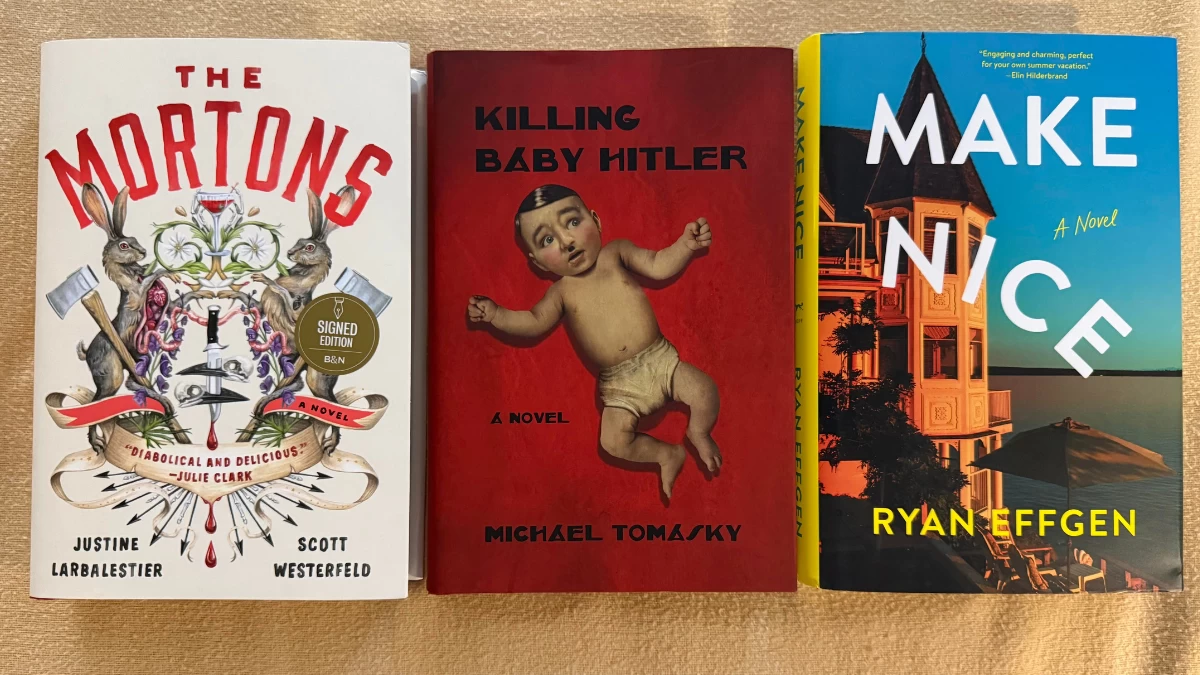
It’s often remarked that writing a great comic novel is one of the most difficult things for an author to aspire for. Here are three that aspire, and your call to say how effective they are. I found them enjoyable to read, for different reasons.
"The Mortons" by Justine Larbalestier and Scott Westerfeld
Lush in terms of world-building, and funny in a dark way, this collaborative novel from a real-life couple blends dark academia, a family saga, and crime fiction. The Mortons of the title refer to a family known for their old money and impeccable taste in everything from crafted cocktails to tailored vintage apparel. As for their core business, 'murder is the currency, and the business is booming.' The Mortons send their children to Helshire College, and that is for a specific reason; as it’s where the ‘legacies’ (Morton family members) get to mix with the other students and forge convenient friendships. These other students would be the affluent young, and the children of the very rich. Our narrator for this adventure is Jessica Morton, who is considered the prodigy of her generation. Her first kill unknots a series of startling revelations about the family and the world they inhabit.
From the College, to the family’s country estate, and on to the New York City art scene, the Mortons like to flex and exert their influence on all that transpires within the pages of this book. They seek new recruits and accounts, find ways to incorporate or mow down the opposition, and spend most of their time preaching the values of family over any individual aspirations or priorities. At one level, the novel is about alliances and amalgamating power; it’s about loyalty and kinship, and there’s the sharp veneer of moral ambiguity in the face of the Morton credo. When ruthless ambition becomes the path to advancing the family, it's only expected that some of the younger members will begin to question this blind devotion and submission. What happens as these little seeds of dissent begin to flourish becomes the narrative focus of the last third of this novel.
"Killing Baby Hitler" by Michael Tomasky
The often remarked-upon trope of what to do if time travel really existed - to head back in time and snuff out the life of Adolf Hitler, and alter the course of so much that went wrong with the 20th century - gets its SciFi, political satire treatment via this novel. Set in a 2141 where democracy is a relic of an idea, where billionaires rule with impunity, and the environment is rapidly collapsing, a ragtag team of scientists led by Helvetica Cope stumbles upon the formula for real-time travel. The one complication is that this team of Helvetica, Harry, Karl, Wadjda, and Lydia all work under the umbrella of Freecorps, which is now run by Jayden Shrike, daughter of founder Darius Shrike; and her intended use for time travel is very different from what these idealistic scientists had in mind. Jayden wants to use it for high-end tourism and her own ultra-right-wing ends.
Besides, Jayden has her own Project Vitality, an ironic moniker, as the aim of the project is to release chemicals in the rain to make the whole global population super-submissive. In terms of detailed world-building, you’ll appreciate how this novel first opens with a lengthy history of what transpired since the 2050s, and why the USA of 2141 is as it is described here. In a tone that is at times reminiscent of the likes of Kurt Vonnegut, Connie Willis, and to a point, Douglas Adams, there is much social commentary going on within these pages - an effort to understand why the absurdity of life today, and how it’s only going to get worse. In this version, Hitler grows up in the US, but we see him rise to be assistant editor at a much-hated newspaper in Detroit. There’s humor, fantasy, and political rage in this novel - a warped history of unintended consequences and shifting timelines.
"Make Nice" by Ryan Effgen
The complicated dynamics of a family vacation/reunion are what lie as the plot device of this novel, which aims for humor and light reflection. After the death of their mother, the Pickford family gather at the grand hotel on Mackinac Island, Lake Michigan, in support of their father’s request. They used to own a summer house on the island, but that was since sold. There’s the eldest Viv, with daughter Ashley in tow; and she’s saying her husband is busy with work, but he just declared to her that he’s gay. Then there’s Mr. Nice guy Pete, who’s a mollusk/snail scientist, with minimal social skills. Lastly, there’s Corey, known as the one spoiled by his Mom, the wayward son. He disappears for lengthy periods of time, gets into all sorts of trouble, is good-looking, and is carrying five pounds of cocaine that he’s hoping to sell to the other guests at the hotel.
Their father is picking up the tab for the weeklong hotel stay, and it’s soon clear that there is also more to the picture with him than what is being acknowledged as family memories. On an island that seems trapped in time, with horse-drawn carriages and fudge shops, what’s left of the Pickford family has to navigate a coming-to-terms that includes letting go of a lot of things they believed in, all their lives. This is a family saga of a different kind, where three generations confront family secrets, and expose themselves to feeling more, and caring less, about surface appearances. Also a brilliant comedy of manners; the light, very real humor that Effgen effortlessly produces helps make these characters resonate. Each reader will gravitate towards one of the Pickford siblings - and that’s to the credit of Effgen’s writing, how he doesn’t seem to be choosing favorites. He’s just adept at making each family member a full-blooded, sympathetic character. There’s so much to enjoy in this novel.